Method Article

Competitive Binding Assay to Identify Compounds Disrupting Receptor-Ligand Interactions

July 8th, 2025

In This Article

Abstract

Loading...
$$\rightleftharpoonup{xx}$$ $$\longleftharp{xx}$$, $$\longrightharp{xx}$$,

Source: Schoofs, G., et al. A Flow Cytometry-based Assay to Identify Compounds That Disrupt Binding of Fluorescently-labeled CXC Chemokine Ligand 12 to CXC Chemokine Receptor 4. J. Vis. Exp. (2018).

In this video, we describe a flow cytometry-based competitive binding assay to detect the interactions between the CXC Chemokine Receptor 4 (CXCR4) and its fluorescently-labeled natural ligand CXC Chemokine Ligand 12 (CXCL12), in the presence of a CXCR4-targeting small molecule. Incubating CXCR4-expressing cells with lower small molecule concentrations allows CXCR4-CXCL12 binding to some extent, which progressively declines upon a gradual increase in small molecule concentrations.
Protocol

Loading...
$$\rightleftharpoonup{xx}$$ $$\longleftharp{xx}$$, $$\longrightharp{xx}$$,

1. Preparation of CXCL12, Assay Buffer, and Jurkat Cells for the Competition Binding Assay

  1. Prepare a stock solution of CXCL12AF647 (20 µg/mL; see Table of Materials and Reagents) by dissolving the lyophilized reagent (stored at -80 °C, in the dark) in ultrapure water supplemented with 0.01% (volume/volume) of Polysorbate 20. Store single-use aliquots from this stock solution at -80 °C, protected from light.
  2. Prepare assay buffer by adding 40 mL HEPES (1 M, 20 mM final concentration) to 200 mL Hank's Balanced Salt Solution (HBSS, 10x, without phenol red and without sodium bicarbonate, 1x f....

Access restricted. Please log in or start a trial to view this content.

Results

Loading...
$$\rightleftharpoonup{xx}$$ $$\longleftharp{xx}$$, $$\longrightharp{xx}$$,

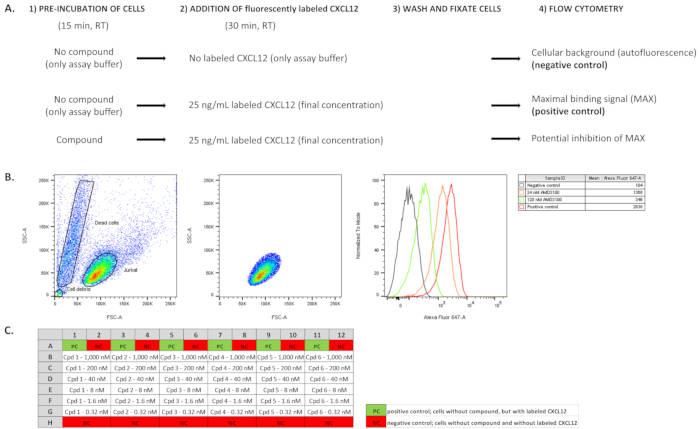
Flow cytometry analysis; steps include cell pre-incubation, CXCL12 labeling, washing, graph results.
Figure 1: Overview of the workflow and illustration of the type of data obtained. (A). The main steps of the protocol are schematized for the negative and positive control samples, and compound-treated samples. Samples without compound .......

Access restricted. Please log in or start a trial to view this content.

Disclosures

Loading...
$$\rightleftharpoonup{xx}$$ $$\longleftharp{xx}$$, $$\longrightharp{xx}$$,
No conflicts of interest declared.

Materials

List of materials used in this article
NameCompanyCatalog NumberComments
BD FACSCanto IIBecton DickinsonNot applicableFlow cytometry device
BD FACSDIVA Software
BD FACSArrayBecton DickinsonNot applicableFlow cytometry device
BD FACSArray System Software
Rapid flow filter: 0.2 μm aPES Thermo Scientific 566-0020
FlowJoFlowJo is now a wholly owned subsidiary of BD.
Vi-CELLBeckman CoulterNot applicableCell viability analyzer
Sigma 3-18 KSSigmaNot applicableCentrifuge
AMD3100SigmaA5602-5mgSpecific CXCR4 antagonist
h-SDF1a (AF647)ALMACCAF-11-B-01Fluorescently-labeled CXCL12, CXCL12AF647
Sterilin microtiter plate, 96-well, U<br/> bottom, clearThermo Scientific611U96
Bovine Serum Albumin (BSA)SigmaA1933-25G
HBSS (10x), calcium, magnesium, no phenol redGibco (Life Technologies)14065-049
HEPES (1M)Gibco (Life Technologies)15630-056
Dulbecco's Phosphate Buffered Saline (DPBS)Gibco (Life Technologies)14190-094
Jurkat cellsATCC
Reagent reservoir PPSigmaBR703411
Falcon tubes, 50mlGreiner Bio-One227 261

Reprints and Permissions

Request permission to reuse the text or figures of this JoVE article

Request Permission

Tags

Competitive Binding AssayFlow CytometryCXCR4 ReceptorCXCL12 LigandReceptor Ligand InteractionSmall Molecule AntagonistFluorescent LabelingCell FixationFluorescence IntensityDose Response

Related Articles