我们提出了一种使用推拿操作模拟器对轻微慢性缩窄损伤大鼠进行"三手三穴"推拿治疗的方案,并通过行为分析测试疼痛变化和使用酶联免疫吸附测定法测试炎症因子表达的变化来评估 24 小时内推拿的有效镇痛时间点。
Method Article
神经损伤大鼠1次推拿干预后24 h内疼痛变化特征
Opens in a new tab
In This Article
Summary
Loading...
$$\rightleftharpoonup{xx}$$
$$\longleftharp{xx}$$,
$$\longrightharp{xx}$$,
Abstract
Loading...
$$\rightleftharpoonup{xx}$$
$$\longleftharp{xx}$$,
$$\longrightharp{xx}$$,
推拿作为中医的外治方法,在临床和基础研究中已被证明对周围神经性疼痛 (pNP) 具有镇痛作用。但推拿镇痛效果的最佳时间点可能因损伤感觉不同而不同,影响推拿镇痛启动机制的探索。
本研究以轻微慢性缩窄损伤 (minor CCI) 模型大鼠模拟 pNP,并使用智能推拿操作模拟器模拟三种方法(按压、拔毛、揉捏)和三种穴位(银门 BL37、成山 BL57 和杨灵泉 GB34)进行推拿治疗。本研究通过检测冷敏阈值 (CST) 、机械撤退阈值 (MWT) 和热撤退潜伏期 (TWL) 评估了轻度 CCI 模型大鼠 24 h 内疼痛的变化和推拿镇痛疗效的最佳时间点。此外,该研究通过 Elisa 检测评估了 IL-10 和 TNF-α 表达变化。结果表明,推拿具有即时和持续的镇痛作用。对于 CST、MWT、TWL 3 个不同的损伤敏感性阈值以及 IL-10 和 TNF-α 2 个细胞因子,干预后 24 h 内推拿的镇痛效果在不同时间点差异显著。
Introduction
Loading...
$$\rightleftharpoonup{xx}$$
$$\longleftharp{xx}$$,
$$\longrightharp{xx}$$,
周围神经性疼痛 (pNP) 是指由周围躯体感觉神经系统的病变或疾病引起的疼痛,表现为一系列症状和体征,痛觉过敏是主要症状之一 1,2。痛觉过敏是由有害刺激(包括针刺、寒冷和热)引起的疼痛加剧3。已经进行了大型流行病学研究,结果表明 pNP 是最常见的,神经性疼痛的患病率为 6.9%-10%4。pNP 可由多种疾病引起,包括神经损伤、带状疱疹后神经痛、痛苦的糖尿病多发性神经病、多发性硬化症、中风、癌症等5。如今,治疗 pNP 的主要方法是药物治疗,但效果并不理想;而且副作用很大,这是个人和社会经济负担沉重的主要原因6。
推拿是一种绿色、经济、安全、有效的中医外治方法7.许多临床研究已经证明了推拿对 pNP 的镇痛作用,基础研究已经验证了推拿的即时和累积镇痛作用 8,9。推拿的主要累积镇痛机制是降低炎症因子的水平并抑制神经胶质细胞的活化10,11。既往研究证实了推拿的累积镇痛作用,发现坐骨神经损伤大鼠背根神经节 (DRG) 和脊髓背角 (SDH) 经过 20 次推拿治疗后存在差异表达基因 (DEGs),主要与蛋白结合、压力反应和神经元投射有关12。在最近的研究中,已经证实推拿具有立竿见影的镇痛作用,并且 1 次推拿干预可以缓解小 CCI 大鼠的痛觉过敏,特别是更有效地缓解热痛觉过敏13。然而,推拿镇痛效果的最佳时间点可能因损伤感觉(冷、热、机械)而异,影响推拿镇痛启动机制的探索。
炎症介质可以致敏和激活疼痛受体,导致放电阈值和异位放电降低,从而促进外周致敏14,15。周围神经损伤后,TNF-α 是炎症反应的启动剂,可促进 IL-10 和 IL-1β 等炎症因子的合成,引起直接组织炎症损伤,刺激局部神经末梢,引起疼痛 16,17,18。推拿可以通过降低 TNF-α、IL-10、IL-6 和 IL-1β 等炎症因子的表达来达到镇痛作用 19,20,21。本研究选取未成年 CCI 模型大鼠模拟临床 pNP,通过冷敏感阈值 (CST) 、机械撤退阈值 (MWT)、热撤潜伏期 (TWL) 选择不同时间点对 1 次推拿干预后冷、热、机械刺激痛进行行为测试,并通过酶联免疫吸附测定 (ELISA) 选择血清中的 IL-10 和 TNF-α, 以期选择推拿镇痛效果显著的时间点,为后期推拿镇痛的启动机制研究提供依据。
Protocol
Loading...
$$\rightleftharpoonup{xx}$$
$$\longleftharp{xx}$$,
$$\longrightharp{xx}$$,
北京中医药大学动物保护与使用委员会 (BUCM-4-2022082605-3043) 批准了本研究中使用的所有程序。
1. 动物和研究设计
- 获得 49 只 8 周龄的雄性 Sprague-Dawley (SD) 大鼠,体重 200 ± 10 克。
- 采用随机数字表法,将大鼠分为假手术组(n = 7)、模型组(n = 7)、推拿组后立即(n = 7)、推拿组后6 h(n = 7)、推拿组后12 h(n = 7)、推拿组后18 h(n = 7)和推拿组后24 h(n = 7)。
2. 建立次要 CCI 大鼠模型(图 1)
注意:对次要 CCI 进行建模的方法如之前的研究 22,23,24 中所述。
- 允许 SD 大鼠适应性喂养 7 天。建模前让大鼠禁食 2-3 小时。
- 将大鼠放入装满 3-5% 异氟醚的盒子中,用麻醉机进行麻醉。麻醉后,将眼药膏涂抹在双眼上以防止干燥。
- 将大鼠固定在桌子上的俯卧位置,剃掉右髋关节区域的皮毛,并用碘对该区域进行消毒(图 1B)。
- 通过捏住脚趾确认手术麻醉平面。沿坐骨神经的行走方向做一个约 0.5-1 cm 的皮肤切口,钝化肌肉层,并完全暴露梨状肌的下缘(图 1C)。
- 将可吸收的铬肠缝合线(4-0 型)松散地系在神经周围,而不会中断神经外血管的血液循环。暴露假组大鼠的坐骨神经 3 分钟而不结扎(图 1A、D、E)。
- 使用不带针头的注射器将 1 滴 0.9% 氯化钠溶液涂抹在坐骨神经上,以帮助重置它。逐层缝合,给予适量的阿莫西林粉等消炎药,缝合肌肉层1针,缝合皮肤2针(图1F)。
注意:从步骤 2.3 到步骤 2.6,保持 2%-3% 异氟醚流入大鼠的口鼻以维持麻醉。 - 让老鼠保持温暖,等待它醒来。将大鼠放回繁殖室。
3. 智能推拿操作模拟器干预(图 2)
注意:治疗从模型建立后的第 7 天开始。
- 在计算机操作界面上将仪器参数调整为 4 N 的刺激力、60 次/分钟的刺激频率和 36 °C 的温度。将大鼠放入大鼠固定器中,暴露后肢穴位位置(图 2A,自主研发机器,专利号。ZL 2023 20511277.5)25.
- 激活仪器以执行按点、拨弦和揉捏方法(表 1)。按推拿组大鼠模型侧的阴门 (BL37)、成山 (BL57) 和阳灵泉 (GB34) 点(表 2)的顺序单击计算机屏幕上显示的压点、拔毛和揉捏(图 2B、C)26。
- 对于推拿组,每天进行一次干预,持续 1 天,力为 4 N,频率为 60 次/分钟,每种方法每点共 9 分钟。
- 抑制假组和模型组 9 分钟,与推拿组相同。
4. 行为测量
注:干预后,分别在 5 个推拿亚组、模型组和假手术组测试阈值冷敏阈值 (CST)、机械撤退阈值 (MWT) 和热撤退潜伏期 (TWL)。模型组和假手术组的测试时间与推拿组相同(即 24 h)。
- 冷敏感阈值 (CST)
- 将大鼠放在表面温度为 4 ± 1 °C 的智能冷热板疼痛检测器上(单击 START > SET),并用透明塑料笼盖住。
- 观察大鼠的探索活动 5 分钟,直到它们适应透明塑料笼。
- 观察并记录在接下来的 5 分钟内后肢手术侧的抬足次数。
注意:不包括由大鼠活动或姿势变化引起的抬脚次数。
- 机械撤离阈值 (MWT)
- 测试前,将大鼠作为网格(0.5 厘米× 0.5 厘米)放在测试箱中底部表面 15-30 分钟。
- 将疼痛探头(EVF 5型)移至大鼠右足底后区中心,用手线性增加压力,记录大鼠抬起和时仪器屏幕上显示的阈值。连续测量 5 次,每次测量间隔 10 分钟。
- 热撤退潜伏期 (TWL)
- 将大鼠放入具有玻璃底面的测试箱中,在开始测试前让它适应 15 分钟。
注意:使用热刺激疼痛仪(PL200 型)检测热收缩足反射的潜伏期。 - 设置参数:最大测试时间为 30 s,强度为 50%。单击 START 和 direction 按钮。
- 将红外探针移动到大鼠右后足底区域的中心并开始检测。
- 记录大鼠抬起和时足部回缩反射的潜伏期。连续测量延迟 5 次,每次测量间隔 10 分钟。
- 将大鼠放入具有玻璃底面的测试箱中,在开始测试前让它适应 15 分钟。
5. 酶联免疫吸附试验
- 行为测试后,用 35 mL/100 g 4% 水合氯剂量麻醉大鼠腹腔注射麻醉。沿大鼠腹部中部纵向切开皮肤和肌肉,露出其内部器官。
- 使用镇流器和持针器进行纯分离,识别腹主动脉,采集新鲜血液,并保留样本进行检测。使用分离管分离血清。取血清样品立即检测,或单独包装并存放在 -80°C 的冰箱中。
注:分离前,让血样凝集 30 分钟。 - 为测试过程准备大鼠血清,并在室温 (RT) 下储存至少 30 分钟。
- 为要测试的样品设置空白孔和标准样品孔。向酶联板中加入总共 50 μL 的标准样品。首先加入 40 μL 稀释剂,然后将 10 μL 样品加入待测样品孔中。
注意:添加样品时,必须将其添加到酶标记孔的底部,确保它们尽可能不接触孔壁,轻轻摇晃并充分混合。空白孔中不包含样品或酶标记试剂,其他步骤相同。样品的最终稀释度为 5 倍。 - 用密封膜密封板后,将其置于 37 °C 培养箱中 30 分钟。
- 用蒸馏水稀释 30 倍浓的洗涤液,放在一边。
- 撕掉密封膜,将液体从孔中倒出,摇干。用洗涤液填充每个孔,静置 30 秒,然后倒出。重复此步骤 5 次,最后摇干。
- 加入辣根过氧化物酶标记的亲和素(每孔 100 μL)。
- 向每个孔中加入 50 μL 显色剂 A,然后加入 50 μL 显色剂 B。轻轻摇动和混合,并将其置于 37 °C 环境中避光 10 分钟。
- 每孔加入 50 μL 终止液以终止反应。
注意:此时,蓝色将变为黄色。 - 将空白孔归零,并在 450 nm 的波长下依次测量每个孔的光密度(OD 值)。
Results
Loading...
$$\rightleftharpoonup{xx}$$
$$\longleftharp{xx}$$,
$$\longrightharp{xx}$$,
CST: 与模型组相比,推拿后 6 h 组抬足次数显著减少,差异有统计学意义 (P < 0.05)。与假手术组相比,模型组的抬足次数显著增加,差异有统计学意义 (P < 0.05)(表 3, 图 3)。
MWT: 与模型组相比,推拿各亚组除推拿后 18 h 外,均显著高于模型组,推拿后 24 h 的 MWT 显著高于模型组,差异有统计学意义(P < 0.05)。与假手术组相比,模型组的 MWT 显著降低,差异有统计学意义 (P < 0.01) (表 3, 图 4)。
TWL:
与模型组相比,推拿后即刻、推拿后 6 h 和推拿后 18 h 均显著增加,差异有统计学意义。与假手术组相比,模型组明显减少,差异有统计学意义 (P < 0.01) (表 3, 图 5)
酶联免疫吸附试验 (ELISA
IL-10: 与模型组相比,推拿后 6 h 和 24 h 明显减少,差异有统计学意义 (P < 0.01) (表 4, 图 6)。
TNF-α: 与模型组相比,推拿后即刻 (**P < 0.01)、推拿后 6 h (**P < 0.01) 和推拿后 24 h (**P < 0.05) 显著降低,差异有统计学意义(表 4, 图 6)
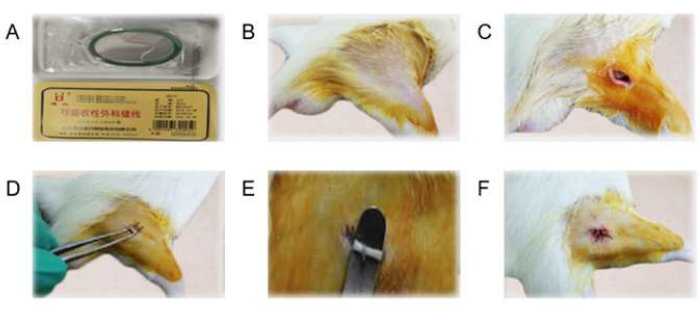
图 1:建立轻微 CCI 大鼠模型。 (A) 铬肠缝合线 (4-0)。(B) 皮肤准备。(C) 切口。(D) 暴露坐骨神经。(E) 神经周围的可吸收铬肠缝合线(4-0 型)。(F) 缝合肌肉层和皮肤。 请单击此处查看此图的较大版本。
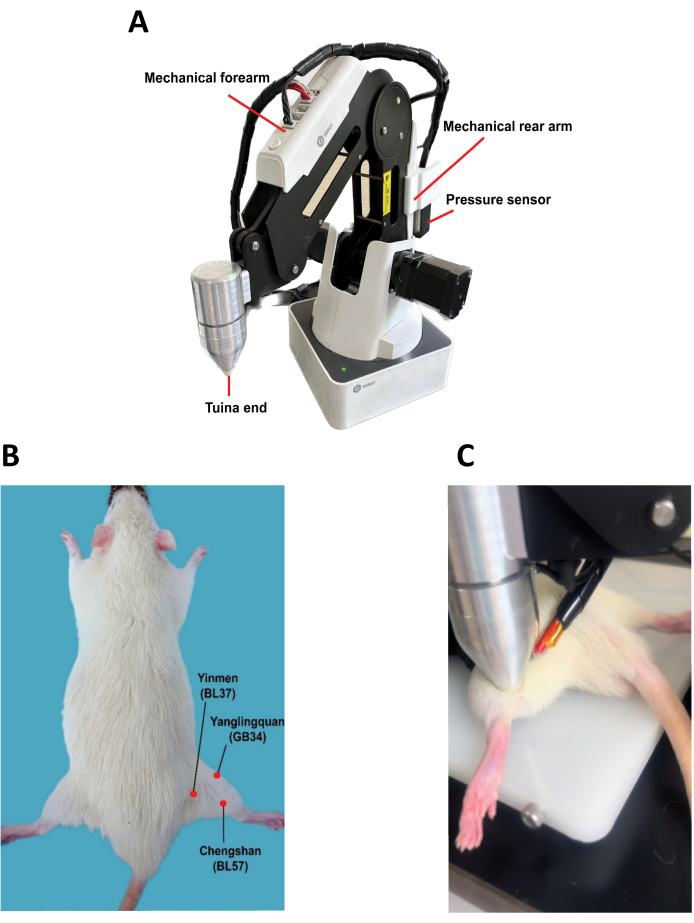
图 2:智能推拿操作模拟器处理。 (A) 智能推拿操作模拟器(专利号ZL ZL 2023 20511277.5)。(B) 银门 (BL37)、澄山 (BL57) 和杨陵泉 (GB34) 的位置。(C) 刺激阴门 (BL37)。 请单击此处查看此图的较大版本。
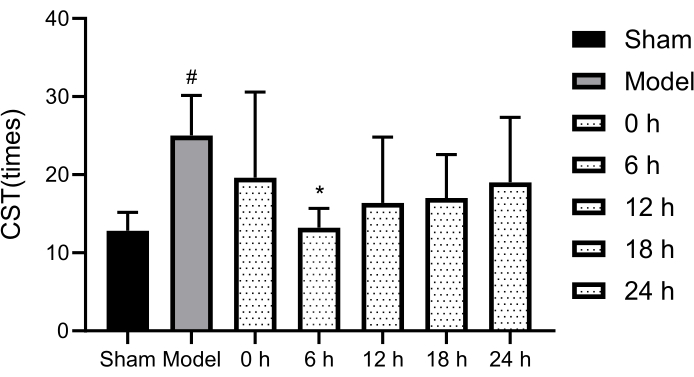
图 3:每组大鼠的冷敏感阈值 (CST) 结果。*与模型组相比,P < 0.05,与假手术组相比,#P <0.05。请单击此处查看此图的较大版本。
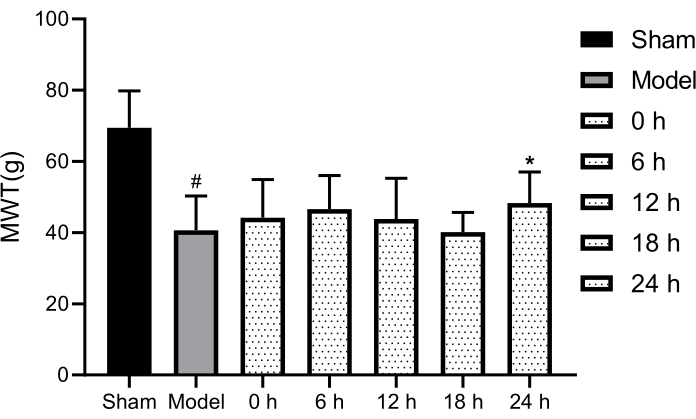
图 4:每组大鼠的机械撤离阈值 (MWT) 结果。 *与模型组相比,P <0.05,与假手术组相比,#P < 0.05。 请单击此处查看此图的较大版本。
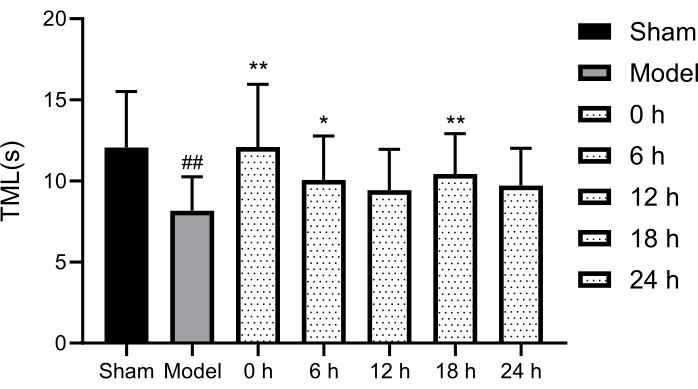
图 5:每组大鼠的热撤退潜伏期 (TWL) 结果。 *P < 0.05,**P < 0.01,与模型组相比;#P <0.05, ##P < 0.01,与假手术组相比。 请单击此处查看此图的较大版本。
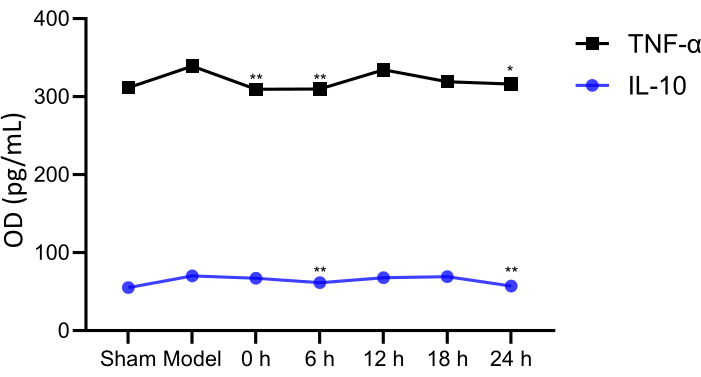
图 6:与模型组相比,每组大鼠血清 IL-10 和 TNF-α 水平的变化(平均值 ± SD,n = 7),"*P<0.05,**P<0.01。请点击此处查看此图的较大版本。
| 三方法 | 方法 | 分类 | 功能 |
| 点压 | 升温和解锁 | 温暖经络并疏通侧支 | |
| 采摘 | 放松 | 作用于神经干并治疗四肢麻木或疼痛 | |
| 揉 | 放松 | 缓解肌肉痉挛 |
表 1:三种刺激方法。
| 三穴 | 穴位 | 经络 | 神经 | 肌肉 |
| 银门 (BL37) | 足鳔经-泰阳 | 坐骨神经干 | 股二头肌 | |
| 澄山(BL57) | 胫神经 | 腓肠肌 | ||
| 杨灵泉(GB34) | 足胆经-邵阳 | 腓总神经 | 胫骨前肌 |
表 2:本研究中使用的三个穴位。
| 假 | 型 | 推拿 | |||||
| 0 小时 | 6 小时 | 12 小时 | 18 小时 | 24 小时 | |||
| CST | 12.8 ± 2.38 | 25 ± 5.15# | 19.6 ± 10.99 | 13.2 ± 2.49* | 16.4 ± 8.41 | 17 ± 5.57 | 19 ± 8.34 |
| MWT | 69.47 ± 10.35 | 40.63 ± 9.65## | 44,19 ± 10,72 | 46,58 ± 9,47 | 42,83 ± 11,41 | 40.1 ± 5.59 | 48.33 ± 8.7* |
| TWL | 12.06 ± 3.45 | 8.16 ± 2.09## | 12.09 ± 3.86** | 10.07 ± 2.7* | 9.44 ± 2.52 | 10.42 ± 2.49** | 9.72 ± 2.29 |
表 3:每组大鼠的 CST、MWT 和 TWL 结果(SD ±平均值,n = 7)。*P<0.05, **P<0.01,与模型组相比;#P<0.05, ##P<0.01,与假手术组相比。
| 假 | 型 | 推拿 | |||||
| 0 小时 | 6 小时 | 12 小时 | 18 小时 | 24 小时 | |||
| IL-10 (英语) | 55.10 ± 1.37** | 70.27 ± 6.22 | 67,28 ± 1,28 | 61.41 ± 3.36** | 67,98 ± 1,85 | 69.03 ± 6.29 | 57.16 ± 1.30** |
| TNF-α | 311.52 ± 13.45** | 339.33 ± 24.50 | 309.47 ± 8.37** | 309.99 ± 14.95** | 334.62 ± 21.85 | 319.22 ± 10.38 | 316.24 ± 8.72* |
表 4:各组大鼠血清 IL-10 和 TNF-α 水平的变化 (平均值 ± SD,n = 7,pg/mL)。*P < 0.05,**P < 0.01,与组模型相比(*P < 0.05,**P < 0.01。
Discussion
Loading...
$$\rightleftharpoonup{xx}$$
$$\longleftharp{xx}$$,
$$\longrightharp{xx}$$,
该研究使用次要 CCI 模型模拟临床坐骨神经损伤引起的 pNP。次要 CCI 模型涉及通过结扎对神经干进行持续、慢性的压迫和约束,伴有结扎线逐渐肿胀,导致坐骨神经内水肿,并在 3-5 天内形成稳定的慢性疼痛27,28。在初步研究中,研究组发现,次要 CCI 模型组在建模后的第 7 天比经典模型组更稳定,使其更适合短期实验设计。因此,我们选择这个时间点进行推拿干预。
先前的研究验证了智能推拿操作模拟器(动物)在使用"三法三穴"进行 20 次推拿治疗后,可以有效缓解坐骨神经损伤大鼠的疼痛29,30,31。此外,课题组发现推拿一次能有效缓解轻度 CCI 大鼠的疼痛超敏反应症状,尤其是热痛觉过敏13。本研究采用按点法、拔毛法和揉捏法作为三种治疗方法。按点法是一种升温疏通技术,具有暖经络疏通的功能。拔毛法是一种作用于神经干的放松技术,可以治疗四肢麻木或疼痛。揉捏法是一种放松技术,可以缓解肌肉痉挛,消除疲劳,缓解受伤部位的疼痛(表1)。该研究选择鄞门 (BL37) 、成山 (BL57) 和杨灵泉 (GB34) 作为治疗的三个穴位(表 2)。根据针灸中沿经络和局部选择穴位的原则,三个穴位分别属于足部膀胱经-邵阳和足部-邵阳胆经。根据解剖神经定位,阴门 (BL37) 位于坐骨神经及其分支,成山 (BL57) 位于胫神经,阳灵泉 (GB34) 位于腓总神经。根据解剖肌肉位置,三个穴位位于股二头肌、腓肠肌和胫前肌周围(表2)。因此,通过三种方法和三个穴位的干预,可以刺激穴位-神经-肌肉的相关区域。本研究在形成稳定的慢性疼痛和一次推拿干预后,检测到疼痛的行为变化,进一步验证了推拿具有立竿见影的镇痛作用,且对不同损伤受体具有不同的治疗意义时间点,为下一步推拿镇痛启动机制研究提供治疗支持。
该研究以 CST 、 MWT 和 TWL 为指标,探讨推拿对不同损伤感觉的疗效。pNP 诱发疼痛的临床表现主要包括痛觉过敏和痛觉异常,即冷热刺激引起的疼痛和机械触觉诱发的疼痛4。目前,这两种疼痛感觉的经典定量行为研究指标是 CST、MWT 和 TWL。在 CST 测试中,冷板测试,本实验中使用的 ZH-6C 智能冷热板痛点测试仪,相对客观,受周围环境因素影响较小,具有恒温,精度高32,33。在基础研究中,Von Frey 细丝通常用于估计 MWT,MWT 是评估神经性疼痛的经典指标之一。它主要针对机械刺激引起的针灸疼痛,以评估啮齿动物的机械触觉诱发的疼痛34,35。Hargreaves 试验使用热痛刺激器检测和评估啮齿类动物对热痛敏感性的反应,用于评估神经损伤后疼痛敏感性的恢复情况或热痛反应,观察动物的后爪是否因受热而出现收缩反应。该仪器检测到动物后爪36 的运动,控制器将自动关闭红外停止计时器34,称为 TWL。实验表明,次要 CCI 模型大鼠对 TWL 的敏感性是最优的38。因此,本次对未成年 CCI 模型大鼠行为的定量研究方法是采用冷板实验、电子机械刺破装置和热刺刺装置进行检测。
早期推拿干预后对不同伤害感觉的疗效显著时间点不同。目前,已对推拿镇痛的临床疗效和机制进行了初步探索。我们之前的研究主要集中在一定数量的推拿后的镇痛机制上。近 2 年对推拿初期的镇痛机制进行了研究,探讨推拿镇痛是如何开始的。本研究采用"三法三穴"对轻度 CCI 模型大鼠进行一次干预。然后选择 5 个时间点进行 CST 、 MWT 和 TWL 检测,观察未成年 CCI 模型大鼠的温度和机械触觉变化。本研究采用 ELISA 检测行为测试后大鼠血清 IL-10 和 TNF-α 水平的变化。结果显示,与模型组相比,1 次推拿干预后,两者均立即改善。这再次证实了之前的研究结果,即推拿有立竿见影的镇痛作用。然而,对于不同类型的疼痛感,镇痛效果显著的时间点并不相同。CST 方面,推拿后 6 h 有统计学意义;在 MWT 方面,推拿后 24 h 有统计学意义;TWL 方面,推拿后 6 h 有统计学意义,推拿后即刻和 18 h 有显著统计学意义;血清 IL-10 水平方面,推拿后 6 h 和推拿后 24 h 显著降低,差异有统计学意义。血清 TNF-α 水平方面,推拿后即刻、推拿后 6 h 和推拿后 24 h 显著降低,差异有统计学意义。它表明,虽然推拿的镇痛作用可以持续,但对冷刺激引起的疼痛和机械触觉引起的疼痛的疗效时间点有明显的延迟,并且它是立即有效的,并且对热刺激引起的疼痛具有更显着和持久的疗效。本实验室正在进一步探索瞬时受体电位 (TRP) 相关蛋白和基因的变化,以及与冷、热和机械敏感性相关的基因,以及其他炎症因子,如 TGF-β 和 IL-6,以进一步探索推拿的镇痛起始机制。
综上所述,根据这项研究的结果可以推断,受推拿影响的蛋白质或通路发挥作用的时间点可能不同,导致具有显著镇痛作用的时间点不同。需要进一步深入研究,探讨推拿镇痛的启动机制,为推拿的临床疗效研究提供依据。
Disclosures
Loading...
$$\rightleftharpoonup{xx}$$
$$\longleftharp{xx}$$,
$$\longrightharp{xx}$$,
作者未声明任何利益冲突,无论是财务还是其他方面。
Acknowledgements
Loading...
$$\rightleftharpoonup{xx}$$
$$\longleftharp{xx}$$,
$$\longrightharp{xx}$$,
作者已获得中国国家自然科学基金(第 82074573 号和第 82274675 号)和北京市自然科学基金(第 7232278 号)的研究、写作和出版资助。
Materials
| Name | Company | Catalog Number | Comments |
|---|---|---|---|
| 麻醉机 | 瑞沃德生命科技有限公司,中国深圳 | R500 | 动物呼吸麻醉相关设备 |
| 铬肠缝合 | 山东博达医疗用品有限公司,中国 | BD210903 | 一种主要由健康年轻山羊肠道加工的胶原蛋白加工而成的可吸收手术缝合线 |
| Electronic Von Frey instrument | Bioseb,美国 | BIO-EVF5 | 一种检测机械撤离阈值的仪器 |
| 智能冷热板痛点检测仪 | 安徽正华生物仪器设备有限公司,中国。 | ZH-6C | 一种检测冷敏阈值的仪器 |
| 异氟醚 | 瑞沃德生命科技有限公司 | 中国 深圳 R510-22-10 | 一种麻醉剂 |
| 多功能全波长酶标仪 | 分子器件(上海)有限公司 | SpectraMax M2 | 一种检测光密度 (OD) |
| 热镇痛仪 | 成都达曼软件有限公司 | PL-200 | 一种检测热提取潜伏期的仪器 |
References
Loading...
$$\rightleftharpoonup{xx}$$
$$\longleftharp{xx}$$,
$$\longrightharp{xx}$$,
- https://www.iasp-pain.org/resources/terminology/#.2022 (2022).">IASP taxonomy. ISAP. , Available from: https://www.iasp-pain.org/resources/terminology/#.2022 (2022).
- Neuropathic pain: diagnosis, pathophysiological mechanisms, and treatment. Lancet Neurol. 9 (8), 807-819 (2010).">Baron, R., Binder, A., Wasner, G. Neuropathic pain: diagnosis, pathophysiological mechanisms, and treatment. Lancet Neurol. 9 (8), 807-819 (2010).
- Neuropathic pain. Nat Rev Dis Primers. 3, 17002(2017).">Colloca, L., et al. Neuropathic pain. Nat Rev Dis Primers. 3, 17002(2017).
- A review on the mechanism of tuina promoting the recovery of peripheral nerve injury. Evid Based Complement Alternat Med. 2021, 6652099(2021).">Liu, Z., et al. A review on the mechanism of tuina promoting the recovery of peripheral nerve injury. Evid Based Complement Alternat Med. 2021, 6652099(2021).
- The IASP classification of chronic pain for ICD-11: chronic neuropathic pain. Pain. 160 (1), 53-59 (2019).">Scholz, J., et al. The IASP classification of chronic pain for ICD-11: chronic neuropathic pain. Pain. 160 (1), 53-59 (2019).
- Pharmacotherapy for neuropathic pain in adults: a systematic review and meta-analysis. Lancet Neurol. 14 (2), 162-173 (2015).">Finnerup, N. B., et al. Pharmacotherapy for neuropathic pain in adults: a systematic review and meta-analysis. Lancet Neurol. 14 (2), 162-173 (2015).
- Massage therapy research review. Complement. Ther Clin Pract. 24, 19-31 (2016).">Field, T. Massage therapy research review. Complement. Ther Clin Pract. 24, 19-31 (2016).
- Aromatherapy massage for neuropathic pain and quality of life in diabetic patients. J Nurs Scholarsh. 49, 379-388 (2017).">Gok Metin, Z., et al. Aromatherapy massage for neuropathic pain and quality of life in diabetic patients. J Nurs Scholarsh. 49, 379-388 (2017).
- Effect of aromatherapy massage on chemotherapy-induced peripheral neuropathic pain and fatigue in patients receiving oxaliplatin: An open label quasi-randomized controlled pilot study. Cancer Nurs. 42, 139-147 (2019).">Izgu, N., et al. Effect of aromatherapy massage on chemotherapy-induced peripheral neuropathic pain and fatigue in patients receiving oxaliplatin: An open label quasi-randomized controlled pilot study. Cancer Nurs. 42, 139-147 (2019).
- Mild mechanic stimulate on acupoints regulation of CGRP-positive cells and microglia morphology in spinal cord of sciatic nerve injured rats. Front Integr Neurosci. 13, 58(2019).">Li, Y., et al. Mild mechanic stimulate on acupoints regulation of CGRP-positive cells and microglia morphology in spinal cord of sciatic nerve injured rats. Front Integr Neurosci. 13, 58(2019).
- Tuina for peripherally-induced neuropathic pain: A review of analgesic mechanism. Front Neurosci. 16, 1096734(2022).">Liu, Z. F., et al. Tuina for peripherally-induced neuropathic pain: A review of analgesic mechanism. Front Neurosci. 16, 1096734(2022).
- Using RNA-seq to explore the repair mechanism of the three methods and three-acupoint technique on DRGs in sciatic nerve injured rats. Pain Res Manag. 2020, 7531409(2020).">Lv, T., et al. Using RNA-seq to explore the repair mechanism of the three methods and three-acupoint technique on DRGs in sciatic nerve injured rats. Pain Res Manag. 2020, 7531409(2020).
- MZF1 in the dorsal root ganglia contributes to the development and maintenance of neuropathic pain via regulation of TRPV1. Neural Plast. 2019, 2782417(2019).">Xing, F., et al. MZF1 in the dorsal root ganglia contributes to the development and maintenance of neuropathic pain via regulation of TRPV1. Neural Plast. 2019, 2782417(2019).
- Neuropathic pain: mechanisms and their clinical implications. BMJ. 348, 7656(2014).">Cohen, S. P., Mao, J. Neuropathic pain: mechanisms and their clinical implications. BMJ. 348, 7656(2014).
- Effect of Bo'fa method on the expression of IL-1β in peripheral serum and 5-HT2A in spinal cord of CCI model rats. Global Traditional Chinese Medicine. 10, 905-909 (2017).">Tao, Y., et al. Effect of Bo'fa method on the expression of IL-1β in peripheral serum and 5-HT2A in spinal cord of CCI model rats. Global Traditional Chinese Medicine. 10, 905-909 (2017).
- Study on curative effect of Duhuo Jisheng decoction combined with Tuina in patients with lumbar disc herniation and changes of TXB2, TNF-α and IL-1β. Chin Arch Tradit Chin Med. 38, 44-46 (2020).">Yang, J., et al. Study on curative effect of Duhuo Jisheng decoction combined with Tuina in patients with lumbar disc herniation and changes of TXB2, TNF-α and IL-1β. Chin Arch Tradit Chin Med. 38, 44-46 (2020).
- Effects of acupressure at 'Shenshu' (BL 23)on lumbar intervertebral disc degeneration and related pain in aging rats. Chin J Tradit Chin Med Pharm. 37, 4360-4365 (2022).">Yao, C., et al. Effects of acupressure at 'Shenshu' (BL 23)on lumbar intervertebral disc degeneration and related pain in aging rats. Chin J Tradit Chin Med Pharm. 37, 4360-4365 (2022).
- Exploring the mechanism of immediate analgesic effect of 1-time tuina intervention in minor chronic constriction injury rats using RNA-seq. Front Neurosci. 16, 1007432(2022).">Wang, H., et al. Exploring the mechanism of immediate analgesic effect of 1-time tuina intervention in minor chronic constriction injury rats using RNA-seq. Front Neurosci. 16, 1007432(2022).
- Exploring the mechanism of tuina-induced central analgesia in rats with lumbar disc herniation based on the p38MAPK signaling pathway. Chin J Tradit Chin Med Pharm. 38 (07), 3348-3352 (2023).">Yao, C., et al. Exploring the mechanism of tuina-induced central analgesia in rats with lumbar disc herniation based on the p38MAPK signaling pathway. Chin J Tradit Chin Med Pharm. 38 (07), 3348-3352 (2023).
- Study on the effects of modified Chuanqianghuo Decoction combined with tuina and physiotherapy on shoulder joint function and inflammation in patients with shoulder joint pain. New Chinese Medicine. 54 (13), 93-97 (2022).">Li, P. Study on the effects of modified Chuanqianghuo Decoction combined with tuina and physiotherapy on shoulder joint function and inflammation in patients with shoulder joint pain. New Chinese Medicine. 54 (13), 93-97 (2022).
- Clinical efficacy of acupuncture and moxibustion, tuina and external application of traditional Chinese medicine on lumbar disc herniation and serum TXB2, IL-1β, Comparison of IL-10 levels. Advances in Modern Biomedicine. 21 (14), 2730-2734 (2021).">Ding, C., et al. Clinical efficacy of acupuncture and moxibustion, tuina and external application of traditional Chinese medicine on lumbar disc herniation and serum TXB2, IL-1β, Comparison of IL-10 levels. Advances in Modern Biomedicine. 21 (14), 2730-2734 (2021).
- A peripheral mononeuropathy in rat that produces disorders of pain sensation like those seen in man. Pain. 33, 87-107 (1988).">Bennett, G. J., Xie, Y. K. A peripheral mononeuropathy in rat that produces disorders of pain sensation like those seen in man. Pain. 33, 87-107 (1988).
- A novel animal model of graded neuropathic pain: Utility to investigate mechanisms of population heterogeneity. J Neurosci Methods. 193, 47-53 (2010).">Grace, P. M., et al. A novel animal model of graded neuropathic pain: Utility to investigate mechanisms of population heterogeneity. J Neurosci Methods. 193, 47-53 (2010).
- Comparison of the characteristics of minor and classic CCI models. J Chin J Comp Med. 32 (10), 1-7 (2022).">Wang, H., et al. Comparison of the characteristics of minor and classic CCI models. J Chin J Comp Med. 32 (10), 1-7 (2022).
- Zhang, Y., et al. An intelligent massage and tuina technique simulator. , Beijing. CN219398169U,19393681 (2023).
- https://kns.cnki.net (2017).">Jia, D. Effects of three methods and three points stimulation on sensory function in rats with sciatic nerve injury. , Available from: https://kns.cnki.net (2017).
- Adoptive transfer of peripheral immune cells potentiates allodynia in a graded chronic constriction injury model of neuropathic pain. Brain Behav Immun. 25 (3), 503-513 (2011).">Grace, P. M., et al. Adoptive transfer of peripheral immune cells potentiates allodynia in a graded chronic constriction injury model of neuropathic pain. Brain Behav Immun. 25 (3), 503-513 (2011).
- Silent cold-sensing neurons contribute to cold allodynia in neuropathic. Brain. 144 (6), 1711-1726 (2021).">MacDonald, D. I., et al. Silent cold-sensing neurons contribute to cold allodynia in neuropathic. Brain. 144 (6), 1711-1726 (2021).
- Chinese tuina downregulates the elevated levels of tissue plasminogen activator in sciatic nerve injured Sprague-Dawley rats. Chinese J Integr Med. 23 (8), 617-624 (2017).">Pan, F., et al. Chinese tuina downregulates the elevated levels of tissue plasminogen activator in sciatic nerve injured Sprague-Dawley rats. Chinese J Integr Med. 23 (8), 617-624 (2017).
- An investigation into the rehabilitative mechanism of tuina in the treatment of sciatic nerve injury. Evid Based Complement Alternat Med. 2020, 5859298(2020).">Lv, T., et al. An investigation into the rehabilitative mechanism of tuina in the treatment of sciatic nerve injury. Evid Based Complement Alternat Med. 2020, 5859298(2020).
- Applying RNA sequencing technology to explore repair mechanism of Tuina on gastrocnemius muscle in sciatic nerve injury rats. Chin Med J. 135 (19), 2378-2379 (2022).">Lv, T., et al. Applying RNA sequencing technology to explore repair mechanism of Tuina on gastrocnemius muscle in sciatic nerve injury rats. Chin Med J. 135 (19), 2378-2379 (2022).
- An effective and concise device for detecting cold allodynia in mice. Sci Rep. 8 (1), 14002(2018).">Ruan, Y., et al. An effective and concise device for detecting cold allodynia in mice. Sci Rep. 8 (1), 14002(2018).
- Berberine ameliorates cold and mechanical allodynia in a rat model of diabetic neuropathy. J Med Food. 16 (6), 511-517 (2013).">Kim, S. O., Kim, H. J. Berberine ameliorates cold and mechanical allodynia in a rat model of diabetic neuropathy. J Med Food. 16 (6), 511-517 (2013).
- Methods used to evaluate pain behaviors in rodents. Front Mol Neurosci. 10, 284(2017).">Deuis, J. R., Dvorakova, L. S., Vetter, I. Methods used to evaluate pain behaviors in rodents. Front Mol Neurosci. 10, 284(2017).
- Long-term potentiation in spinal nociceptive pathways as a novel target for pain therapy. Mol Pain. 7, 20(2011).">Ruscheweyh, R., et al. Long-term potentiation in spinal nociceptive pathways as a novel target for pain therapy. Mol Pain. 7, 20(2011).
- A new and sensitive method for measuring thermal nociception in cutaneous hyperalgesia. Pain. 32 (1), 77-88 (1988).">Hargreaves, K., et al. A new and sensitive method for measuring thermal nociception in cutaneous hyperalgesia. Pain. 32 (1), 77-88 (1988).
- Assesment of thermal pain sensation in rats and mice using the hargreaves test. Bio Protoc. 7 (16), 2506(2017).">Cheah, M., et al. Assesment of thermal pain sensation in rats and mice using the hargreaves test. Bio Protoc. 7 (16), 2506(2017).
- Surgical animal models of neuropathic pain: pros and cons. Int J Neurosci. 125 (3), 170-174 (2015).">Challa, S. R. Surgical animal models of neuropathic pain: pros and cons. Int J Neurosci. 125 (3), 170-174 (2015).
Reprints and Permissions
Request permission to reuse the text or figures of this JoVE article
Request Permission