Method Article

An In Vitro Fluorescence-Based Assay to Measure Plasma Membrane Resealing Efficiency

July 8th, 2025

In This Article

Abstract

Loading...
$$\rightleftharpoonup{xx}$$ $$\longleftharp{xx}$$, $$\longrightharp{xx}$$,

Source: Lam, J. G., et al. High-throughput Measurement of Plasma Membrane Resealing Efficiency in Mammalian Cells. J. Vis. Exp. (2019).

This video demonstrates an assay to study the plasma membrane resealing efficiency in mammalian cells. The cells are exposed to a bacterial pore-forming toxin, which forms pores in the cell membrane. In the presence of extracellular calcium ions, the pore causes calcium influx, inducing membrane-resealing events. The resealing efficiency is assessed using DNA-binding propidium iodide dye, which only enters cells without a resealed membrane.
Protocol

Loading...
$$\rightleftharpoonup{xx}$$ $$\longleftharp{xx}$$, $$\longrightharp{xx}$$,

1. Preparation

  1. Cell Plating
    Note: Human cervical epithelial cells, HeLa and HeLa expressing Histone 2B-GFP (H2B-GFP), were used in this protocol, but this assay can be adapted to other mammalian cells.
    1. Detach adherent cells from a 75 cm2 cell culture flask by washing the cells with 2 mL of Trypsin-EDTA 0.25%. Replace the used trypsin with 2 mL of fresh trypsin-EDTA 0.25%.
    2. Incubate the cells at 37 ˚C for 5 min until the cells have rounded and detached from the flask.
    3. Resuspend the cells in 8 mL of growth medium (DMEM containing 10% heat-inactivated fetal bovine serum,....

Access restricted. Please log in or start a trial to view this content.

Results

Loading...
$$\rightleftharpoonup{xx}$$ $$\longleftharp{xx}$$, $$\longrightharp{xx}$$,

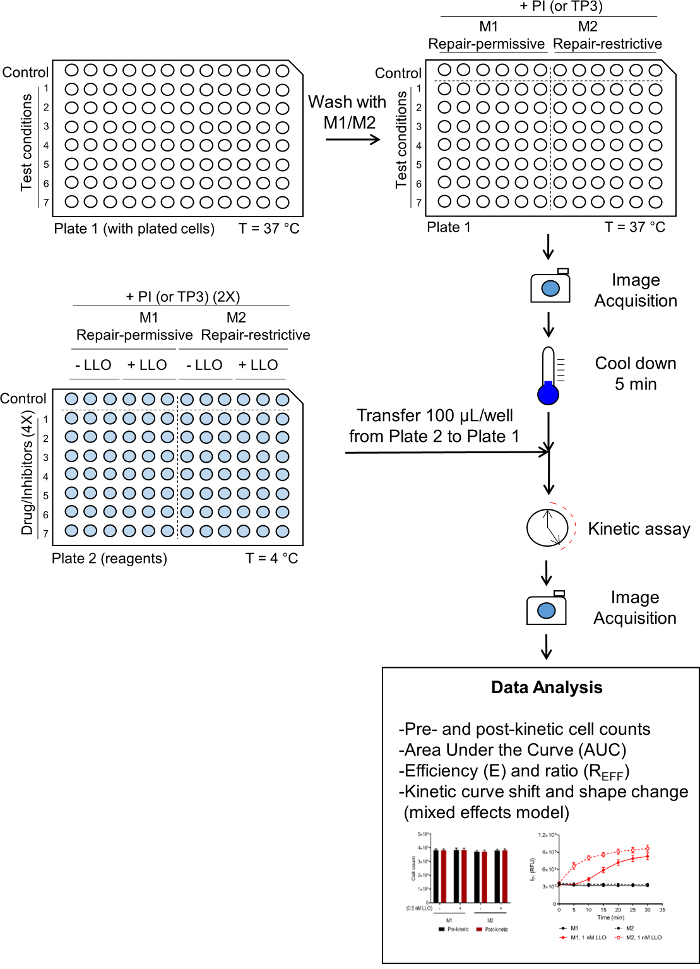
Kinetic assay diagram with 96-well plates for cell analysis, image acquisition, and data analysis steps.
Figure 1: Experimental design. The flow diagram depicts a representative plate design configured to test the effect of seven test conditions in comparison to control non-treated cells. Additional controls should be included if appropriate, as for ex.......

Access restricted. Please log in or start a trial to view this content.

Disclosures

Loading...
$$\rightleftharpoonup{xx}$$ $$\longleftharp{xx}$$, $$\longrightharp{xx}$$,
No conflicts of interest declared.

Materials

List of materials used in this article
NameCompanyCatalog NumberComments
SpectraMax i3x Multi-Mode Microplate ReaderMolecular Devicesi3x
MiniMax 300 Imaging cytometerMolecular Devices5024062
TO-PRO-3ThermoFisher ScientificT3605
Propidium IodideThermoFisher ScientificP3566
HeLaATCCCCL2
HeLa H2B-GFPMilliporeSCC117
Trypsin-EDTA 0.25%ThermoFisher Scientific25200056
96-well Corning flat bottom black polystyrene tissue culture treated plateCorning3603
Hanks' balanced SaltsSigma-AldrichH4891
EGTAISC BioExpress0732-100G
HEPESFisher ScientificBP310-500
D-(+)-Glucose, HybriMaxSigma-AldrichG5146-1KG

Reprints and Permissions

Request permission to reuse the text or figures of this JoVE article

Request Permission

Tags

Plasma Membrane ResealingFluorescence Based AssayPropidium IodideBacterial Pore Forming ToxinCalcium InfluxMembrane RepairListeriolysin OHigh Throughput AssaySpectrofluorometerCell Membrane

Related Articles