A subscription to JoVE is required to view this content. Sign in or start your free trial.

Method Article

Isolation and Culture of Mouse Kupffer Cells

6.4K views

⸱

July 8th, 2025

In This Article

Abstract

Source: Bourgognon, M., et al. Kupffer Cell Isolation for Nanoparticle Toxicity Testing. J. Vis. Exp. (2015)

In this video, we demonstrate the isolation of Kupffer cells or liver macrophages from the mouse liver. The liver is perfused with a digestion solution followed by density gradient separation. The isolated adherent Kupffer cells can be used for further analysis.
Protocol

All procedures involving animal models have been reviewed by the local institutional animal care committee and the JoVE veterinary review board.

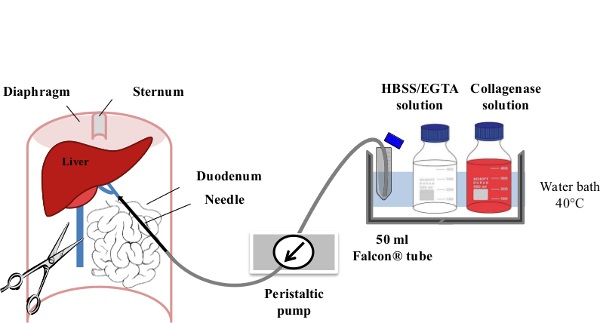
1. Perfusion and Cell Collection (Figure 1)

  1. Prepare freshly all reagents described in the material table.
  2. Warm the EGTA (Ethylene Glycol Tetra-acetic Acid)/HBSS (Hank's Balanced Salt Solution) Solution (50 ml per mouse) and the Collagenase Solution (100 ml per mouse) for 30 min at 40 °C.
  3. Rinse the pump flexible tubing first with 70% ethanol. Pour 40 ml of EGTA/HBSS Solution into a centrifuge tube immersed in the water bath and rinse the pump fle....

Access restricted. Please log in or start a trial to view this content.

Results

Liver perfusion diagram; peristaltic pump setup; HBSS/EGTA, collagenase solutions; enzyme digestion.
Figure 1: Liver Perfusion. After anesthesia of the mouse, the digestive tract is laterally moved to the left of the abdomen in order to make the portal vein (PV) accessible. The PV is cannulated using a slow flow rate (1-3 ml/min) of EGTA/HBSS Solution .......

Access restricted. Please log in or start a trial to view this content.

Disclosures

No conflicts of interest declared.

Materials

List of materials used in this article
NameCompanyCatalog NumberComments
Euthatal (pentobarbital sodium)Merial
CD1 miceCharles River-Mouse weight should vary from 35 to 45 g. We advise the use of male CD1 mice as their weight increase rapidly (e.g. a male CD1 mouse of 7 weeks old exceeds 35 g in weight). It is also advised to contact the animal supplier in advance to arrange for the delivery of older animals. Alternatively animals can be in-house to reach the desired weight.
HBSS (Ca<sup>2+</sup> and Mg<sup>2+</sup> free, with bicarbonate)Life Technologies14175-053HBSS must be Ca<sup>2+</sup> free.
Ethylene Glycol Tetraacetic Acid (EGTA) tetrasodium saltSigma-AldrichE8145EDTA can also be used but EGTA has the advantage of chelating Ca<sup>2+</sup>&nbsp; selectively.
HEPES (1M)Life Technologies15630-056100 ml
Collagenase type-IVWorthingtonCSL-4It is advised to test different batches of collagenase or at least mention to the supplier the product has to be suitable for liver cell isolation
Low glucose DMEMSigma-AldrichD5523500 ml
RPMI (with sodium pyruvate and Glutamax&reg;)Life Technologies12633-012500 ml
Penicillin/SteptomycinLife Technologies15140-122100 ml
Fetal Bovine SerumFirst-Link60-00-850500 ml
Trypan blue solutionSigma-AldrichT8154100 ml
Coated silica particle solution (Percoll&reg;)GE Healtcare17-0891-02Percoll&reg; is very stable and can be kept for several years
1x Phosphate-Buffered SalineLife Technologies10010-023500 ml
10x Phosphate-Buffered SalineLife Technologies70011-036500 ml
Butterfly blood collection set (23G/305mm long tubing)BD367288
Syringe Filters (0.22 &mu;m Blue Rim)Minisart16534-K
Centrifuge Tubes (50 ml Blue Cap)BD Biosciences, Falcon35 2070
Petri dish (90 x 15 mm)Thermo Fisher ScientificBSN 101VR20
100 &mu;m cell strainerBD352360
Peristaltic pumpWatson MarlowSciQ 300Rinse tubing before and after each usage with sterile PBS and 70% ethanol.
24-well platesCorning3526
CentrifugeEppendorf5810R
Serrefine forcepsHammacher GmbHArt. Nr. HSE 004-35 / Cat. Nr. 221-0051The serrefine forceps allow to clamp the vessel cannulated with the 23G needle without the need of holding the forceps during the perfusion procedure. URL: (http://www.hammacher.de/Laboratory-Products/Clamps-forceps/Serrefines/HSE-004-35-Serrefine::25126.html)
Cell scraperBD Biosciences, Falcon353086Cut blade extremities with a pair of scissors to scrape cells in 24-well plates.
EGTA (Ethylene Glycol Tetraacetic Acid)/HBSS (Hank's Balanced Salt Solution) SolutionHBSS containing 0.5 mM EGTA and 25 mM HEPES. Adjust pH to 7.4. Prepare 50 ml for each liver to perfuse.
Collagenase SolutionDMEM low glucose containing collagenase type IV at 100 UI/ml, 15 mM HEPES and 1% Penicllin/Streptamycin (v/v). Adjust pH to 7.4. Prepare 100 ml for each liver to perfuse. After adding the collagenase, it is advised to warm up the solution for 30 min before use. This allows the collagenase activity to be optimum.
Kupffer Cell Isolation MediumRPMI containing, 1% Non-Essential Amino-Acids (v/v),1% glutamax&reg; (v/v) and 1% Penicllin/Streptomycin (v/v). Prepare at least 100 ml for 1-3 livers.
Kupffer Cell Culture MediumRPMI containing 10% Fetal Bovine Serum, 1% Non-Essential Amino-Acids (v/v),1% Glutamax&reg; (v/v) and 1% Penicllin/Streptamycin (v/v). Prepare at least 100 ml for 1-3 livers.
SIP (solution of isotonic coated silica particles)Mix 1.7 ml of 10x Phosphate Buffered Saline with 15.3 ml of Percoll&reg; to obtain 17mL of SIP.
25% SIP solutionMix 5 ml of SIP with 15 ml of 1x Phosphate Buffered Saline
50% SIP solutionMix 10 ml of SIP with 10 ml of 1x Phosphate Buffered Saline
Lysis BufferDMEM media with 0.9% Triton X-100
PBS/BSA SolutionPrepare fresh Phosphate-Buffered Saline pH 7.4 with 1% Bovine Serum Albumin.

Explore More Articles

Liver MacrophagesCell IsolationDensity GradientDifferential CentrifugationNon-parenchymal CellsCell CultureTrypan Blue StainingHemocytometer CountingCell Viability