A description of the formation of a polymer microarray using an on-chip photopolymerization technique. The high throughput surface characterization using atomic force microscopy, water contact angle measurements, X-ray photoelectron spectroscopy and time of flight secondary ion mass spectrometry and a cell attachment assay is also described.
Method Article
Polymer Microarrays for High Throughput Discovery of Biomaterials
Opens in a new tab
In This Article
Summary
Loading...
$$\rightleftharpoonup{xx}$$
$$\longleftharp{xx}$$,
$$\longrightharp{xx}$$,
Abstract
Loading...
$$\rightleftharpoonup{xx}$$
$$\longleftharp{xx}$$,
$$\longrightharp{xx}$$,
The discovery of novel biomaterials that are optimized for a specific biological application is readily achieved using polymer microarrays, which allows a combinatorial library of materials to be screened in a parallel, high throughput format1. Herein is described the formation and characterization of a polymer microarray using an on-chip photopolymerization technique 2. This involves mixing monomers at varied ratios to produce a library of monomer solutions, transferring the solution to a glass slide format using a robotic printing device and curing with UV irradiation. This format is readily amenable to many biological assays, including stem cell attachment and proliferation, cell sorting and low bacterial adhesion, allowing the ready identification of 'hit' materials that fulfill a specific biological criterion3-5. Furthermore, the use of high throughput surface characterization (HTSC) allows the biological performance to be correlated with physio-chemical properties, hence elucidating the biological-material interaction6. HTSC makes use of water contact angle (WCA) measurements, atomic force microscopy (AFM), X-ray photoelectron spectroscopy (XPS) and time-of-flight secondary ion mass spectrometry (ToF-SIMS). In particular, ToF-SIMS provides a chemically rich analysis of the sample that can be used to correlate the cell response with a molecular moiety. In some cases, the biological performance can be predicted from the ToF-SIMS spectra, demonstrating the chemical dependence of a biological-material interaction, and informing the development of hit materials5,3.
Protocol
Loading...
$$\rightleftharpoonup{xx}$$
$$\longleftharp{xx}$$,
$$\longrightharp{xx}$$,
1. Preparation of low-fouling background
- Weigh out 2 g of poly(hydroxyethyl methacrylate) (pHEMA) (Sigma - cell culture tested) into a 50 mL centrifuge tube. Dissolve in 50 mL of 95% (v/v) ethanol in water. This typically takes 24 hrs of sonication.
- Dip-coat epoxy-functional glass slide (Genetix) with the pHEMA solution. The epoxy groups will rapidly form covalent linkages with the pHEMA coating. Dip-coating is achieved by holding the glass slide with tweezers and dipping the slide into the solution. Typically 5 mm of the slide is left uncoated, which is useful for orientating the slide and can also act as a positive control as an adhering surface. The slide is then withdrawn from the pHEMA solution over a period of 1 s, inverted and left to dry in a near horizontal position for 10 min before placing in a slide holder.
- The pHEMA coated slides are then left at atmospheric conditions for 1 week to allow the complete evaporation of the solvent.
2. Preparation of monomer solution
- Weigh 120 mg of the photoinitiator 2,2-dimethoxy-2-phenyl acetophenone and add to 3 mL of dimethylformamide (DMF) to make a 4% (w/v) photoinitiator solution. This is best done fresh before each print run, so the mass and volume of the solution made can be varied to suit how much photoinitiator solution is required. The solution is stable up to a month.
- Monomer solutions are made by adding 1 part of the photoinitiator solution to 3 parts of the neat monomer. This is achieved by pipetting 5 μL of photoinitiator solution and 15 μL of monomer into a 384 well source plate. A total volume of 20 μL is ideal for spot formation. Higher volumes require additional blotting before uniform spots can be produced. Smaller volumes may result in incomplete loading of the pin.
- This method is currently limited to the use of acrylate/methacrylate monomers that are soluble in DMF by virtue of these being the only combinations that have been explored; acrylamides and other solvents are likely to be amenable to the printing process. To achieve the monomer concentration suggested (75% w/w) liquid monomers are also required, although lower monomer concentrations can be used for solid monomers (the reduced monomer concentration does not appear to adversely alter the surface chemistry of the resultant polymer however it is likely that the molecular weight and glass transition temperature is altered). Highly volatile monomers are also difficult to use due to the rapid evaporation of monomer prior to the UV curing step when polymerising. Depending on the number of monomer solutions a run can take as long as 6 hours and towards the end of the run volatile monomers will have evaporated from the source plate. Use of volatile monomers can be achieved by cooling the printing stage and using short print runs only.
- With the exception of a few highly hydrophilic monomers such as poly(ethylene glycol) acrylate, the dissolution of the resultant polymer spots in aqueous buffers has not been observed, thus, the use of a crosslinking monomer is not required, although is not excluded.
3. Polymer microarray formation
The typical procedure for polymer microarray formation is depicted schematically in Figure 1.
- Microarray formation is achieved using a contact robot (Biodot) using a XYZ stage (Figure 2). Slotted pins of 220 μm diameter are used (Arrayit 96B). All pins should be cleaned by sonication in dichloromethane for 10 mins prior to the print run and likewise the pin holder should also be cleaned.
- Pins are loaded into the holder, blotting and array slides are loaded and then the entire chamber is filled with argon to reduce the oxygen level to below 2000 ppm, which is sufficiently low to avoid quenching of the polymerization radicals by oxygen. The humidity is maintained at between 30-40%. Including humidity allows for the pHEMA to swell allowing for the formed polymer to interpenetrate the pHEMA layer and become physically entrapped to the surface 2.
- The print run is commenced. Each run consists of:
- Loading sample from source plate. The pins are lowered into the solutions at a speed of 25 mm/s, held in solution for 2.5 s and then withdrawn at a speed of 25 mm/s (Figure 2).
- Pins must be blotted before printing to remove monomer solution from the outside of the pin. Subsequently monomer delivery occurs from the quilled part of the pin to achieve consistent spot formation. The blotting sequence used consists of 33 contacts with a clean glass slide. For the first four positions the number of contacts made is 10, 5, 4 and 3 respectively. The next four positions 2 contacts are made and in the last 3 positions 1 contact is made. Total contact time for each contact is 10 ms and approach and withdrawal speed is 175 mm/s. By this point the spots formed should have a consistent shape and geometry. Failure at this point indicates unclean pins or dust contaminant in the monomer solutions.
- The monomer solutions are then printed onto the pHEMA coated glass slides (Figure 2). One contact is made per spot at a pin movement of 175 mm/s and contact time of 10 ms, which depending on the viscosity and surface energy of the monomer solution gives an average spot diameter of 400 μm. Typically 3 replicate arrays are printed onto each glass slide and a total of 10 slides are printed on a single run. This equates to 30 spots per cycle.
- Pins are washed in DMF. 2.5 L of fresh DMF is provided for the entire wash run. Pins are washed in a flow bath with agitation.
- Concurrent with the wash, the freshly printed slides are irradiated with a short wave UV (365 nm) source at a density of 30 mV/cm2 for the duration of the wash period that lasts 30 s.
- After all monomer solutions are printed the arrays are irradiated with UV (365 nm) for additional 10 min.
- The freshly printed arrays are kept at low pressure (<50 mTorr) for 1 week to remove unpolymerized monomer and solvent.
4. High throughput surface characterization (HTSC)
A general scheme of the HTSC techniques is shown in Figure 3. Central to the automated, high throughput approach is the alignment of the polymer microarray with the characterization apparatus. In all cases this is achieved using a camera that gives a top view of the array. Initially, the array is rotated to align with the X-Y movement of the stage. A corner spot of the array is then located and designated specific coordinates. The position of each polymer spot can then be predicted using the dimensions of the array.
- Water contact angle (WCA) measurements
- WCA measurements are taken using the sessile drop method on an automated Krüss DSA 100 instrument. A single water drop with a volume of ~400 pL is dispensed using a piezo-driven print head onto each polymer spot. The diameter of a polymer spot is typically 300 μm and the base diameter of the water droplet on the polymer spot is typically 100 μm, thus, only one measurement can be obtained per polymer spot.
- An X-Y stage allows for the automated positioning of each polymer spot under the print head 7. This is achieved using a camera located above the sample that provides a top view of the array. Initially, the camera position must be adjusted to align the dispensing of the water droplet to the centre of the camera view and then the array can be aligned to the print head.
- A high speed camera records the side profile of the droplet upon hitting the surface and subsequently evaporating. The frame that captures the initial impact of drop is used to measure the contact angle. A circle is fitted to the drop profile and the contact angle subsequently determined.
- Time-of-Flight Secondary Ion Mass Spectrometry (ToF-SIMS)
- Sample is loaded onto stage. This involves firstly lining the stage with clean Al foil, which helps with charge compensation, and then holding the slide in place by use of metal screw tabs.
- Sample stage is placed into the transfer chamber of the ToF-SIMS and allowed to pump down until 1.6 × 10⁻⁶ mbar. The sample is then transferred to the main analysis chamber, which typically has a vacuum pressure of 1.0 × 10⁻⁸ mbar.
- ToF-SIMS measurements are conducted using an ION-ToF IV instrument operated using a monoisotopic Bi3+ primary ion source operated at 25 kV in "bunched mode". A pulsed 1 pA primary ion beam is rastered over the analysis area, with both positive and negative secondary ions collected from a 100 × 100 μm area of each polymer spot in the microarray for a 10-second acquisition time. Ion masses were determined using a high resolution Time-of-Flight analyzer allowing accurate mass assignment. The typical mass resolution (at m/z 41) was just over 6000. Low energy electrons (20 eV) were used to compensate for surface charging caused by the positively charged primary ion beam on the insulating surfaces 8.
- Atomic force microscopy (AFM)
- A large stage AFM with an automated stage is required for analysing the arrays on the glass slide. A Dimension or ICON microscope is ideal for this purpose.
- Sample is placed on stage and stage position is homed to top right corner of the array.
- The position of the bottom left corner of the array is found, which allows the position of all other spots to be interpolated.
- A position list is generated and fed into the auto-sampling feature of the software.
- AFM measurements are taken using a Nanoscope 3000A instrument in tapping mode. Silicon tips with a resonant frequency of approximately 300 kHz and a force constant of 40 N/m are used (Tap300Al, Budget Sensors). 5x5 μm regions of the polymer are measured 9.
- The root mean square (RMS) roughness is measured across this region for each image using SPIP batch processing software. Each image is initially flattened prior to roughness measurements.
- All images require a manual viewing to identify imaging artefacts that may need to be removed from roughness measurements. During this step images may also be categorised based upon common surface features 9.
- X-ray photoelectron spectroscopy (XPS)
- A microarray slide is affixed to a sample bar using double sided tape and subsequently loaded into the sample chamber of a Kratos Axis Ultra XPS instrument.
- Enter into the sample chamber and wait until it reaches a pressure below 10-8 Torr.
- The appropriate operation parameters, such as a monochromated x-ray source (Al, 1486.6 eV), anode potential and current (10kV and 15mA), aperture size (110μm), pass energy (80 eV for wide scan and 20 eV for high resolution scan) are selected. The X-ray source is focused using two opposite corners of the microarray and optimizing the oxygen signal from the sample. The x and y positions of individual spots is then determined and logged as a position list.
- A program chart is written and then run for the acquisition of data, including wide scans and high resolution scans for specific elements.
- Raman spectroscopy
- Raman spectra are taken for each polymer spot using a Raman microscope LabRAM HR (Horiba Jobin Yvon). Initially, the Raman signal is calibrated using a silicon wafer and the Raman shift of Si at 520.7 cm-1.
- The sample is then placed on the stage and the focus of the laser (wavelength = 523 nm) is adjusted to maximize the C-H Raman shift at 2950 cm-1.
- The position of the centre of the top left spot on the microarray is then set as the origin and a map of the microarray is setup using the array function on the labRAM HR software.
- 10 spectra are acquired cumulatively for each sample with an irradiation time of 0.5 s.
5. Bacterial assay
The array can be exposed to many different biological assays including attachment and proliferation of stem cells, other cells types and bacteria 3,10,4. Here we describe a bacterial attachment assay, which is shown schematically in Figure 4.
- A bacterial strain transformed with GFP expressed plasmid is cultured overnight at 37 °C in 10 mL of LB media in a 50 mL falcon tube with shaking at 200 rpm.
- The OD600 of the bacterial culture is measured and sufficient overnight culture is inoculated into 15 mL RPMI-1640 defined media to result in a final OD600 of 0.01.
- Arrays are prewashed in sterilized distilled water for 10 mins to remove any dissolvable components from the arrays (unpolymerised monomer, oligomers and solvent)
- Washed array slides are placed in a clean petri dish and UV sterilized for 10 min.
- A slide with the array is placed into a petri dish and 15 mL of the inoculated RMPI-1640 media is added. Concurrently another slide is placed in a petri dish and incubated with non-innoculatd RPMI-1640 as a control.
- Slides are incubated at 37 °C for 72 hours with shaking at 60 rpm.
- Slides are washed twice with 15 mL of sterile PBS.
- Slides are washed twice with 15 mL of sterile distilled water.
- Slides are air-dried.
- Slides are imaged using a GenePix Autoloader 4200AL Scanner (Molecular Devices, US) with a 488 nm excitation laser and standard blue emission filter (510-560nm). A representative polymer autofluorescence image is shown in Figure 2. This should be done as soon as possible to avoid the decay of the GFP. If this is not possible the cells should undergo fixation. Furthermore, the inclusion of appropriate positive controls with a known bacterial response is imperative to be able to normalize the results and allow experiments conducted on different days to be quantitatively comparable. The total fluorescence intensity from polymer spots is acquired using GenePix Pro 6 software (Molecular Devices, US). This is done for both slides incubated with bacteria and just media. To find the fluorescence due to growth of bacteria the fluorescence on the media control is subtracted from the fluorescence measured on the slide incubated with bacteria.
- Slides can also be stained by 20 μM SYTO17 nucleic acid dye (Invitrogen, UK) at room temperature for 30 minutes and imaged using a Carl Zeiss LSM 700 Laser Scanning Microscope with ZEN 2009 imaging software (Carl Zeiss, Germany). The coverage of bacteria on the surface is determined using open source Image J 1.44 software (National Institute of Health, US).
6. Representative Results
The conditions of printing have been optimized to print the highest quality polymer microarrays. The humidity should be kept at between 30-40%. The delamination of polymer spots in aqueous environments was observed frequently for arrays printed at a humidity below 30%, suggesting that this humidity is insufficient to swell the pHEMA layer and allow for the physical entrapment of the polymer to the substrate. The humidity can be increased further to alter the diameter of the polymer spots, but this is dependent on the monomer chemistry. For example, where equal volumes of polymerization solution were printed and as humidity was increased from 40 to 80 % the spot diameter decreased from 430 μm to 370 μm for a monomer containing a hydrophilic ethylene glycol moiety equal volume whilst for a monomer containing a hydrophobic aliphatic carbon ring structure the spot diameter increased from 290 μm to 350 μm (Figure 5).
The degree of polymerization can be monitored using Raman spectroscopy to measure the C=C Raman shift that is detected at 1640 cm-1, which should be normalized with the C=O Raman shift at 1720 cm-1. The Raman spectra was measured for polymer spots polymerized for varied UV exposure (Figure 6). The C=C:C=O ratio decreased as UV exposure increased from 0 to 50 s, whereupon no further decrease in the C=C:C=O ratio was observed with further UV irradiation (Figure 6). Raman spectra were also measured for polymer spots polymerized at varied O2 level and the C=C Raman shift was observed as the O2level was decreased to 2000 ppm, however no further reduction was observed for an O2 level below this (Figure 7A). Raman spectroscopy also demonstrated the ability of the vacuum extraction step to remove unpolymerized monomer. Prior to vacuum extraction the C=C Raman shift was greater for the polymer polymerized at 3300 ppm compared with 2000 ppm (Figure 7A), however, after vacuum extraction the height of the Raman shift is indistinguishable (Figure 7B), suggesting all unpolymerized monomer has been removed during the vacuum extraction step. To summarize, polymerization conditions include a humidity of 30-40%, UV exposure greater than 50 s at an O2 level below 2000 ppm with a vacuum extraction step after printing for 7 days.
After printing and vacuum extraction the success of the polymerization of polymer spots can be assessed by simple light microscopy to identify and anomalous spot morphologies. Typically, spots should appear circular and uniform, as shown in Figure 8 on the left. The likely cause for a change in geometry is a damaged or unclean pin. For a small number of monomer combinations we have observed misshapen spots, for example a central spot with a satellite of small spots, shown in Figure 8 on the right, or a fried egg shape where there is a central spot on top of large, flatter spot. This may be caused by phase separation prior to printing relating to differences in the viscosity, hydrophilicity, volatility or surface tension of the monomers and suggests that the monomer combination is not compatible with this format. Additional chemical mapping of polymer spots by techniques such as ToF-SIMS is also an important and sometimes necessary quality control step to determine the distribution of the materials' chemistries across the spots and the array. This technique can identify excessive spreading of some materials not visible by light microscopy and identify phase separation within individual polymer spots.
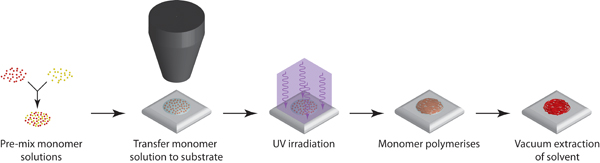
Figure 1. Schematic depicting the various steps involved in the formation of a polymer spot.
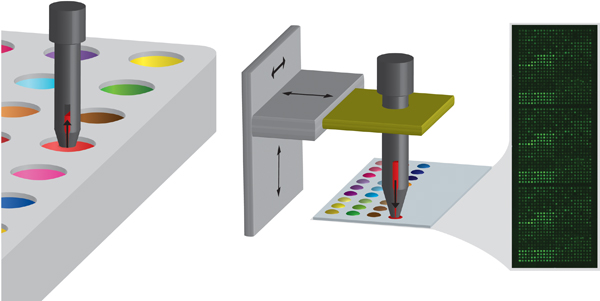
Figure 2. Schematic of the methodology of pin printing involving initially loading the pin with monomer in a source plate and then depositing the monomer onto a substrate by making contact. The pin is controlled by an X-Y-Z robotic arm. The inset shows a typical image of the autofluorescence from an array after production.
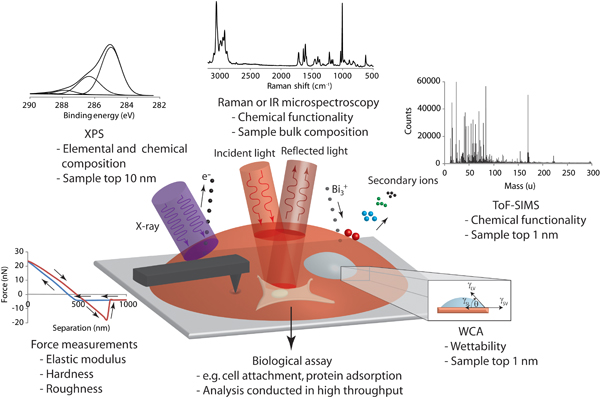
Figure 3. Schematic highlighting the techniques associated with HTSC and also bioassays applied to the study of polymer microarrays.
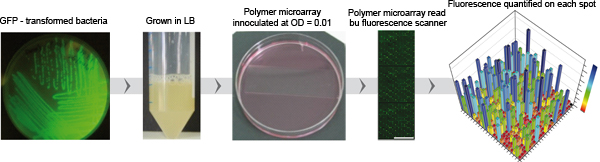
Figure 4. Schematic of the bacterial attachment assay.
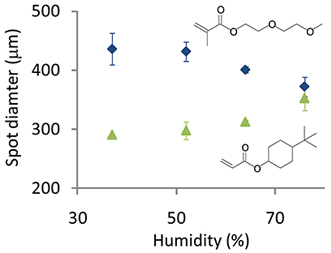
Figure 5. Polymer spot diameter printed at varied humidity for two different monomers: 4-tert-butylcyclohexyl acrylate and di(ethylene glycol) ethyl ether methacrylate.
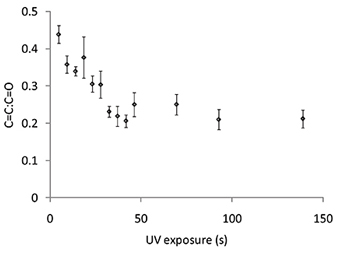
Figure 6. The ratio of the Raman intensity for the C=C Raman shift at 1640 cm-1 and the C=O Raman shift at 1720 cm-1 from polymer spots of 4-tert-butylcyclohexyl acrylate with varied UV exposure. The error bars equal one standard deviation (n = 3).
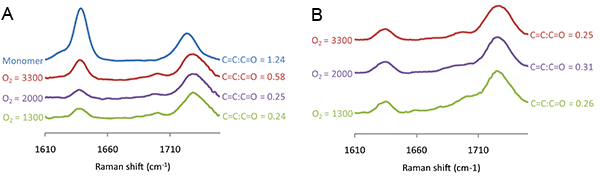
Figure 7. The Raman spectra measured for polymer spots of 4-tert-butylcyclohexyl acrylate printed at varied O2levels, indicated to the left of each spectrum, (A) before and (B) after vacuum extraction. The ratio of the Raman intensity for the C=C Raman shift at 1640 cm-1 and the C=O Raman shift at 1720 cm-1 is shown to the right of each spectrum.
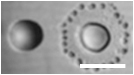
Figure 8. A light microscopy image of two polymer spots. The spot on the left shows a well formed spot, whilst the spot on the right is an example of a spot containing a very unevenly distribution of monomer. The scale bar is 500 μm.
Discussion
Loading...
$$\rightleftharpoonup{xx}$$
$$\longleftharp{xx}$$,
$$\longrightharp{xx}$$,
Polymer microarrays have been successfully used for the discovery of new materials by screening hundreds of novel polymer in a biological assay and identifying 'hit' materials that can subsequently be scaled up to useful devices. In this case, the surface characterization described may be employed subsequent to the biological assay and exclusively on the 'hit' materials to study those materials in more detail. This strategy may be of interest if HTSC is not available to the experimentalist employing this approach. However, to fully utilize polymer microarrays to study biological-material interactions the entire array of hundreds of materials should be analyzed prior to biological assays using HTSC methodologies, which can subsequently be used to observe general structure-function trends.
Contact printing relies on the metal pin sliding up and down freely within the pin holder. Pin and pin holder cleanliness is paramount is ensuring printing occurs successfully and should be rigorously undertaken. Before commencing a printing run the appropriate movement of the pin within the pin holder can be tested by performing a dry run, with no monomers present. The cleaning step should continue until the pin movement is achieved reproducibly.
Considerable thought should go into the design of the monomer mixture. In order to easily produce a combinatorial library of polymers, hundreds of copolymers are formed by mixing a few monomers at different ratios. Typically we produce 576 member libraries as this forms a 24 x 24 array, which is suitable for the geometry of a glass slide. In order to produce a combinatorial library that explores the most combinatorial space the easiest method is to mix 24 monomers pairwise at a 2:1 ratio. Alternatively, the inclusion of compositional gradients within the array are useful for enabling the observations of trends, which allows optimal monomer compositions to be determined. As an example of this 22 monomers can be used as the first component in a co-monomer mixture that is sequentially diluted with 1 of 6 second components. If 5 dilutions are used, for example mixing the first and second components at ratios of 90:10, 75:25, 50:50, 25:75 and 10:90, this would result in 488 unique copolymer solutions. To bring the total up to 576, replicates of the homopolymers of the monomers used can be introduced, which often is an important reference sample. 576 monomer solutions should be dispensed into 2 384 well plates. For programming the robot it is easier to have two identical plates in terms of the position of the monomers, thus, the monomer solutions should be split evenly between the two plates.
A significant amount of time can be saved in the preparation of the source plates by the use of multichannel pipettes, and the design of source plates should be determined in order to exploit the use of the multichannel pipettes.
To achieve automated HTSC of the arrays the spot position must be successfully aligned with the characterization apparatus. Typically the pitch of an acrylate array is 500-1000 μm and the polymer spot diameter is 300 μm. Most X-Y stages have a resolution below 10 μm, thus there is adequate tolerance for the surface characterization apparatus to reliably access the array positions once the correct dimensions have been input to the sample positioning software. The limitation to the automated positioning is in fact the accurate printing of the array. To ensure accurate printing it is important to prevent movement of the substrate on the printing stage either using vacuum suction or spring clamps together with appropriate slide dimensions (note that both a US and EU standard slide size exist).
ToF-SIMS is an extremely surface sensitive technique that will observe any contamination on samples. Thus, upmost care must be taken to avoid contact with the surface. Samples should only be handled, but the surface of interest not contacted with, with clean gloves (preferably polyethylene) and with freshly cleaned tweezers. We typically wash with chloroform and hexane. Sample storage prior to measurements is best done in a sample holder that holds the slides apart, for example the 5 slide holder or 20 slide holder.
The arrays are designed specifically to be compatible with many biological assay formats and readouts, that is, the substrate used is a microscope slide ideally suited to fluorescence scanners and light microscopes. This means the format is well suited to exploring many material-biological interactions. Furthermore, the format allows hundreds of materials to be screened in parallel. This allows many more materials to be screened than conventional methods whereby each new material chemistry is screened individually. The increased scope for biological-material interactions allows for the elucidation of mechanisms of biological surface interactions, as well as finding the optimal material for a given application.
Disclosures
Loading...
$$\rightleftharpoonup{xx}$$
$$\longleftharp{xx}$$,
$$\longrightharp{xx}$$,
We have nothing to disclose.
Acknowledgements
Loading...
$$\rightleftharpoonup{xx}$$
$$\longleftharp{xx}$$,
$$\longrightharp{xx}$$,
Funding from the Wellcome Trust is kindly acknowledged (grant number 085245/Z/08/Z). Nottingham Nanotechnology and Nanoscience Centre is kindly acknowledged for giving access to the Raman system and for the East Midlands Development Agency for funding this equipment.
Materials
| Name | Company | Catalog Number | Comments |
|---|---|---|---|
| Epoxy slides | Genetix | K2652 | |
| Contact printer | Biodot | XYZ3060 Platform | |
| Metal pin | ArrayIt | 946MP6B | |
| ToF-SIMS instrument | ION-TOF | ||
| XPS instrument | Kratos Analytical | ||
| WCA apparatus | Krüss | DSA 100 | |
| AFM | Bruker Corporation | Dimension Icon | |
| RPMI-1640 cell culture media | Sigma-Aldrich | R0883 | |
| SYTO17 | Invitrogen | S-7579 |
References
Loading...
$$\rightleftharpoonup{xx}$$
$$\longleftharp{xx}$$,
$$\longrightharp{xx}$$,
- High throughput methods applied in biomaterial development and discovery. Biomaterials. 31, 187-198 (2010).">Hook, A. L., Anderson, D. G., Langer, R., Williams, P., Davies, M. C., Alexander, M. R. High throughput methods applied in biomaterial development and discovery. Biomaterials. 31, 187-198 (2010).
- Nanoliter-scale synthesis of arrayed biomaterials and application to human embryonic stem cells. Nature Biotechnology. 22, 863-866 (2004).">Anderson, D. G., Levenberg, S., Langer, R. Nanoliter-scale synthesis of arrayed biomaterials and application to human embryonic stem cells. Nature Biotechnology. 22, 863-866 (2004).
- Combinatorial development of biomaterials for clonal growth of human pluripotent stem cells. Nature Materials. 9, 768-778 (2010).">Mei, Y., Saha, K., Bogatyrev, S. R., Yang, J., Hook, A. L., Kalcioglu, Z. I., Cho, S. W., Mitalipova, M., Pyzocha, N., Rojas, F., Van Vliet, K. J., Davies, M. C., Alexander, M. R., Langer, R., Jaenisch, R., Anderson, D. G. Combinatorial development of biomaterials for clonal growth of human pluripotent stem cells. Nature Materials. 9, 768-778 (2010).
- Colonising new frontiers-microarrays reveal biofilm modulating polymers. Journal of Materials Chemistry. 21, 96-101 (2011).">Pernagallo, S., Wu, M., Gallagher, M. P., Bradley, M. Colonising new frontiers-microarrays reveal biofilm modulating polymers. Journal of Materials Chemistry. 21, 96-101 (2011).
- Polymer surface functionalities that control human embryoid body cell adhesion revealed by high throughput surface characterization of combinatorial material microarrays. Biomaterials. 31, 8827-8838 (2010).">Yang, J., Mei, Y., Hook, A. L., Taylor, M., Urquhart, A. J., Bogatyrev, S. R., Langer, R., Anderson, D. G., Davies, M. C., Alexander, M. R. Polymer surface functionalities that control human embryoid body cell adhesion revealed by high throughput surface characterization of combinatorial material microarrays. Biomaterials. 31, 8827-8838 (2010).
- High throughput surface characterisation of a combinatorial material library. Advanced Materials. 19, 2486-2491 (2007).">Urquhart, A. J., Anderson, D. G., Taylor, M., Alexander, M. R., Langer, R., Davies, M. C. High throughput surface characterisation of a combinatorial material library. Advanced Materials. 19, 2486-2491 (2007).
- Picoliter water contact angle measurement on polymers. Langmuir. 23, 6875-6878 (2007).">Taylor, M., Urquhart, A. J., Zelzer, M., Davies, M. C., Alexander, M. R. Picoliter water contact angle measurement on polymers. Langmuir. 23, 6875-6878 (2007).
- TOF-SIMS analysis of a 576 micropatterned copolymer array to reveal surface moieties that control wettability. Analytical Chemistry. 80, 135-142 (2008).">Urquhart, A. J., Taylor, M., Anderson, D. G., Langer, R., Davies, M. C., Alexander, M. R. TOF-SIMS analysis of a 576 micropatterned copolymer array to reveal surface moieties that control wettability. Analytical Chemistry. 80, 135-142 (2008).
- Acrylate polymers with hydro-responsive topography. Soft Matter. 7, Forthcoming 7194-9197 (2011).">Hook, A. L., Yang, J., Chen, X., Roberts, C. J., Mei, Y., Anderson, D. G., Langer, R., Alexander, M. R., Davies, M. C. Acrylate polymers with hydro-responsive topography. Soft Matter. 7, Forthcoming 7194-9197 (2011).
- Deciphering cellular morphology and biocompatibility using polymer microarrays. Biomedical Materials. 3, (2008).">Pernagallo, S., Unciti-Broceta, A., Diaz-Mochon, J. J., Bradley, M. Deciphering cellular morphology and biocompatibility using polymer microarrays. Biomedical Materials. 3, (2008).
Reprints and Permissions
Request permission to reuse the text or figures of this JoVE article
Request Permission