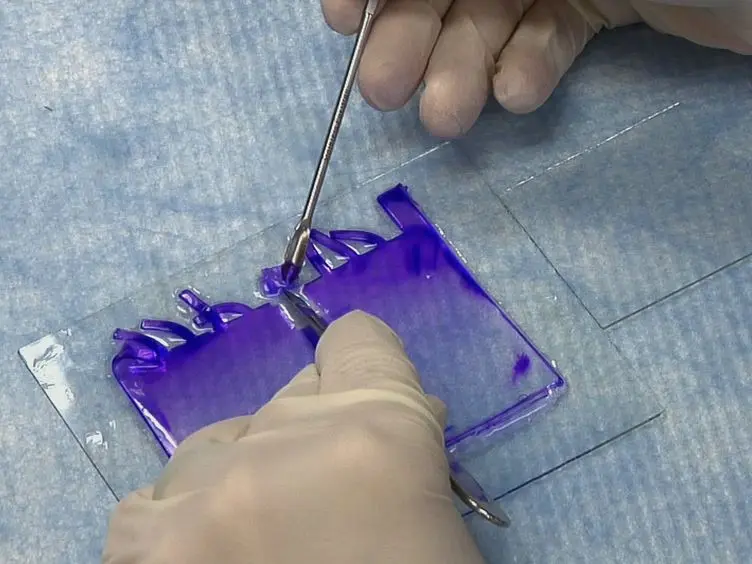
In order to comprehensively explore the diversity of O-linked glycans, a new procedure for in-gel reductive β-elimination, combined with permethylation and a rapid phase-partition method, is applied to the analysis of O-linked glycans directly released from glycoproteins resolved by SDS-PAGE and amenable to subsequent glycomic analysis by mass spectrometry.
A subscription to JoVE is required to view this content. Sign in or start your free trial.
Method Article
Improved In-gel Reductive β-Elimination for Comprehensive O-linked and Sulfo-glycomics by Mass Spectrometry
In This Article
Summary
Abstract
Separation of proteins by SDS-PAGE followed by in-gel proteolytic digestion of resolved protein bands has produced high-resolution proteomic analysis of biological samples. Similar approaches, that would allow in-depth analysis of the glycans carried by glycoproteins resolved by SDS-PAGE, require special considerations in order to maximize recovery and sensitivity when using mass spectrometry (MS) as the detection method. A major hurdle to be overcome in achieving high-quality data is the removal of gel-derived contaminants that interfere with MS analysis. The sample workflow presented here is robust, efficient, and eliminates the need for in-line HPLC clean-up prior to MS. Gel pieces containing target proteins are washed in acetonitrile, water, and ethyl acetate to remove contaminants, including polymeric acrylamide fragments. O-linked glycans are released from target proteins by in-gel reductive β-elimination and recovered through robust, simple clean-up procedures. An advantage of this workflow is that it improves sensitivity for detecting and characterizing sulfated glycans. These procedures produce an efficient separation of sulfated permethylated glycans from non-sulfated (sialylated and neutral) permethylated glycans by a rapid phase-partition prior to MS analysis, and thereby enhance glycomic and sulfoglycomic analyses of glycoproteins resolved by SDS-PAGE.
Introduction
Glycosylation is an essential protein post-translational modification, contributing to organismal physiology, tissue pathology, and cellular recognition 1-3. Despite major advances in analytical glycoscience, characterizing the complete diversity of glycans on a specific protein remains an extremely challenging task, especially on proteins isolated from primary biological sources. Nonetheless, the microheterogeneity of glycoprotein glycans frequently affects functional interactions with other proteins. Therefore, characterization of glycan diversity is essential for understanding the physiological significance of cellular and tissue glycosylation 4,5
Access restricted. Please log in or start a trial to view this content.
Protocol
NOTE: Lab Safety Concerns
In keeping with standard laboratory best practices, observe the following. Store all organic solvents in appropriate locations. Keep all waste materials in chemical waste containers with clear labeling of chemical compositions. As several reagents used in these protocols are potential carcinogens or generate volatile combustible gases, handle all reagents in a fume hood with ventilation. Wear personal protective equipment such as gloves, lab coat, and eye protection when working with organic solvents.
Access restricted. Please log in or start a trial to view this content.
Results
Effect of Ethyl Acetate Treatment Prior to In-gel Reductive β-Elimination
A representative mass spectrum of permethylated O-linked glycan samples released from bovine mucin using in-gel reductive β-elimination is shown in Figure 3. The EtOAc wash of the gel pieces effectively removes SDS and polyacryl contaminants which interfere with subsequent MS analysis 27.
Access restricted. Please log in or start a trial to view this content.
Discussion
Combining in-gel reductive β-elimination with aqueous-organic extraction enhances the sensitivity and depth of structural data that can be acquired for characterizing sulfated and non-sulfated O-linked glycans harvested from small amounts of mucin-type glycoproteins resolved from other proteins by SDS-PAGE. The essential advances of the technical approaches presented in this study are: (a) facile removal of gel derived contaminants by simple washing steps; (b) quantitative recovery of permethylated sulfoglycans in t.......
Access restricted. Please log in or start a trial to view this content.
Disclosures
The authors declare no competing financial interest.
Acknowledgements
This work was supported by the grant P01HL107151 from the NHLBI/NIH. The authors also gratefully acknowledge the support and access to instrumentation provided through grant P41GM103490 from the NIGMS/NIH.
....Access restricted. Please log in or start a trial to view this content.
Materials
| Name | Company | Catalog Number | Comments |
|---|---|---|---|
| Water, deionized water | Sigma-Aldrich | 270733-4L | CHROMASOLV, for HPLC |
| Acetic acid, Glacial | Fisher | A38-500 | Certified ACS ≥99.7% w/w |
| Methanol | Sigma-Aldrich | 34860-4L-R | CHROMASOLV, for HPLC, ≥99.9% |
| Ammonium bicarbonate | Fluka | 09830-500G | BioUltra, ≥99.5% (T), Step 1 |
| Acetonitrile | Sigma-Aldrich | 34998-4L | CHROMASOLV Plus, for HPLC, ≥99.9%, Step 1 |
| Ethyl acetate | Fluka | 34972-1L-R | LC-MS CHROMASOLV, Step 1 |
| Sodium borohydride | Aldrich | 213462-25G | ReagentPlus, 99%, Step 2 |
| Iodomethane | Sigma-Aldrich | 289566-100G | ReagentPlus, 99.5%, Step 6. Store at 4 °C until use. Sit at room temperature before use. |
| Sodium hydroxide solution, 50% w/w | Fisher | SS254-1 | Certified, Step 6 |
| Dimethyl sulfoxide, anhydrous | Sigma-Aldrich | 276855-1L | Anhydrous, ≥99.9%, Step 6 |
| Methanol, anhydrous | Sigma-Aldrich | 322415-100ML | Anhydrous, 99.8%, Step 6 |
| Dichloromethane | Sigma-Aldrich | 34856-4L | CHROMASOL®, for HPLC, ≥99.8%, contains amylene as stabilizer, Step 7 |
| Dowex 50WX8 hydrogen formhydrogen form 100-200 mesh | Sigma-Aldrich | 217506-500G | Step 3 |
| AG 50W-X8 Resin | Bio-Rad | 142-1441 | Step 3 |
| BAKERBOND spe 1 ml x 100 mg Solid Phase Extraction Column, PP, Octadecyl (C18) Reverse Phase | JT Baker | JT-7020-01 | Step 5 and 8 |
| 7.5% Mini-PROTEAN TGX Precast Gel | Bio-Rad | Step 1 | |
| Bio-Safe Coomassie Stain | Bio-Rad | 161-0786 | G-250, Step 1 |
| Silver Stain Kit for Mass Spectrometry | Pierce | 24600 | Step 1 |
| Oligosaccharides Kit (Maltotriose, Dp3: R474140) | Supelco | 47265 | |
| Oligosaccharides Kit (Maltotetraose, Dp4: R474135) | Supelco | 47265 | |
| Disposable Pasteur Pipets, Glass, Short Tip | VWR | 14673-010 | Wash before use |
| PYREX 13 x 100 mm Disposable Round Bottom Threaded Culture Tubes | Corning | 99447-13 | Wash before use |
| PYREX 16 x 125 mm Disposable Round Bottom Threaded Culture Tubes | Corning | 99447-16 | Wash before use |
| Phenolic Caps/Closures with PTFE-Faced Rubber Liner | Kimble | 45066C-13 | Wash before use |
| Phenolic Caps/Closures with PTFE-Faced Rubber Liner | Kimble | 45066C-15 | Wash before use |
| Hamilton HPLC syringe | HAMILTON | 81265 | volume 500 μl, needle size 22 G |
| Hamilton HPLC syringe | HAMILTON | 81165 | volume 250 μl, needle size 22 G |
| Hamilton HPLC syringe | HAMILTON | 81065 | volume 100 μl, needle size 22s G |
| Hamilton HPLC syringe | HAMILTON | 80965 | volume 50 μl, needle size 22s G |
| Hamilton Calibrated Syringes | HAMILTON | 80300 | volume 10 μl, needle size 26s G |
| Petri Dish Glass 100 mm x 15mm | GSC INTERNATIONAL INC | 1500-4 | Wash before use, Step 1 |
| Bard-Parker Surgical Blades | Fisher | 371310 | Step 1 |
| Reacti-Therm Heating/Stirring Module | Pierce | 18870 | Step 1, 4 and 7 |
| Heating Blocks | Fisher | 125D | Step 2 |
| Pyrex fiber glass wool borosilicate pore size 8 μm | Aldrich | CLS3950 | Step 3 |
| Fused Silica CutterTubing cutter | alltech | 3194 | Step 3 |
| Multi-tube vortexers | VWR | 444-7063 | Step 6 |
| Lyophilizer 25EL Freezemobile | Virtis | 25EL | |
| Centrifuge | VWR | Clinical 50 | |
| LTQ Orbitrap Discovery | Thermo Fisher Scientific |
References
- Varki, A. Biological roles of oligosaccharides: all of the theories are correct. Glycobiology. 3 (2), 97-130 (1993).
- Ohtsubo, K., Marth, J. D. Glycosylation in cellular mechanisms of health and disease. Cell. 126 (5), 855-867 (2006).
- Moremen, K. W., Tiemeye....
Access restricted. Please log in or start a trial to view this content.
Reprints and Permissions