Here we present a protocol for cardiac-specific gene manipulation in mice. Under anesthesia, the mouse hearts were externalized through the fourth intercostal space. Subsequently, adenoviruses encoding specific genes were injected with a syringe into the myocardium, followed by protein expression measurement via in vivo imaging and Western blot analysis.
Method Article
A Simple and Efficient Method for In Vivo Cardiac-specific Gene Manipulation by Intramyocardial Injection in Mice
* These authors contributed equally
In This Article
Summary
Abstract
Gene manipulation specifically in the heart significantly potentiate the investigation of cardiac disease pathomechanisms and their therapeutic potential. In vivo cardiac-specific gene delivery is commonly achieved by either systemic or local delivery. Systemic injection via tail vein is easy and efficient in manipulating cardiac gene expression by using recombinant adeno-associated virus 9 (AAV9). However, this method requires a relatively high amount of vector for efficient transduction, and may result in nontarget organ gene transduction. Here, we describe a simple, efficient, and time-saving method of intramyocardial injection for in vivo cardiac-specific gene manipulation in mice. Under anesthesia (without ventilation), the pectoral major and minor muscles were bluntly dissected, and the mouse heart was quickly exposed by manual externalization through a small incision at the fourth intercostal space. Subsequently, adenovirus encoding luciferase (Luc) and vitamin D receptor (VDR), or short hairpin RNA (shRNA) targeting VDR, was injected with a Hamilton syringe into the myocardium. Subsequent in vivo imaging demonstrated that luciferase was successfully overexpressed specifically in the heart. Moreover, Western blot analysis confirmed the successful overexpression or silencing of VDR in the mouse heart. Once mastered, this technique can be used for gene manipulation, as well as injection of cells or other materials such as nanogels in the mouse heart.
Introduction
Cardiac disease is the leading cause of morbidity and mortality worldwide1,2. The lack of effective therapeutic strategies for life-threatening heart conditions including myocardial infarction and heart failure attracts intensive exploration of underlying pathomechanisms and identification of novel therapeutic options3. For these scientific explorations, cardiac-specific gene manipulation is widely used4,5. Cardiac gene manipulation can be achieved by genome editing using the powerful transcription activator-like effector nuclease (TALEN) and clustered regularly interspaced short palindromic repeats (CRISPR)/CRISPR associated protein 9 (Cas9) tools, or by delivery of ectopic genetic materials (e.g., virus vectors carrying genes encoding proteins of interest)6. Though genome editing allows precise and spatiotemporal genome modifications in living mice, it is still a time-consuming and labor-intensive practice6. Alternatively, cardiac-specific gene manipulation by virus vector or small interfering RNA (siRNA) complex delivery are routinely performed6.
Virus vector delivery to the adult mouse heart is achieved by roughly two strategies: systemic or local injection. Systemic injection of cardiotropic serotype of AAVs such as AAV9 is noninvasive for cardiac specific gene manipulation7. However, this method requires a relatively high amount of vector necessary for efficient transduction and gene expression, and may result in significant transduction of nontarget organs such as the muscle and liver7. Local virus injection is achieved by intramyocardial injection or intracoronary delivery7. Intracoronary delivery leads to a more even distribution of virus within the heart compared to intramyocardial injection. However, the disadvantages of this technique are the rapid wash out of viral vectors to the systemic circulation and transduction in nontarget organs8, and its requirement of devices for pressure measurement during the operation. By contrast, intramyocardial injection enables better virus retention in the myocardium as well as site specific delivery, but it fails to evenly distribute viral vector7. For small animals, intracoronary delivery is technically difficult to perform, while systemic AAV9 injection and intramyocardial injection are more commonly practiced4,5,7. Though systemic injection is easy to perform, conventional intramyocardial injection requires mechanical ventilation and thoracotomy, causes extensive tissue damage, and is time-consuming.
In this report, we described an easy, time-saving, and highly efficient method for intramyocardial injection. Adenovirus encoding luciferase and VDR, or shRNA targeting VDR, was injected to manipulate cardiac gene expression. Once mastered, this method can be used for gene manipulation, as well as injection of cells or other materials in the mouse heart.
Protocol
All animal experiments were carried out according to the National Institutes of Health Guidelines on the Use of Laboratory Animals, and were approved by the Institute's Animal Ethics Committee. Male C57BL/6J mice (aged 8 - 10 weeks) were used for all the experiments. Mice were housed under pathogen-free conditions at 24 °C ± 4 °C, under a 12-h light/dark cycle, with free access to water and food.
1. Preparation of Adenovirus Solution
- Upon arrival of the purified adenovirus solution, store the solution in a -80 °C freezer.
NOTE: The adenovirus injection was performed in viable mice. To ensure the sterility of the adenovirus vector, the adenovirus (encoding luciferase, VDR, or shRNA targeting VDR) were prepared and purified commercially9,10. - On the day of operation, take out the purified adenovirus solution (3 x 10¹⁰ plaque forming units [pfu]/mL) from the -80 °C freezer, and thaw adenovirus vector solution on ice.
- Put on a facemask, sterile gloves, and sterile gown.
- Prepare a 50-µL Hamilton syringe which has been sterilized the day before the operation.
NOTE: For sterilization, the Hamilton syringe was wrapped in gauze and placed in a high temperature/high pressure sterilizer. The mode of "Sterilization for the solid" was selected and sterilization was commenced by pressing the "start" button. - After complete thawing of the purified adenovirus solution, spray the tube containing adenovirus solution with 75% ethanol, and move the adenovirus solution into a laminar flow sterile hood.
- In a laminar flow sterile hood, aspirate 50 µL adenovirus solution using the Hamilton syringe without a needle, followed by attachment of a 30 G needle to the Hamilton syringe.
- Hold the syringe with the 30 G needle upward, and gently push the plunger of the syringe until the needle is filled with adenovirus solution (confirmed by the appearance of the first solution drops from the needle tip).
NOTE: It takes approximately 45 µL solution to fill the 30 G needle, so now almost no solution is visible in the syringe. - Use the above prepared syringe to carefully aspirate another 30 µL adenovirus solution, and place the loosely capped syringe on ice for subsequent use.
2. Anesthesia and Operative Preparation
- Add 20 mL isoflurane into an isoflurane vaporizer, and connect the isoflurane vaporizer to an oxygen tank.
- Open the valve and let the oxygen flow from the oxygen tank to the isoflurane vaporizer. Maintain the oxygen flow rate at 2 L/min via an oxygen flow monitor in the isoflurane vaporizer.
- Induce anesthesia of the mouse with 4% isoflurane in 100% oxygen (2 L/min) for 2 min in a plastic cage connected to the isoflurane vaporizer.
- Take out the anesthetized mouse from the plastic cage, and secure it on a plastic platform in the prone position in a laminar flow sterile hood, and maintain anesthesia with 2% isoflurane in 100% oxygen (2 L/min) via a nose cone.
- Confirm adequate anesthesia by the absence of toe pinch response.
- Apply sterile ophthalmic cream to each eye to protect the corneas from drying.
- Shave the chest and the upper abdomen. Apply commercially available depilatory cream to the shaved site for 1 min. Remove the depilatory cream and remaining fur with wet gauzes.
- Sterilize the surgical site (left lower part of the chest) with 3 scrubs of iodine-chlorhexidine based antiseptic (e.g. entoiodine). Cover the surgical site with a sterile drape.
3. Intramyocardial Injection of Adenovirus in Mouse Heart
- Take off the gloves and put on a new pair of sterile gloves.
- Sterilize forceps, a micro-mosquito hemostat, a pair of surgical scissors, and a needle holder on the day before operation in a high temperature/high pressure sterilizer (see step 1.4 note).
- Make a 0.5-cm skin incision along the line connecting the xiphoid and axilla. Bluntly dissect the pectoral major and pectoral minor muscles with forceps and a micro-mosquito hemostat.
- Expose the intercostal spaces by retracting the pectoral major and pectoral minor muscles. Pierce through and open the fourth intercostal space (or the widest intercostal space by observation) with a micro-mosquito hemostat.
- Push the heart toward the incision to externalize the heart with the index finger of the non-dominant hand by gently pressing against the right side of the chest wall.
- Gently secure the externalized heart with the index finger and thumb of the non-dominant hand.
- Inject a total of 30 µL adenovirus solution into the myocardium of the left ventricle in three sites (ventral, dorsal, and lateral wall of the left ventricle) via the Hamilton syringe filled with adenovirus (Figure 1C) with the dominant hand.
- After completion of injection, immediately place the heart back into the intrathoracic space.
- Manually evacuate the air in the intrathoracic space by gently pressing the chest wall toward the skin incision site.
Note: Successful air evacuation can be evidenced by flapping of the pectoral major and pectoral minor muscles caused by the expelled air. - Close the skin by horizontal mattress suture with a 5-0 silk suture.
Note: The pectoral major and pectoral minor muscles should not be sutured, because they are only bluntly dissected and their anatomical structures are intact throughout the operation.
4. Postoperative Management
- Administer buprenorphine (3 mg/kg) twice daily via subcutaneous injection to reduce post-operative pain for the first 48 h after operation11.
- After operation, immediately maintain the mice on a heat pad (37 °C) until fully recovered. Place the mouse back to the cage after it fully recovers.
- Sterilize the used Hamilton syringe and 30 G syringe needle in a high temperature/high pressure sterilizer (see step 1.4 note). Collect the sterilized 30 G syringe needle in a sharps container.
5. In Vivo Imaging for Measuring Cardiac Luciferase Expression
- On day 5 after adenovirus injection, prepare a fresh stock solution of luciferin at 15 mg/mL in Dulbecco's phosphate buffered saline (DPBS). Filter the solution through a 0.2 µm filter.
- Intra-peritoneally inject the awake mice with the luciferin solution at 150 mg/kg body weight.
- Turn on the imaging system.
- After automatic self-test of the imaging system, select the imaging mode as "Luminescent," and make the following settings: Exposure: Auto; Binning: 8; FStop: 1; Excitation: Block; Emission: Open.
- At 10 min after luciferin injection, anesthetize the mice by chloral hydrate injection (300 mg/kg body weight). Confirm adequate anesthesia by the absence of toe pinch response.
- Secure the anesthetized mice on a heated imaging stage in the prone position, with the chest directed towards the camera.
- Collect images (1 image for each mouse) and quantify the intensity of signals by drawing identical circular measurement regions of interest (ROI) around the chest.
- After the collection of images, sacrifice the mice and collect the tissues as mentioned in the following section.
6. Harvesting Tissues
- At different time points after virus injection (Figure 1B), anesthetize the mice with 4% isoflurane, and maintain anesthesia with 2% isoflurane via a nose cone, and secure it on a plastic platform in the prone position.
- Make a midline ventral incision in the anterior neck. Expose the right common carotid artery by retracting the omohyoid and sternocleidomastoid muscles.
- Sacrifice the mice by transecting the right common carotid artery and draining the blood.
- Make a midline ventral incision in the abdomen. Cut the ribs from both sides of the rib cage along the midclavicular line, and transect the diaphragm.
- Expose the heart by lifting the xiphoid. Find the ascending aorta and gently remove the perivascular fat tissue.
- Cannulate the aorta and retrogradely perfuse the heart with a 30 G needle attached to a 1 mL syringe filled with 0.5 mL of 4 °C phosphate buffer solution (PBS).
- After perfusion, excise the heart, and divide it into the left and right ventricles. Excise the liver, lung, and spleen.
- After two washes in cold PBS (4 °C), store all the collected tissues separately in cryogenic vials in liquid nitrogen.
7. Determination of Protein Expression
- Prepare homogenization buffer by adding protease inhibitor cocktail into commercially available lysis buffer at a ratio of 1:100. Calculate the total volume based on the number of samples to be processed. Keep the prepared homogenization buffer at 4 °C for subsequent use.
- Take out the tissues from the liquid nitrogen tank. Weigh the tissue on high-precision scales (approximately 60 mg for each piece of tissue).
- Transfer the tissue to a new 1.5-mL microcentrifuge tube. Immediately add 200 µL homogenization buffer and precooled 1.5-mm steel balls (4 °C) into the microcentrifuge tube.
- Secure the microcentrifuge tubes in precooled (4 °C) metal holders in an automatic tissue grinding machine, and commence homogenization by starting the machine with the following settings: Frequency: 70 Hz; time: 120 s.
- After homogenization, centrifuge the homogenate (16,000 × g, 4 °C), and carefully transfer the supernatant to a new 1.5-mL tube with a 100 µL pipette.
- Add loading buffer solution (5x) to the protein supernatant at a ratio of 1:4, and denature the protein at 100 °C for 5 min.
- The protein expression levels in the heart and other organ tissues are further monitored by Western blot analysis (representative results are shown in Figure 2C and Figure 3) according to the protocol previously described12.
Results
The experiment protocol and some of the key steps for the reported method are shown in Figure 1. At 5 days after intramyocardial injection of adenovirus encoding luciferase (Adv-luc), in vivo imaging in adv-luc injected mice indicated robust overexpression of luciferase specifically in the heart (Figure 2A, B), which was confirmed by Western blot analysis (Figure 2C), suggesting the absence of nontarget organ transduction. By contrast, no luciferase expression was detected in control mice. Consistent with the successful overexpression of luciferase, Western blot analysis suggested significantly increased VDR expression in the left ventricle of mice injected with adenovirus encoding VDR (adv-VDR) (Figure 3A). Moreover, adv-shVDR injection significantly reduced VDR expression in the left ventricle (Figure 3B). By contrast, VDR expression was not significantly changed in the right ventricles neither in adv-VDR injected mice or adv-shVDR injected mice (Figure 3C, D), because the adenovirus was only injected into the left ventricular myocardium.
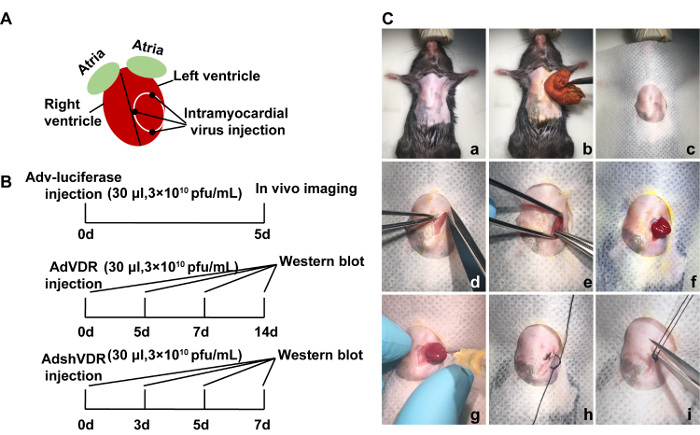
Figure 1. Schema for mouse intramyocardial injection and gene expression detection protocol. (A) Illustration showing three injection sites in the myocardium of the left ventricle. (B) Protocol for gene expression detection in mouse heart after injection of indicated viruses. Adv-luciferase: adenovirus encoding luciferase; AdVDR: adenovirus encoding VDR; AdshVDR, adenovirus encoding shRNA targeting VDR. (C) Representative images showing multiple steps of the modified method for mouse intramyocardial injection. a. Removal of the fur by commercially available depilatory cream. b. Sterilization of the surgical site with 3 scrubs of povidone-iodine. c. Covering the surgical site with a sterile drape. d. 0.5-cm skin incision along the line connecting xiphoid and axilla. e. Blunt dissection of the pectoral major and pectoral minor muscles with forceps and a micro-mosquito hemostat. f. Externalization of the heart. g. Injection of 30 µL adenovirus solution into the myocardium of the left ventricle via the Hamilton syringe. h-i. Closure of the skin by a purse-string suturing with a 5-0 silk suture. Please click here to view a larger version of this figure.
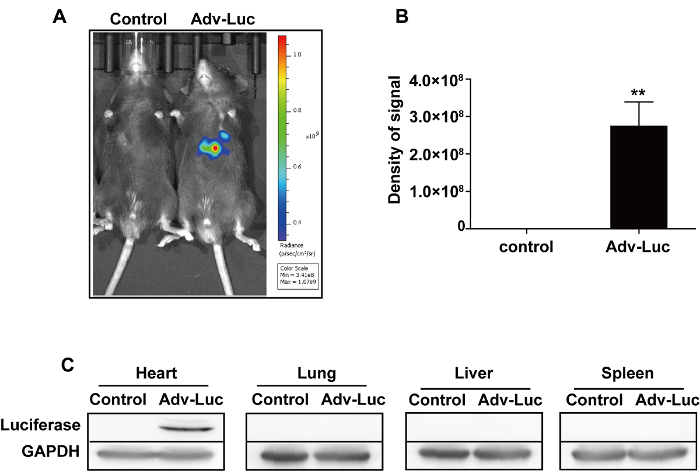
Figure 2. Detection of luciferase expression in heart. (A) Images collected by the imaging system showing the luminescent signal of the heart in control mice and mice injected with adenovirus encoding luciferase on 5 days after injection. (B) Luminescent signal intensities in different groups (n = 3) are subjected to statistical analysis by t test. **p <0.01 versus control mice. (C) Western blot analysis results showing luciferase protein levels in heart, lung, liver, and spleen in indicated groups at 5 days after adenovirus injection (n = 3). Since luciferase expression was only detected in the heart of Adv-luc injected mice, statistical analysis was not performed. Adv-luc: adenovirus encoding luciferase. Please click here to view a larger version of this figure.
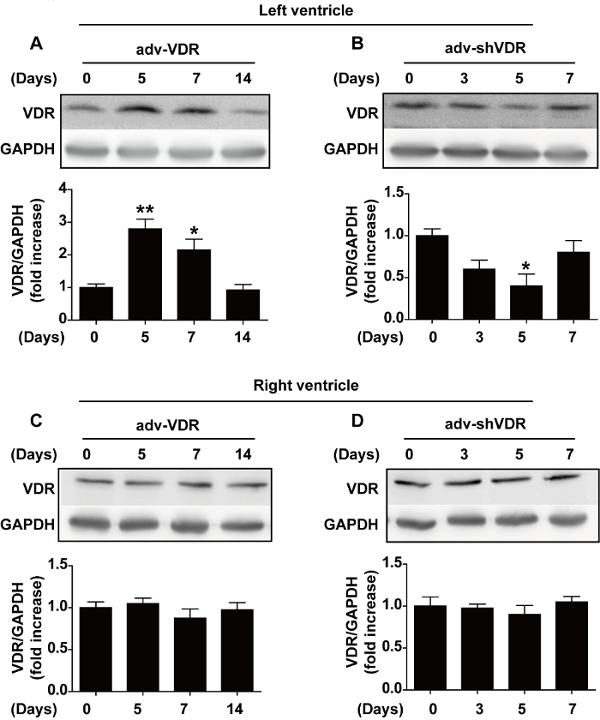
Figure 3. Detection of VDR expression in heart. (A) Top panel: Western blot bands showing VDR levels in the left ventricle (where the adenovirus is injected) at 0 day, 5 days, 7 days, and 14 days after adv-VDR injection. Bottom panel: semi-quantitative analysis of VDR expression levels in different groups (n = 4 per time point). Results were normalized against GAPDH and converted to fold change relative to 0 day. One-way analysis of variance (ANOVA) followed by the Bonferroni post-test (equal variances assumed) or Tamhane post-test (equal variances not assumed) was performed for statistical analysis. *p <0.05 or **p <0.01 versus 0 day. (B) Top panel: Western blot bands showing VDR levels in the left ventricle at 0 day, 3 days, 5 days, and 7 days after adv-shVDR injection. Bottom panel: semi-quantitative analysis of VDR expression levels in different groups (n = 4 per time point). *p <0.05 versus 0 day. (C) Top panel: Western blot bands showing VDR levels in the right ventricle (where the adenovirus is not injected) at 0 day, 5 days, 7 days, and 14 days after adv-VDR injection. Bottom panel: semi-quantitative analysis of VDR expression levels in different groups (n = 4 per time point). (D) Top panel: Western blot bands showing VDR levels in the right ventricle at 0 day, 3 days, 5 days, and 7 days after adv-shVDR injection. Bottom panel: semi-quantitative analysis of VDR expression levels in different groups (n = 4 per time point). Please click here to view a larger version of this figure.
Discussion
The current report demonstrates a modified technique for intramyocardial injection of viral vectors for cardiac gene manipulation, which was modified from a method for myocardial infarction induction by Gao et al.13 Currently, in vivo characterization of specific gene functions most often involve the generation of knockout or transgenic mice3,14,15,16,17, which is expensive, time-consuming, and labor-intensive. Alternatively, delivery of gene vectors or siRNA by systemic or local injection is also widely practiced for gene manipulation in cardiovascular research4,5,7. In particular, intramyocardial injection cannot be substituted for cardiac gene manipulation under certain circumstances: when site directed injection is required (e.g., border zone injection in the myocardial infarction model)11; when duration-restricted gene manipulation is required (e.g., adenovirus injection). Here, we showed that the modified intramyocardial injection method is simple, time-saving, and highly efficient.
Critical Steps Within the Protocol and Troubleshooting:
For successful operation of this protocol, several critical steps should be noted. Before aspirating virus, the air within the Hamilton syringe and the attached needle must be evacuated, otherwise the air injected into the myocardium may cause topical cardiac injury or even death. To further avoid this issue, the ready-to-use Hamilton syringe filled with an adequate virus volume should not be placed with the plunger end downward, because this may spontaneously aspirate air by the gravity of the metal plunger. Anesthesia should be carefully monitored, as deep anesthesia may delay post-operation recovery, and severely deep anesthesia may cause death. After adequate anesthesia, the heart should not be externalized out of the chest cavity by force, since this may result in severe lung injury. Indeed, proper heart externalization requires only a gentle push of the heart, and any resistance may indicate pushing toward the improper direction.
Limitations of the Technique:
The elimination of intubation in this technique, which reduces the time needed for the procedure, suggests that the intramyocardial injection procedure should be finished within a relatively limited time window to avoid death. According to our experience, the heart should not be externalized for more than 30 s, because this increases the death rate and slows post-operative recovery. Therefore, the use of intubation is recommended for the first attempts of the protocol described here. Another limitation is the uneven distribution of viral vectors delivered by this method, which also exists in conventional methods of intramyocardial injection7. Moreover, the method described here is more useful for cardiac-specific gene manipulation in uninjured hearts, which can be followed by the establishment of different cardiac disease models18,19,20,21,22,23. However, the use of the current method in delivering agents to injured hearts such as infarcted hearts may be limited, because these mice may not tolerate the procedure.
Significance with Respect to Existing Methods:
Conventional intramyocardial injection requires intubation and mechanical ventilation24, and makes it difficult to locate the injection site due to the fast mouse heartbeat. These issues significantly prolong the operation time13, thus increasing variations posed by the time delay. The modified technique presented here is quick and allows precise injection site location by manually securing the externalized heart; overall, significantly potentiating subsequent study. Moreover, the elimination of intubation and mechanical ventilation make the modified method accessible to almost any laboratory.
Disclosures
The authors have nothing to disclose.
Acknowledgements
This work was supported by National Science Fund for Distinguished Young Scholars (81625002), National Natural Science Foundation of China (81470389, 81270282, 81601238), Program of Shanghai Academic Research Leader (18XD1402400), Shanghai Municipal Education Commission Gaofeng Clinical Medicine Grant Support (20152209), Shanghai Shenkang Hospital Development Center (16CR3034A), Shanghai Jiao Tong University (YG2013MS42), Shanghai Jiao Tong University School of Medicine (15ZH1003 and 14XJ10019), Shanghai Sailing Program (18YF1413000), and Postgraduate Innovation Program of Bengbu Medical College (Byycx1722). We thank Dr. Erhe Gao for his previous help in our lab.
Materials
| Name | Company | Catalog Number | Comments |
|---|---|---|---|
| Equipments | |||
| Laminar flow sterile hood | Fengshi Animal Experimental Equipment Techonology Co., Ltd. (Soochow, China) | FS-CJ-2F | |
| Centrifuge | Thermo Scientific (Waltham, USA) | 75005282 | |
| Tissue grinding machine | Scientz Biotechnology Co., Ltd. (Ningbo, China) | Scientz-48 | |
| High temperature/high pressure sterilizer | Hirayama (Saitama, Japan) | HVE-50 | |
| Isoflurane vaporizer | Matrix (Orchard Park, USA) | VIP3000 | |
| IVIS Lumina III imaging system | PerkinElmer (Waltham, USA) | CLS136334 | |
| Precision balance | Sartorius (Göttingen, Germany) | 28091873 | |
| Instruments | |||
| Eppendorf pipette (100 µL) | Eppendorf (Westbury, USA) | 4920000059 | |
| Eppendorf pipette (10 µL) | Eppendorf (Westbury, USA) | 4920000113 | |
| Forceps | Shanghai Medical Instruments (Group) Ltd., Corp. | JD4020 | Curved tip |
| Hamilton syringe | Hamilton (Nevada, USA) | 80501 | Volume 50 μL |
| Micro-mosquito hemostat | F.S.T (Foster City, USA) | 13011-12 | Curved, tip width 1.3mm |
| Needle holder | Shanghai Medical Instruments (Group) Ltd., Corp. (Shanghai, China) | J32110 | |
| Surgical scissors | F.S.T (Foster City, USA) | 14002-12 | |
| 1-mL Syringe | WeiGao Group Medical Polymer Co.,Ltd. (ShangDong, China) | ||
| Materials and reagents | |||
| Anti-GAPDH antibody | CST (Danvers, USA) | #2118 | |
| Anti-Luciferase antibody | Abcam (Cambridge, UK) | ab187340 | |
| Anti-rabbit IgG | CST (Danvers, USA) | #7074 | |
| Anti-VDR antibody | Abcam (Cambridge, UK) | ab109234 | |
| Buprenorphine | Thermo Scientific (Waltham, USA) | PA175056 | |
| Chloralic hydras | LingFeng Chemical (ShangHai, China) | ||
| Cryogenic Vials | Thermo Scientific (Waltham, USA) | 375418 | 1.8 mL |
| Depilatory cream | Veet (Shanghai, China) | ||
| Dulbecco's phosphate buffered saline | Gibco (Grand Island, USA) | 14040133 | |
| Entoiodine | LiKang (Shanghai, China) | 310132 | |
| EP tube | Sarstedt (Newton, USA) | PCR001 | |
| Filter | Millipore (Bedford, USA) | Pore size 0.2 µm | |
| Isoflurane | Yipin Pharmaceutical Company (Hebei, China) | ||
| Luciferin | Promega (Madison, USA) | P1041 | |
| Lysis buffer for western blot | Beyotime (Shanghai, China) | P0013J | Without inhibitors |
| Ophthalmic cream | Apex Laboratories ( Melbourne, Australia)) | ||
| PBS | Gibco (Grand Island, USA) | 10010023 | |
| Protease inhibitor cocktail | Thermo Scientific (Waltham, USA) | 78438 | |
| 5-0 silk suture | Shanghai Medical Instruments (Group) Ltd., Corp. (Shanghai, China) | ||
| Steel ball | Scientz Biotechnology Co., Ltd. (Ningbo, China) | Width 1.5 mm | |
| Syringe needle | Kindly Medical Devices Co., Ltd. (Zhejiang, China) | 30 gauge | |
| Warm mat | Warmtact Electrical Heating Technology Co., Ltd. (Guangdong, China ) | NF-GNCW |
References
- Yancy, C. W., et al. 2017 ACC/AHA/HFSA Focused Update of the 2013 ACCF/AHA Guideline for the Management of Heart Failure: A Report of the American College of Cardiology/American Heart Association Task Force on Clinical Practice Guidelines and the Heart Failure Society of America. J Card Fail. 23 (8), 628-651 (2017).
- Pu, J., et al. Cardiomyocyte-expressed farnesoid-X-receptor is a novel apoptosis mediator and contributes to myocardial ischaemia/reperfusion injury. Eur Heart J. 34 (24), 1834-1845 (2013).
- He, B., et al. The nuclear melatonin receptor RORα is a novel endogenous defender against myocardial ischemia_reperfusion injury. J Pineal Res. (3), 313-326 (2016).
- Yao, T., et al. Vitamin D receptor activation protects against myocardial reperfusion injury through inhibition of apoptosis and modulation of autophagy. Antioxid Redox Signal. 22 (8), 633-650 (2015).
- He, Q., et al. Activation of liver-X-receptor alpha but not liver-X-receptor beta protects against myocardial ischemia/reperfusion injury. Circ Heart Fail. 7 (6), 1032-1041 (2014).
- Ding, J., et al. Preparation of rAAV9 to Overexpress or Knockdown Genes in Mouse Hearts. J Vis Exp. (118), (2016).
- Bish, L. T., Sweeney, H. L., Muller, O. J., Bekeredjian, R. Adeno-associated virus vector delivery to the heart. Methods Mol Biol. 807, 219-237 (2011).
- Michael, J., et al. Cardiac gene delivery with cardiopulmonary bypass. Circulation. 104 (2), 131-133 (2001).
- Lei, S., et al. Increased Hepatic Fatty Acids Uptake and Oxidation by LRPPRC-Driven Oxidative Phosphorylation Reduces Blood Lipid Levels. Front Physiol. 7, 270(2016).
- Zhang, H. B., et al. Maintenance of the contractile phenotype in corpus cavernosum smooth muscle cells by Myocardin gene therapy ameliorates erectile dysfunction in bilateral cavernous nerve injury rats. Andrology. 5 (4), 798-806 (2017).
- Virag, J. A., Lust, R. M. Coronary artery ligation and intramyocardial injection in a murine model of infarction. J Vis Exp. (52), (2011).
- Mahmood, T., Yang, P. C. Western blot: technique, theory, and trouble shooting. N Am J Med Sci. 4 (9), 429-434 (2012).
- Gao, E., et al. A novel and efficient model of coronary artery ligation and myocardial infarction in the mouse. Circ Res. 107 (12), 1445-1453 (2010).
- Zhao, Y., et al. Novel protective role of nuclear melatonin receptor RORα in diabetic cardiomyopathy. J Pineal Res. 62 (3), (2017).
- Nduhirabandi, F., Lamont, K., Albertyn, Z., Opie, L. H., Lecour, S. Role of toll-like receptor 4 in melatonin-induced cardioprotection. J Pineal Res. 60 (1), 39-47 (2016).
- Wu, H. M., et al. JNK-TLR9 signal pathway mediates allergic airway inflammation through suppressing melatonin biosynthesis. J Pineal Res. 60 (4), 415-423 (2016).
- de Luxan-Delgado, B., et al. Melatonin reduces endoplasmic reticulum stress and autophagy in liver of leptin-deficient mice. J Pineal Res. (1), 108-123 (2016).
- Scofield, S. L., Singh, K. Confirmation of Myocardial Ischemia and Reperfusion Injury in Mice Using Surface Pad Electrocardiography. J Vis Exp. (117), (2016).
- Cai, B., et al. Long noncoding RNA H19 mediates melatonin inhibition of premature senescence of c-kit(+) cardiac progenitor cells by promoting miR-675. J Pineal Res. 61 (1), (2016).
- Chua, S., et al. The cardioprotective effect of melatonin and exendin-4 treatment in a rat model of cardiorenal syndrome. J Pineal Res. 61 (4), 438-456 (2016).
- Pei, H. F., et al. Melatonin attenuates postmyocardial infarction injury via increasing Tom70 expression. J Pineal Res. 62 (1), (2017).
- Yu, L., et al. Membrane receptor-dependent Notch1_Hes1 activation by melatonin protects against myocardial ischemia-reperfusion injury_ in vivo and in vitro studies. J Pineal Res. 59 (4), 420-433 (2015).
- Yu, L., et al. Melatonin rescues cardiac thioredoxin system during ischemia-reperfusion injury in acute hyperglycemic state by restoring Notch1/Hes1/Akt signaling in a membrane receptor-dependent manner. J Pineal Res. 62 (1), (2017).
- Poggioli, T., Sarathchandra, P., Rosenthal, N., Santini, M. P. Intramyocardial cell delivery: observations in murine hearts. J Vis Exp. (83), e851064(2014).
Reprints and Permissions
