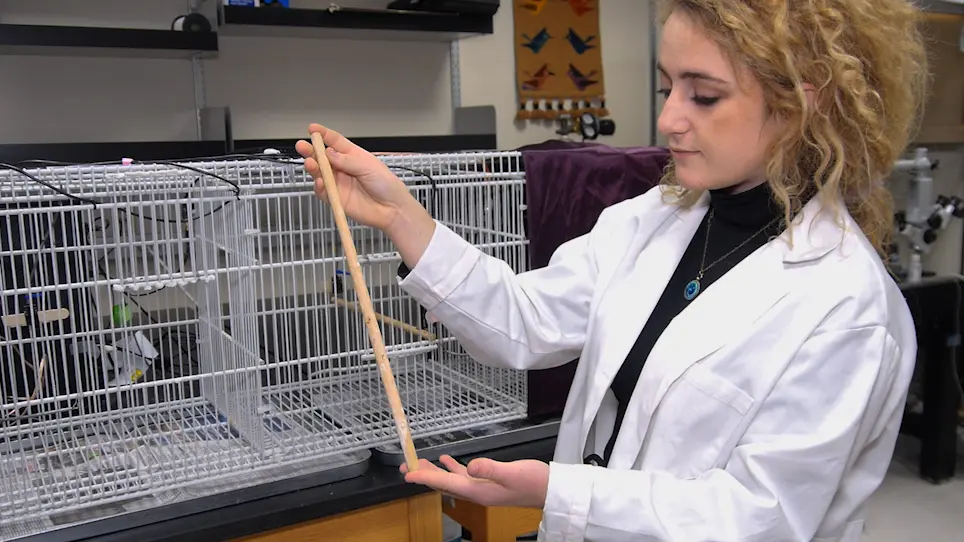
We describe a technique to evaluate song preference in zebra finches. Females are placed in a two-chambered cage and song preference is measured by the number of times she triggers the playback of one song by landing on a perch within one chamber, compared with triggering a different song in the second chamber. Perch landings are counted using infrared sensors.
A subscription to JoVE is required to view this content. Sign in or start your free trial.
Method Article
Operant Conditioning Task to Measure Song Preference in Zebra Finches
In This Article
Erratum Notice
Important: There has been an erratum issued for this article. View Erratum Notice
Summary
Abstract
An operant conditioning paradigm is used to test the song preference of female zebra finches. Finches are placed in a two-chambered cage with a connecting opening and indicate their preference for a song by landing on a perch within each chamber. By interrupting the infrared beam from a photoelectric sensor above each perch, the bird activates the playback of a song through a speaker located on each side of the cage. Freely available software is used to trigger the song playback from each perch. To determine the song preference of each animal, her chamber preference is first identified by triggering no song playback when she lands on each perch. This chamber preference is then compared to her song preference. A minimum activity threshold is set to ensure the preference is real. Using this method, we show that paired females prefer the song of their partner. This method was used to understand the contribution of dopamine to the formation and maintenance of song preference.
Introduction
One of the fundamental questions in biology is how animals form affiliative bonds. In particular, what are the neural mechanisms by which these bonds are made and are these basic mechanisms conserved across vertebrate species? The prairie vole has given clues to some of the neurotransmitter systems that are important for pair-bond formation1,2,3. In particular, dopamine acting through receptors in the nucleus accumbens can induce partner preference in both male and female voles4,5. It is unclear whether the general pr....
Access restricted. Please log in or start a trial to view this content.
Protocol
All experiments were approved by the Institutional Care and Use Committee of the W.M. Keck Science Department, in accordance to NIH guidelines. All animals used were adults (>90 days post hatch).
1. Construction of Operant Conditioning Chamber
- Build a testing cage composed of two identical chambers, 15 x 15 x 17 inch3 each (Figure 1A). Make a small door (as an entrance to each chamber) on the side of the cage near the perches by cutting out a small 4.5 x 6 inch2 window that is 2.5 inchs away from the center of the cage between the chambers. Use a separate p....
Access restricted. Please log in or start a trial to view this content.
Results
Following the protocol, we found that paired females preferred their partner's song (Figure 2A). There was a significant difference between the side chamber preference during silence to that during song playback (t-test corrected for multiple comparisons; p = 0.004; t = 3.35, df = 16). Thus, the female preferentially triggered the song of her partner in comparison to the song of an unfamiliar male.
Females that were paired with an unfamiliar male .......
Access restricted. Please log in or start a trial to view this content.
Discussion
We describe a method to test the song preference of zebra finches. We used this assay to test the preference of a paired female for her partner's song. In addition, the assay was used to test the effect of dopamine on induction of song preference in naive females. This method is relatively inexpensive and was designed and used by undergraduate students, making it an excellent training tool for students. Several other studies have tested song preference in several song species, making this method useful to many investigat.......
Access restricted. Please log in or start a trial to view this content.
Disclosures
The authors have nothing to disclose.
Acknowledgements
We thank Petra Grutzik for construction of the behavioral cage, Dr. Thomas Borowski for help designing the experiment, and Dr. Stephanie White for her generous support. Funding from an HHMI undergraduate summer research grant (HHMI #30052007536 to D.S. and L.H).
....Access restricted. Please log in or start a trial to view this content.
Materials
| Name | Company | Catalog Number | Comments |
|---|---|---|---|
| (-)-Quinpirole | sigmaaldrich | Q102 | |
| acoustic foam | Coulbourn Instruments, Allentown, PA | H10-24A | |
| audio amplifier - 2 channel | Amazon | Pyle PCAU46A | any small audio amplifier should work |
| Banner Engineering Q08 Series, emitter. SO60-Q08 | https://www.alliedelec.com | Stock #:70659809 | photoelectric sensor |
| Banner Engineering Q08 series, receiver. EO60-Q08-AN6X | https://www.alliedelec.com | Stock #:70699384 | photoelectric sensor |
| Car stereo speakers | Amazon | Pioneer TS - F1643R | |
| Digital I/O card | National Instruments | PCI-6503 or USB-6501 | |
| LED lights - under-counter | Amazon | ||
| multifunctional ribbon cable | National Instruments | 180524-20 | |
| sound pressure level meter | Amazon | ||
| terminal block | National Instruments | 777101-1 |
References
- McGraw, L. A., Young, L. J. The prairie vole: an emerging model organism for understanding the social brain. Trends in Neuroscience. 33 (2), 103-109 (2010).
- Young, K. A., Gobrogge, K. L., Liu, Y., Wang, Z. The neurobiology of pai....
Access restricted. Please log in or start a trial to view this content.
Reprints and Permissions
Erratum
Formal Correction: Erratum: Operant Conditioning Task to Measure Song Preference in Zebra Finches
Posted by JoVE Editors on 2/18/2020. Citeable Link.
An erratum was issued for: Operant Conditioning Task to Measure Song Preference in Zebra Finches. An affiliation was updated.
One of the affiliations was updated from:
W.M. Keck Science Department, Clarmont McKenna College – Pitzer College – Scripps College
to:
W.M. Keck Science Department, Claremont McKenna College – Pitzer College – Scripps College