We describe optimized tools to study the zebrafish heart in vivo with light sheet fluorescence microscopy. Specifically, we suggest bright cardiac transgenic lines and present new gentle embedding and immobilization techniques that avoid developmental and heart defects. A possible data acquisition and analysis pipeline adapted to cardiac imaging is also provided.
Method Article
Light Sheet Microscopy of Fast Cardiac Dynamics in Zebrafish Embryos
Opens in a new tab
In This Article
Summary
Loading...
$$\rightleftharpoonup{xx}$$
$$\longleftharp{xx}$$,
$$\longrightharp{xx}$$,
Abstract
Loading...
$$\rightleftharpoonup{xx}$$
$$\longleftharp{xx}$$,
$$\longrightharp{xx}$$,
Embryonic cardiac research has greatly benefited from advances in fast in vivo light sheet fluorescence microscopy (LSFM). Combined with the rapid external development, tractable genetics, and translucency of the zebrafish, Danio rerio, LSFM has delivered insights into cardiac form and function at high spatial and temporal resolution without significant phototoxicity or photobleaching. Imaging of beating hearts challenges existing sample preparation and microscopy techniques. One needs to maintain a healthy sample in a constricted field of view and acquire ultrafast images to resolve the heartbeat. Here we describe optimized tools and solutions to study the zebrafish heart in vivo. We demonstrate the applications of bright transgenic lines for labeling the cardiac constituents and present novel gentle embedding and immobilization techniques that avoid developmental defects and changes in heart rate. We also propose a data acquisition and analysis pipeline adapted to cardiac imaging. The entire workflow presented here focuses on zebrafish embryonic heart imaging but can also be applied to various other samples and experiments.
Introduction
Loading...
$$\rightleftharpoonup{xx}$$
$$\longleftharp{xx}$$,
$$\longrightharp{xx}$$,
To uncover the complex events and interactions in the early beating heart, in vivo imaging of the whole organ is required. With its minimal phototoxicity1,2,3, low photobleaching4, and high speed, light sheet microscopy has evolved as the primary imaging tool for embryonic and cardiac development5,6. It has delivered insights into cardiac form and function at a high spatial and temporal resolution7,8,9 and has allowed researchers to image and track fluorescently labeled parts of the heart at high speed, study hemodynamic forces, and follow the heart development directly inside the body of developing embryos6,10,11,12.
To precisely and reproducibly constrain zebrafish in the field of view, a variety of embedding protocols for light sheet exist, for the short and long term, as well as single or multi-sample13,14,15,16,17,18,19. The most common protocol involves tricaine immobilization and agarose mounting inside a glass or plastic tube. However, as the heart rate can change due to the temperature, anesthetics, and embedding material used20,21,22, zebrafish cardiac imaging requires specific, gentle protocols to ensure sample health6,8,11,12,20,21,22,23. For short-term imaging (up to an hour), one can anesthetize the fish in 130 mg/L tricaine and embed it in Fluorinated Ethylene Propylene (FEP) tubes with 0.1% agarose solution and a plug, as described in Weber et al. 201416. However, as tricaine can lead to developmental defects20,22, different protocols must be used for long-term imaging.
Here we describe a new strategy for long-term cardiac imaging. While many light sheet implementations exist24, we recommend using a hanging sample in a T-SPIM microscope (one detection and two illumination lenses in a horizontal plane with the sample hanging vertically in the common focus). This gives the necessary freedom of movement and rotation for the precise sample positioning. The fish are immobilized by injecting 30 pg α-bungarotoxin mRNA at the one- or two-cell stage. α-bungarotoxin is a snake venom that paralyzes muscles without affecting cardiovascular development or physiology22. For precise, distortion-free imaging, we recommend mounting fish in tubes made of FEP, a polymer with a refractive index almost identical to water. We discuss how to best prepare the FEP tubes by straightening and cleaning them prior to imaging. The fish are then mounted in these tubes, head down, in media, and the bottom of the tube is sealed with a 2% agarose plug, on which fish heads rest. Cutting holes in the FEP tube facilitates gas exchange and ensures fish growth. The embedded fish can be kept in media until mounted onto a sample holder right before imaging. We also suggest a data acquisition and analysis pipeline for reproducible high-speed imaging. Further, we discuss the use of cytoplasmic versus membrane marker transgenic lines for robust heart cell labeling, as well as different options to stop the heart. These mounting techniques ensure sample health while allowing to constrain the heart precisely and reproducibly in the field of view.
Protocol
Loading...
$$\rightleftharpoonup{xx}$$
$$\longleftharp{xx}$$,
$$\longrightharp{xx}$$,
All zebrafish (Danio rerio) adults and embryos were handled in accordance with protocols approved by the UW-Madison Institutional Animal Care and Use Committee (IACUC).
1. Preparation of zebrafish
- Handle zebrafish according to established protocols25,26 and institutional guidelines. Breed adult fish of desired transgenic line (see Discussion). Collect the embryos and keep them at 28 °C in a Petri dish filled with fish medium, e.g., E327.
- Choose a method of immobilization (see Discussion).
- If using α-bungarotoxin mRNA to immobilize the fish, inject 30 pg mRNA22 into the yolk of one- or two-cell stage embryos using a bore glass needle mounted onto a micromanipulator and connected to a picoinjector28.
- If using tricaine, make 0.4% stock solution buffered to pH 7.0-7.4 with 1 M Tris base and store at -20 °C until imaging.
- Keep the eggs in an E3 filled Petri dish at 28 °C and transfer the eggs every 24 h to a new dish with fresh E3 until imaging.
- To prevent pigment formation, if the zebrafish background is not albino, transfer fish at 24 h post-fertilization (hpf) to a new E3 dish with 0.2 mM tyrosinase inhibitor 1- phenyl 2-thiourea (see Discussion).
2. Preparation of FEP tubes
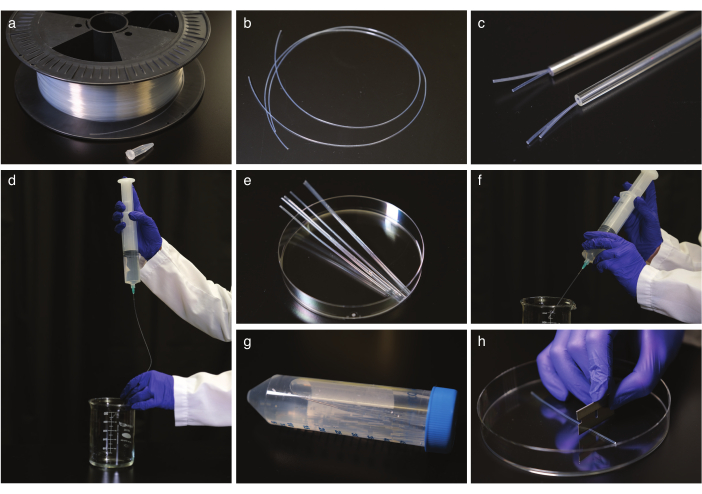
Figure 1: FEP tube cleaning and straightening. (a) FEP tubes on a cable drum. (b) FEP tubes before straightening. (c) FEP tubes in glass and steel autoclave-safe tubing. (d) Flushing of the FEP tubes after straightening and cool down. (e) FEP tube cut to the size of a centrifuge tube for sonication. (f) Flushing of FEP tubes after sonication. (g) Storage of the cleaned and straightened FEP tubes in a centrifuge tube. (h) Cutting the FEP tube prior to imaging. Please click here to view a larger version of this figure.
- Straighten the FEP tubes (Figure 1a,b) by placing them in a glass or steel autoclave-safe tubing (Figure 1c) with the correct inner diameter to fit FEP tubes, usually 1.6 or 2.4 mm, and autoclave to 180 °C for 2 h. Let the tubes cool down at room temperature for at least 5 h. Then, remove from the straightening tubes.
NOTE: Use gloves when manipulating the tubes and work with 50 cm tubing at a time. - Clean the FEP tubes.
NOTE: Syringes with blunt needle tip of the inner FEP tube size are recommended for safety, but a regular needle will work.- Flush the tubes with 1 M NaOH twice with a 50 mL syringe (Figure 1d).
- Cut the FEP tubes to the size of a 50 mL centrifuge tube with a razor blade (Figure 1e), place cut tubes in 0.5 M NaOH filled centrifuge tubes, and ultrasonicate them for 10 min.
- Flush the FEP tubes with double-distilled H2O, then repeat flushing with 70% ethanol (Figure 1f).
- Transfer tubes to 70% ethanol and ultrasonicate for 10 min.
- Flush the tubes with double-distilled H2O and store them in centrifuge tubes in double-distilled H2O (Figure 1g).
3. Preparation of 2% agarose dish
- In a glass flask, dissolve low melting point agarose powder in E3. Heat the solution in a microwave and stir it every 20 s, until all powder is dissolved.
- Pour agarose into a glass or plastic Petri dish to make a 1-2 mm coat. Wait until agarose is solidified.
- To store, gently pour E3 on the top of the agar to prevent drying. Wrap in paraffin film and keep at 4 °C.
4. Preparation of embedding media
- Prepare enough E3 to fill the sample chamber.
NOTE: Avoid using methyl blue if media is in contact with objective lenses. - If using tricaine, thaw stock solution and add 0.02% tricaine to E3.
5. Sample mounting
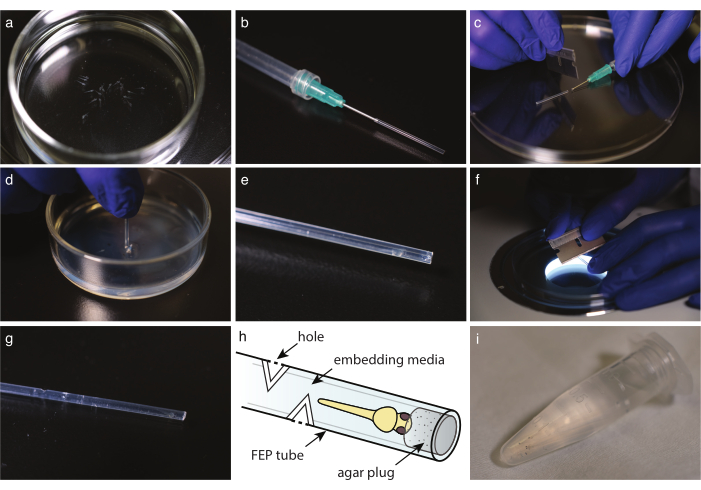
Figure 2: Embryo mounting in FEP tube. (a) Anesthetized pigment-free fish in mounting media. (b) A syringe with blunt end needle and FEP tube attached. (c) Once media and fish are taken up in the FEP tube, cut the tube at the edge of the needle. (d) Dipping the cut tube into a dish coated with 2% agarose to plug its end. (e) A zebrafish in a plugged FEP tube. (f) Gently cut the FEP tube at 30° to create gas-exchange holes. (g) FEP tube with four holes above an embedded zebrafish. (h) Scheme of a zebrafish embedded in an FEP tube. Holes and agar plug are indicated. (i) Multiple embedded zebrafish ready for imaging. Please click here to view a larger version of this figure.
- With a disposable glass pipette, transfer fish to embedding media (Figure 2a). If using tricaine, transfer fish to Petri dish filled with tricaine-containing E3, 10 min before imaging. In both cases, view under a stereomicroscope to verify that the fish stopped moving and that the heart is beating at the similar speed when compared to the control.
- Cut the FEP tube to the ideal length with a razor blade (Figure 1h).
NOTE: The length should be adjusted to the microscope's sample holder; the typical length is about 3 cm. - Prepare a syringe with a blunt end cannula. Fill the syringe with air, then mount the FEP tube onto the needle and gently flush out any remaining water by emptying the syringe (Figure 2b).
NOTE: Avoid making bubbles by slowly flushing out the air. - With the syringe mounted FEP tube, first, take up media to fill the FEP tube, then take up an embryo head down. Keep the fish head as close to the tube end as possible. Avoid making any bubbles; if a bubble is present, discard the sample.
- With a razor blade, carefully cut the FEP tube at the edge of the blunt end cannula or needle (Figure 2c).
- Discard any liquid on the top of the agar-coated dish. Plunge the FEP tube straight into the agar (Figure 2d). Rotate the tube and take it out to release the plug from the agarose bed.
- Under a stereoscope, verify the presence of the agar plug at the end of the tube (Figure 2e).
- For long-term imaging, cut 3-5 holes into the FEP tube at each cardinal direction, at least 5 mm above the end of the fish.
- Under a stereoscope, use a razor blade perpendicular to the axis of the tube to make a 30° incision into the FEP tube until reaching the mounting media (Figure 2f).
- Make a second cut at 180° to create a hole (Figure 2g,h).
- Transfer mounted embryo head down into a 1.5 mL microcentrifuge tube with embedding media until ready to image (Figure 2i).
6. Sample positioning
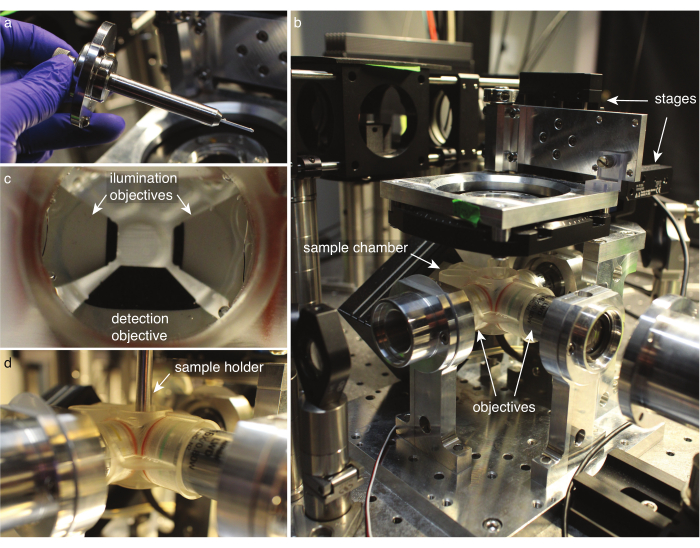
Figure 3: Sample chamber. (a) FEP tube mounted on a sample holder. (b) The sample chamber with stages and objectives. (c) Top view of the media-filled sample chamber, with illumination and detection objective in a T-SPIM configuration. (d) Sample holder mounted on the microscope, with the sample in the chamber. Please click here to view a larger version of this figure.
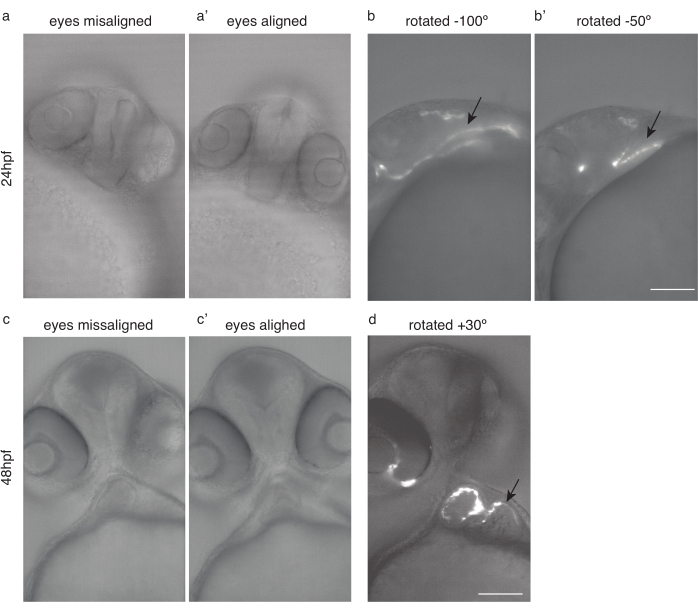
Figure 4: Embryo positioning for heart imaging. (a) 24 hpf Tg(kdrl:Hsa.HRAS-mCherry) zebrafish with eyes misaligned. (a') Same fish, with eyes aligned. (b) Same fish rotated -100 ° and (b') -50 ° for optimal heart imaging. (c) 48 hpf zebrafish with eyes misaligned. (c') Same fish, with eyes aligned. (d) Same fish rotated by 30° for optimal heart imaging. Black arrows point to heart. Scale bar 100 µm. Please click here to view a larger version of this figure.
- At the microscope, mount the FEP tube in the sample holder (Figure 3a) and fill the imaging chamber with embedding media (Figure 3b,c). Next, place the sample holder on the stage with the sample dipping into the chamber (Figure 3d).
- Check the sample's health. Visually assess heart rate to evaluate overall fish wellness, as specific heart rate is stage and temperature dependent, by comparing to non-mounted control fish. If the heartbeat is too slow, discard the fish.
NOTE: Ensure gentle handling of embryos, careful transfer to embedding media, imaging immediately after embedding, avoiding rapid temperature changes, avoiding tricaine, and lowering the exposure time to tricaine. - For reproducible imaging, always use the same sample position. Aligning the eyes and imaging at an angle is recommended.
- Rotate the fish so that both eyes (Figure 4a,c) are in the focal plane (Figure 4a',c')
- From that position, further rotate the fish approximately 50 °-100 ° clockwise for 24 hpf imaging (Figure 4b, b'), and approximately 20°-30° counterclockwise for 48 hpf imaging (Figure 4d).
NOTE: The early heart, before 30 hpf, can be difficult to image due to its hidden position (Figure 4b).
7. Image acquisition
- Choose the illumination side that gives the best image quality and adapt the laser power to every fish.
NOTE: Record the laser power used for subsequent image analysis. - At each z-plane, record 4-5 heartbeats at 300 frames per second (fps) or more.
NOTE: The field of view can be cropped to increase acquisition speed. For example, at 48 hpf the zebrafish heart beats two to three times per second, therefore, at 300 fps, between 300 and 600 frames are required to acquire four to six heartbeats. - To record the beating heart, move the sample stepwise through the light sheet. Use a z-spacing of 1-2 µm, covering the entire depth of the heart.
8. Image processing
- Synchronize recorded movie to reconstruct a 4D (x,y,z, time) heart using a Fiji (Image J229,30) plugin as previously described6.
- To explore data and generate movies of the rendered zebrafish heart, load the 4D file (x,y,z, time) into a 3D rendering software.
Results
Loading...
$$\rightleftharpoonup{xx}$$
$$\longleftharp{xx}$$,
$$\longrightharp{xx}$$,
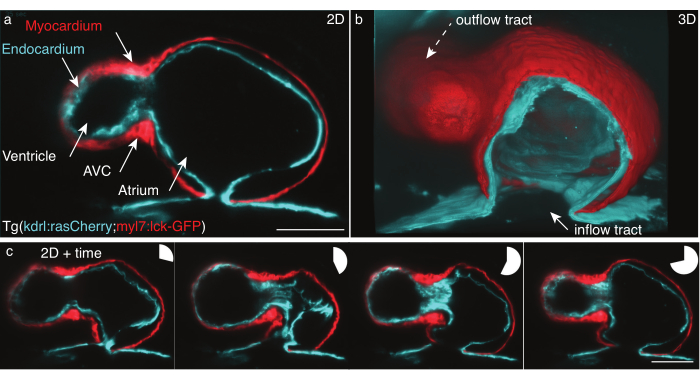
Figure 5: The 48 hpf zebrafish heart. (a) Still of one z-frame, anterior-ventral view of 48 hpf Tg(kdrl:Hsa.HRAS-mCherry; myl7:lck-EGFP) zebrafish, imaged with LSFM, (b) 3D reconstruction of movie stacks, cut view through the atrium. (c) Montage of four frames over a full heartbeat at one z-plane. Pie charts indicate the time during heartbeat. Scale bar 50 µm. Please click here to view a larger version of this figure.
We have recorded the 48 hpf beating heart of Tg(kdrl:Hsa.HRAS-mCherry; myl7:lck-EGFP) zebrafish according to the protocol detailed above (Figure 5). A 488 nm and a 561 nm laser light sheet illuminated the sample simultaneously. The emitted fluorescence was detected perpendicularly using a 16x/0.8 W objective lens and a scientific metal oxide semiconductor (sCMOS) camera.
At 48 hpf, the heart has just undergone looping and has two chambers, the ventricle and the atrium but has yet to develop valves. In our movies, the different heart structures such as inflow tract, ventricle, atrioventricular canal (AVC), atrium, and outflow track are easily distinguishable (Figure 5a,b). These data show the precise beating and reveal complexinteractions between the heart's two cell layers: the myocardium, a single-cell muscle layer contracting and generatingforce (Figure 5c, red), and the endocardium, a single cell layer that connects the heart to the vasculature (Figure 5c, cyan).
The heartbeat reconstruction in x,y,z (3D) + time (4D) + color (5D) was performed according to Mickoleit et al.6. The reconstruction is based on two hypotheses: the motion of the heart is repetitive, and data should be acquired with a small z-step. The output is a reconstructed single heartbeat in 5D, measuring 30 GB to 80 GB per heartbeat. To render the data, we used the free, open-source tool FluoRender for in depth rendering31 as it was designed to handle multidimensional datasets and easily renders 5D movies of both cell layers and individual layers (Figure 5b).
Discussion
Loading...
$$\rightleftharpoonup{xx}$$
$$\longleftharp{xx}$$,
$$\longrightharp{xx}$$,
Transgenic lines to image the heart
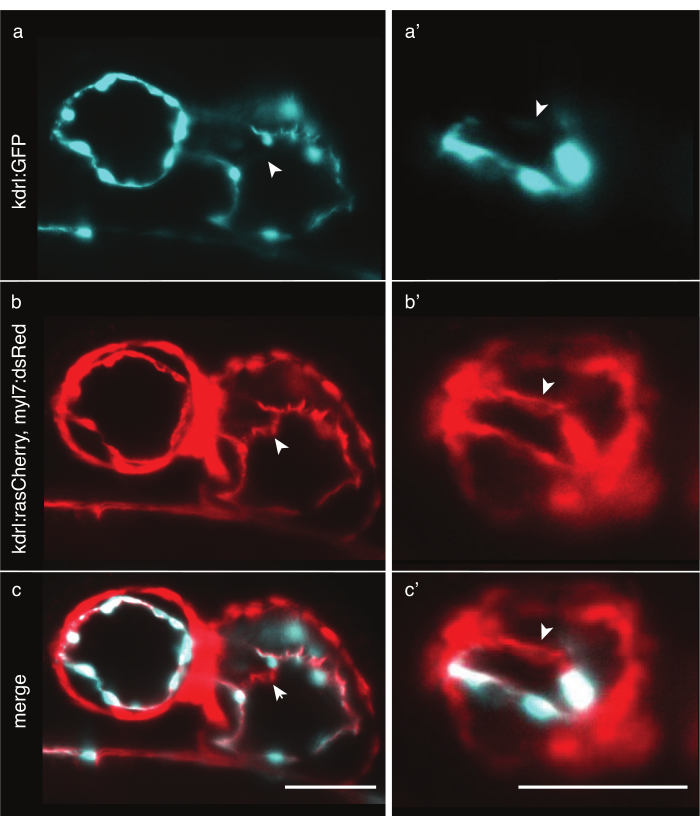
Figure 6: Comparison of cytoplasmic- and membrane-marker zebrafish transgenic lines. Anterior-ventral view of 48 hpf zebrafish hearts imaged with LSFM. White arrows indicate structures visible only with a membrane-marker transgenic line. (a) Tg(kdrl:EGFP)32 signal in cyan in the heart and (a') in the ventricle. (b) Tg(kdrl:Hsa.HRAS-mCherry; myl7:dsRed)33 signal in red in the heart and (b') in the ventricle.( c,c') merge of both Tg(kdrl:Hsa.HRAS-mCherry; myl7:dsRed) and Tg(kdrl:EGFP) signal. Scale bar 50 µm. Please click here to view a larger version of this figure.
Imaging the zebrafish heart requires precise heart-cell labeling. While the myocardial thickness is relatively constant throughout the cells, endocardial cells are thick around the nucleus but have thin membrane protrusions, in some regions thinner than 2 µm. Cytoplasmic transgenic lines such as Tg(kdrl:EGFP)32 effectively label the regions around endocardial nuclei, but further away, the thin cytoplasm might not emit enough photons to be detected with such short exposure times, leading to artificial holes in the data (Figure 6a). In contrast, membrane marker transgenic lines such as Tg(kdrl:Hsa.HRAS-mCherry)33 can effectively label the endocardium and reveal more details (Figure 6b,c). For each experiment, carefully choose the most appropriate transgenic line.
Zebrafish immobilization
The choice of immobilization technique depends on the length of the experiment and the age of the fish to image. Tricaine has commonly been used for zebrafish immobilization, mostly due to its ease of use. Indeed, simply adding 130 mg/L tricaine to the fish media results in their anesthetization in 10 min. As it can lead to developmental defects and affect heart physiology20,22, we recommend using tricaine only for short experiments (less than 30 min). For longer imaging, α-bungarotoxin mRNA injections at the one- or two-cell stage paralyzes fish up to 3 days post fertilization (dpf) without affecting cardiovascular development or physiology22.
Choosing the right FEP tubes
FEP tubes are available in various diameters and thicknesses. To image 0-5 dpf fish, 0.8 mm is a good inner diameter; choose either thick wall 0.8 x 1.6 mm tubes or thin wall 0.8 x 1.2 mm tubes. We recommend thin-walled tubes; however, thicker walls offer increased stability and rigidity, which can be important if the sample chamber has flowing media that could disrupt and move a thin tube. For larger samples, 1.6 x 2.4 mm and 2 x 3 mm can be used.
Temperature and gas exchanges
An essential aspect of the zebrafish embryo's well-being is temperature. Ideally, keep the fish at 28.5 °C while imaging, as the environment's temperature affects development and heart rate34.
In our experience, oxygen exchange through the 2% agarose plug only maintains a stable heart rate until 3-4 dpf. Therefore, cutting holes in the tube ensures oxygen diffusion. It can also be necessary for drug delivery to the sample if desired.
Suspension of heartbeat.
The fast acquisition speeds of appropriately equipped light sheet microscopes allow recording of the beating heart in vivo. However, to acquire an undisturbed z-stack, one can slow down or stop the heart. However, stopping the heart leads to heart muscle relaxation and might result in the collapse of the heart6. Heartbeat suspension can be done by using morpholinos, low temperatures, an inhibitor of muscle contraction or optogenetics. These methods each have their drawbacks and must be carefully evaluated for every experiment.
The injection of 4 ng of silent heart (sih) morpholino at the one cell stage can stop the heartbeat by targeting the gene tnnt2a crucial for sarcomere formation35. sih zebrafish do not have a heartbeat and only survive until 7 dpf, when the embryos start to rely on circulating blood for oxygenation. As heart morphogenesis is driven by both genetic and biomechanical forces36, these fish present heart malformations around 3 dpf.
As the flow of Ca2+ is temperature sensitive, temperature influences heart rate in embryonic zebrafish21. Consequently, lowering the temperature in the imaging chamber slows down the heartbeat. Stopping the heartbeat requires temperatures below 15 °C. As zebrafish are usually kept at 28.5 °C, such low temperatures can only be maintained for brief periods (less than 10 min).
Drugs such as chemical inhibitors of muscle contractions, 2,3-Bu-tanedione 2-monoxime (BDM), can be added to the zebrafish media (50 nM37,38) to suspend the heartbeat temporarily. BDM is convenient to use as it stops heart contraction in under 15 minutes and can be washed away to restore cardiac function. However, as BDM alters the cardiac action potential, it must be used with a caution37.
Finally, the heart of transgenic zebrafish expressing light-gated ion channels or pumps such as channelrhodopsin or halorhodopsin in their myocardium can be manipulated and stopped by illuminating the pacemaker at the inflow tract with light39,7,40,41,9.
Outlook
The presented optimized tools and solutions to study the zebrafish heart in vivo allow long term, gentle imaging of ultrafast cardiac dynamics. The sample embedding can be adapted to suit different imaging modalities, such as confocal microscopy, two-photon microscopy, or optical projection tomography (OPT). Light sheet microscopy, however, is likely the preferred technique that offers optical sectioning at a speed sufficient to capture the dynamics of the heart. While this protocol focuses on zebrafish embryonic heart imaging, we believe that it could also be applied to various other samples and experiments. It will be interesting to see in the future if similar embedding and imaging techniques can also be used at later stages during development when the heart is more hidden and the larva less translucent.
Disclosures
Loading...
$$\rightleftharpoonup{xx}$$
$$\longleftharp{xx}$$,
$$\longrightharp{xx}$$,
The authors have nothing to disclose.
Acknowledgements
Loading...
$$\rightleftharpoonup{xx}$$
$$\longleftharp{xx}$$,
$$\longrightharp{xx}$$,
We thank Madelyn Neufeld for the illustration in Figure 2h. This work was supported by the Max Planck Society, Morgridge Institute for Research, the Chan Zuckerberg Initiative, and the Human Frontier Science Program (HFSP).
Materials
| Name | Company | Catalog Number | Comments |
|---|---|---|---|
| 1.5mL Eppendorf | Eppendorf | 22364111 | To carry embedded samples |
| 15mL Falcon tubes | Falcon | 352095 | To carry embedded samples |
| 50mL centrifuge tubes | Falcon | 352070 | 50ml tubes for sonication step, and storing cleaned, straightened FEP tubes |
| 50mL syringe | BD | 309654 | 50ml syringe for FEP cleaning |
| Agarose, low gelling temperature | Sigma Aldrich | 39346-81-1 | To make plug |
| Blunt Tip Needles, 21 gauge | VWR | 89500-304 | Blunt end needle for 0.8 inner diameter FEP tube |
| Borosilicate glass tube | McMaster-Carr | 8729K33 | Tubing for FEP tube straightening 9.5mm outer diameter, 5.6 inner diameter, 30cm long, other sizes available |
| Borosilicate glass tube | McMaster-Carr | 8729K31 | Tubing for FEP tube straightening 6.35mm outer diameter, 4mm inner diameter, 30cm long, other sizes available |
| Conventional needles, 21 Gauge | BD | 305165 | Conventional needle for 0.8 inner diameter FEP tube |
| Disposable glass pipette | Grainger | 52NK56 | To transfer fish, use with pipette pump |
| E3 medium for zebrafish embryos | |||
| Ethanol | Sigma Aldrich | 64-17-5 | Ethanol for FEP cleaning |
| FEP tube, 0.8 / 1.2 mm | ProLiquid | 2001048 | FEP tube with thin wall, other sizes available |
| FEP tube, 0.8 / 1.6 mm | Bola | S1815-04 | FEP tube with thick wall, other sizes available |
| FEP tube, 2/3mm | BGB | 211581 | Large FEP tube with thick wall, other sizes available |
| Hot Hand Rubber Mitt | Cole-Parmer | 691000 | To carry hot equipment after autoclaving |
| Omnifix 1mL Syringes | B Braun | 9161406V | 1ml syringe for embedding |
| Petri dish, small | Dot Scientific | PD-94050 | To make agarose plug |
| Pipette pumps | Argos Technologies | 04395-05 | To transfer fish, use with disposable glass pipette |
| PTU | Sigma Aldrich | 103-85-5 | Also known as: N-Phenylthiourea, 1-Phenyl-2-thiourea, Phenylthiocarbamide |
| Razor blades | Azpack | 11904325 | To cut FEP tubes |
| Sodium Hydroxide | Dot Scientific | DSS24000 | NaOH for FEP cleaning |
| Tricaine | Sigma Aldrich | E10521 | Also known as: MS-222, Ethyl 3-aminobenzoate methanesulfonate, Tricaine |
References
Loading...
$$\rightleftharpoonup{xx}$$
$$\longleftharp{xx}$$,
$$\longrightharp{xx}$$,
- Controlled light-exposure microscopy reduces photobleaching and phototoxicity in fluorescence live-cell imaging. Nature Biotechnology. 25 (2), 249-253 (2007).">Hoebe, R. A., et al. Controlled light-exposure microscopy reduces photobleaching and phototoxicity in fluorescence live-cell imaging. Nature Biotechnology. 25 (2), 249-253 (2007).
- Comparing phototoxicity during the development of a zebrafish craniofacial bone using confocal and light sheet fluorescence microscopy techniques. Journal of Biophotonics. 6 (11-12), 920-928 (2013).">Jenielita, M., Taormina, M. J., Delaurier, A., Kimmel, C. B., Parthasarathy, R. Comparing phototoxicity during the development of a zebrafish craniofacial bone using confocal and light sheet fluorescence microscopy techniques. Journal of Biophotonics. 6 (11-12), 920-928 (2013).
- Phototoxicity in live fluorescence microscopy, and how to avoid it. BioEssays. 39 (8), 1700003(2017).">Icha, J., Weber, M., Waters, J. C., Norden, C. Phototoxicity in live fluorescence microscopy, and how to avoid it. BioEssays. 39 (8), 1700003(2017).
- Light sheet-based fluorescence microscopy: more dimensions, more photons, and less photodamage. Human Frontier Science Program Journal. 2 (5), 266-275 (2008).">Reynaud, E. G., Kržič, U., Greger, K., Stelzer, E. H. K. Light sheet-based fluorescence microscopy: more dimensions, more photons, and less photodamage. Human Frontier Science Program Journal. 2 (5), 266-275 (2008).
- Light sheet microscopy for real-time developmental biology. Current Opinion in Genetics & Development. 21 (5), 566-572 (2011).">Weber, M., Huisken, J. Light sheet microscopy for real-time developmental biology. Current Opinion in Genetics & Development. 21 (5), 566-572 (2011).
- High-resolution reconstruction of the beating zebrafish heart. Nat Methods. 11 (9), 919-922 (2014).">Mickoleit, M., et al. High-resolution reconstruction of the beating zebrafish heart. Nat Methods. 11 (9), 919-922 (2014).
- Optogenetic control of cardiac function. Science. 330 (6006), 971-974 (2010).">Arrenberg, A. B., Stainier, D. Y., Baier, H., Huisken, J. Optogenetic control of cardiac function. Science. 330 (6006), 971-974 (2010).
- Dynamic structure and protein expression of the live embryonic heart captured by 2-photon light sheet microscopy and retrospective registration. Biomed Optics Express. 6 (6), 2056-2066 (2015).">Trivedi, V., et al. Dynamic structure and protein expression of the live embryonic heart captured by 2-photon light sheet microscopy and retrospective registration. Biomed Optics Express. 6 (6), 2056-2066 (2015).
- Cell-accurate optical mapping across the entire developing heart. eLife. Yelon, D. 6, 28307(2017).">Weber, M., et al. Cell-accurate optical mapping across the entire developing heart. eLife. Yelon, D. 6, 28307(2017).
- In vivo imaging of cardiac development and function in zebrafish using light sheet microscopy. Swiss Medical Weekly. 145, 14227(2015).">Weber, M., Huisken, J. In vivo imaging of cardiac development and function in zebrafish using light sheet microscopy. Swiss Medical Weekly. 145, 14227(2015).
- Cardiac light-sheet fluorescent microscopy for multi-scale and rapid imaging of architecture and function. Science Reports. 6 (1), 1-12 (2016).">Fei, P., et al. Cardiac light-sheet fluorescent microscopy for multi-scale and rapid imaging of architecture and function. Science Reports. 6 (1), 1-12 (2016).
- Continuous addition of progenitors forms the cardiac ventricle in zebrafish. Nature Communication. 9 (1), 1-14 (2018).">Felker, A., et al. Continuous addition of progenitors forms the cardiac ventricle in zebrafish. Nature Communication. 9 (1), 1-14 (2018).
- Science. 305 (5686), New York, NY. 1007-1009 (2004).">Huisken, J., Swoger, J., Del Bene, F., Wittbrodt, J., Stelzer, E. H. K. Optical sectioning deep inside live embryos by selective plane illumination microscopy. Science. 305 (5686), New York, NY. 1007-1009 (2004).
- Life sciences require the third dimension. Current Opinion in Cell Biology. 18 (1), 117-124 (2006).">Keller, P. J., Pampaloni, F., Stelzer, E. H. Life sciences require the third dimension. Current Opinion in Cell Biology. 18 (1), 117-124 (2006).
- Reconstruction of zebrafish early embryonic development by scanned light sheet microscopy. Science. 322 (5904), 1065-1069 (2008).">Keller, P. J., Schmidt, A. D., Wittbrodt, J., Stelzer, E. H. K. Reconstruction of zebrafish early embryonic development by scanned light sheet microscopy. Science. 322 (5904), 1065-1069 (2008).
- Multilayer mounting for long-term light sheet microscopy of zebrafish. Journal of Visualized Experiments. (84), e51119(2014).">Weber, M., Mickoleit, M., Huisken, J. Multilayer mounting for long-term light sheet microscopy of zebrafish. Journal of Visualized Experiments. (84), e51119(2014).
- Dynamic and non-contact 3D sample rotation for microscopy. Nature Communications. 9 (1), 1-7 (2018).">Berndt, F., Shah, G., Power, R. M., Brugués, J., Huisken, J. Dynamic and non-contact 3D sample rotation for microscopy. Nature Communications. 9 (1), 1-7 (2018).
- Multi-sample SPIM image acquisition, processing. and analysis of vascular growth in zebrafish. Development. , 173757(2019).">Daetwyler, S., Günther, U., Modes, C. D., Harrington, K., Huisken, J. Multi-sample SPIM image acquisition, processing. and analysis of vascular growth in zebrafish. Development. , 173757(2019).
- A versatile, multi-laser twin-microscope system for light-sheet imaging. Review of Scientific Instruments. 91 (5), 053703(2020).">Keomanee-Dizon, K., Fraser, S. E., Truong, T. V. A versatile, multi-laser twin-microscope system for light-sheet imaging. Review of Scientific Instruments. 91 (5), 053703(2020).
- Multilayer mounting enables long-term imaging of zebrafish development in a light sheet microscope. Development. 139 (17), Cambridge, England. 3242-3247 (2012).">Kaufmann, A., Mickoleit, M., Weber, M., Huisken, J. Multilayer mounting enables long-term imaging of zebrafish development in a light sheet microscope. Development. 139 (17), Cambridge, England. 3242-3247 (2012).
- Automated high-throughput heartbeat quantification in medaka and zebrafish embryos under physiological conditions. Science Reports. 10 (1), 1-12 (2020).">Gierten, J., et al. Automated high-throughput heartbeat quantification in medaka and zebrafish embryos under physiological conditions. Science Reports. 10 (1), 1-12 (2020).
- Improved long-term imaging of embryos with genetically encoded α-bungarotoxin. PLOS ONE. 10 (8), 0134005-0134015 (2015).">Swinburne, I. A., Mosaliganti, K. R., Green, A. A., Megason, S. G. Improved long-term imaging of embryos with genetically encoded α-bungarotoxin. PLOS ONE. 10 (8), 0134005-0134015 (2015).
- Adaptive prospective optical gating enables day-long 3D time-lapse imaging of the beating embryonic zebrafish heart. Nature Communication. 10 (1), 1-15 (2019).">Taylor, J. M., et al. Adaptive prospective optical gating enables day-long 3D time-lapse imaging of the beating embryonic zebrafish heart. Nature Communication. 10 (1), 1-15 (2019).
- A guide to light-sheet fluorescence microscopy for multiscale imaging. Nature Methods. 14 (4), 360-373 (2017).">Power, R. M., Huisken, J. A guide to light-sheet fluorescence microscopy for multiscale imaging. Nature Methods. 14 (4), 360-373 (2017).
- Zebrafish: A Practical Approach. , Oxford University Press. (2002).">Nüsslein-Volhard, C., Dahm, R. Zebrafish: A Practical Approach. , Oxford University Press. (2002).
- Regular care and maintenance of a zebrafish (Danio rerio) laboratory: An introduction. Journal of Visualized Experiments. (69), e4196(2012).">Avdesh, A., et al. Regular care and maintenance of a zebrafish (Danio rerio) laboratory: An introduction. Journal of Visualized Experiments. (69), e4196(2012).
- E3 medium (for zebrafish embryos). Cold Spring Harbor Protocols. 2011, 66449(2011).">Cold Spring Harbor. E3 medium (for zebrafish embryos). Cold Spring Harbor Protocols. 2011, 66449(2011).
- Microinjection of mRNA and morpholino antisense oligonucleotides in zebrafish embryos. Journal of Visualized Experiments. (27), e1113(2009).">Yuan, S., Sun, Z. Microinjection of mRNA and morpholino antisense oligonucleotides in zebrafish embryos. Journal of Visualized Experiments. (27), e1113(2009).
- Fiji: an open-source platform for biological-image analysis. Nat Methods. 9 (7), 676-682 (2012).">Schindelin, J., et al. Fiji: an open-source platform for biological-image analysis. Nat Methods. 9 (7), 676-682 (2012).
- ImageJ2: ImageJ for the next generation of scientific image data. BMC Bioinformatics. 18 (1), 529(2017).">Rueden, C. T., et al. ImageJ2: ImageJ for the next generation of scientific image data. BMC Bioinformatics. 18 (1), 529(2017).
- www.fluorender.com (2020).">FluoRender. , Available from: www.fluorender.com (2020).
- Cellular and molecular analyses of vascular tube and lumen formation in zebrafish. Development. 132 (23), 5199-5209 (2005).">Jin, S. -W., Beis, D., Mitchell, T., Chen, J. -N., Stainier, D. Y. Cellular and molecular analyses of vascular tube and lumen formation in zebrafish. Development. 132 (23), 5199-5209 (2005).
- Foxn4 directly regulates tbx2b expression and atrioventricular canal formation. Genes and Development. 22 (6), 734-739 (2008).">Chi, N. C., et al. Foxn4 directly regulates tbx2b expression and atrioventricular canal formation. Genes and Development. 22 (6), 734-739 (2008).
- Temperature during embryonic development has persistent effects on thermal acclimation capacity in zebrafish. Proceedings of the National Academy of Sciences. 109 (35), 14247-14252 (2012).">Scott, G. R., Johnston, I. A. Temperature during embryonic development has persistent effects on thermal acclimation capacity in zebrafish. Proceedings of the National Academy of Sciences. 109 (35), 14247-14252 (2012).
- Cardiac troponin T is essential in sarcomere assembly and cardiac contractility. Nature Genetics. 31 (1), 106-110 (2002).">Sehnert, A. J., et al. Cardiac troponin T is essential in sarcomere assembly and cardiac contractility. Nature Genetics. 31 (1), 106-110 (2002).
- Current Topics in Developmental Biology. Wellik, D. M. 132, Academic Press. Chapter 11 395-416 (2019).">Sidhwani, P., Yelon, D. Fluid forces shape the embryonic heart: Insights from zebrafish. Current Topics in Developmental Biology. Wellik, D. M. 132, Academic Press. Chapter 11 395-416 (2019).
- Blebbistatin effectively uncouples the excitation-contraction process in zebrafish embryonic heart. Cell Physiology and Biochemistry. 25 (4-5), 419-424 (2010).">Jou, C. J., Spitzer, K. W., Tristani-Firouzi, M. Blebbistatin effectively uncouples the excitation-contraction process in zebrafish embryonic heart. Cell Physiology and Biochemistry. 25 (4-5), 419-424 (2010).
- following endocardial tissue movements via cell photoconversion in the zebrafish embryo. Journal of Visualized Experiments. (132), e57290(2018).">Chow, R. W. -Y., Lamperti, P., Steed, E., Boselli, F., Vermot, J. following endocardial tissue movements via cell photoconversion in the zebrafish embryo. Journal of Visualized Experiments. (132), e57290(2018).
- Channelrhodopsin-2, a directly light-gated cation-selective membrane channel. Proccedings of the National Academy of Sciences. 100 (24), 13940-13945 (2003).">Nagel, G., et al. Channelrhodopsin-2, a directly light-gated cation-selective membrane channel. Proccedings of the National Academy of Sciences. 100 (24), 13940-13945 (2003).
- Pacing lightly: optogenetics gets to the heart. Nature Methods. 7 (11), 889-891 (2010).">Knollmann, B. C. Pacing lightly: optogenetics gets to the heart. Nature Methods. 7 (11), 889-891 (2010).
- Optogenetic control of heart muscle in vitro and in vivo. Nature Methods. 7 (11), 897-900 (2010).">Bruegmann, T., et al. Optogenetic control of heart muscle in vitro and in vivo. Nature Methods. 7 (11), 897-900 (2010).
Reprints and Permissions
Request permission to reuse the text or figures of this JoVE article
Request Permission