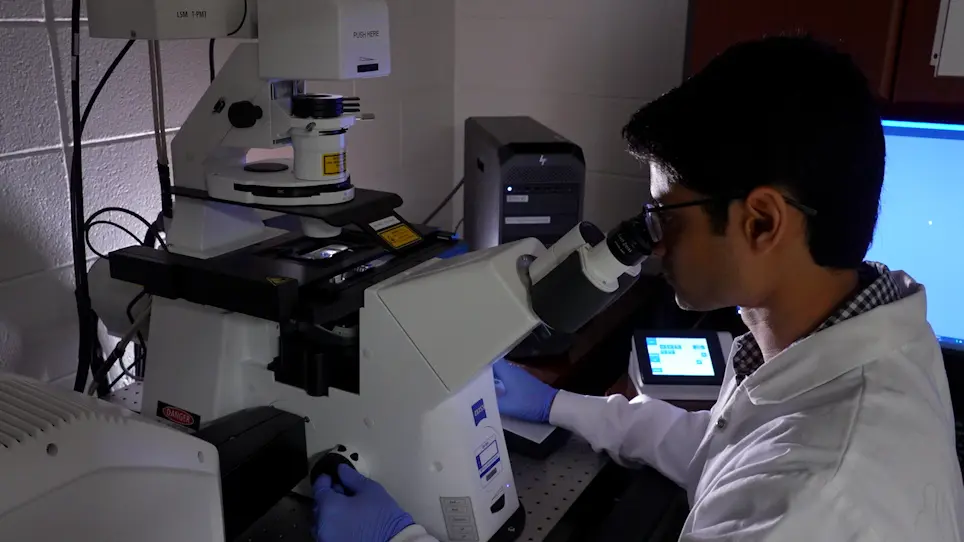
The basement membrane is essential for tissue and organ morphogenesis during development. To better understand the mechanisms leading to proper placement of this structure, the protocol presented describes methods to visualize and characterize the intracellular trafficking and secretion of basement membrane proteins in epithelial cells using confocal and super-resolution microscopy.
A subscription to JoVE is required to view this content. Sign in or start your free trial.
Method Article
Confocal and Super-Resolution Imaging of Polarized Intracellular Trafficking and Secretion of Basement Membrane Proteins During Drosophila Oogenesis
In This Article
Summary
Abstract
The basement membrane (BM) - a specialized sheet of extracellular matrix present at the basal side of epithelial cells - is critical for the establishment and maintenance of epithelial tissue morphology and organ morphogenesis. Moreover, the BM is essential for tissue modeling, serving as a signaling platform, and providing external forces to shape tissues and organs. Despite the many important roles that the BM plays during normal development and pathological conditions, the biological pathways controlling the intracellular trafficking of BM-containing vesicles and how basal secretion leads to the polarized deposition of BM proteins are poorly understood. The follicular epithelium of the Drosophila ovary is an excellent model system to study the basal deposition of BM membrane proteins, as it produces and secretes all major components of the BM. Confocal and super-resolution imaging combined with image processing in fixed tissues allows for the identification and characterization of cellular factors specifically involved in the intracellular trafficking and deposition of BM proteins. This article presents a detailed protocol for staining and imaging BM-containing vesicles and deposited BM using endogenously tagged proteins in the follicular epithelium of the Drosophila ovary. This protocol can be applied to address both qualitative and quantitative questions and it was developed to accommodate high-throughput screening, allowing for the rapid and efficient identification of factors involved in the polarized intracellular trafficking and secretion of vesicles during epithelial tissue development.
Introduction
The basement membrane (BM) is a thin sheet of layered cell-adherent extracellular matrix (ECM) critical for epithelial structure and morphogenesis1. It comprises ~50 proteins and is found ubiquitously underlying the epithelial and endothelial cells, and ensheathing skeletal, smooth, and heart muscle cells and adipocytes1,2,3. The three main components of the BM at the basal side of the epithelial cells are Collagen IV, Perlecan, and Laminins. The BM underlies the epithelial cells and is responsible for many functions, including tissue separation and ba....
Access restricted. Please log in or start a trial to view this content.
Protocol
1. Fly preparation for ovary dissections
- Put 10-15 Drosophila melanogaster female flies (1-2 days old) of the desired genotype in a narrow vial containing ~8 mL of Drosophila fly medium sprinkled with a small amount of granulated baker's yeast 2-3 days prior to dissection at 25 °C. Adding a few males to the vial can boost egg chamber yield. However, ensure that the total number of flies does not exceed 20 as this can negatively affect ovary development.
NOTE: Description of Drosophila males and females, and useful tips and advice for scientists without prior Drosophila experie....
Access restricted. Please log in or start a trial to view this content.
Results
The methods described herein can be used to efficiently and accurately image and characterize the intracellular trafficking and secretion of BM proteins in polarized epithelial cells, such as the FE of the Drosophila ovary. Next, we provide anticipated results obtained using the described methods, as well as helpful advice and potential pitfalls. To do so, Vkg-GFP, an endogenously tagged Vkg (Drosophila Col IV) is used. However, the same results can be achieved with other endogenously tagged BM proteins.......
Access restricted. Please log in or start a trial to view this content.
Discussion
The BM is critical for embryonic and organ morphogenesis, and adult physiological functions. Moreover, the BM acts as a signaling platform for the establishment and maintenance of epithelial polarity and provides tissues with support2. Yet, the mechanisms that regulate the proper placement of BM proteins are poorly understood. A better understanding of the biological pathways dedicated to the intracellular trafficking and polarized secretion of BM proteins requires a careful analysis of the compon.......
Access restricted. Please log in or start a trial to view this content.
Disclosures
The authors have nothing to disclose.
Acknowledgements
The authors are grateful to Julie Merkle for her helpful comments on the manuscript. This work was supported by NIH grant R15GM137236 to O.D. The confocal and super-resolution images were acquired using a Zeiss LSM 900 with Airyscan 2, purchased with NSF MRI grant 2018748.
....Access restricted. Please log in or start a trial to view this content.
Materials
| Name | Company | Catalog Number | Comments |
|---|---|---|---|
| Alexa Fluor 546 phalloidin | Invitrogen | A22283 | F-Actin Stain (1/500 of 66µM) |
| Alexa Fluor 647 phalloidin | Invitrogen | A22287 | F-Actin Stain (1/100 of 66µM)) |
| Anti-GM130 Antibody | abcam | ab30637 | For Golgi Stain (colocalization); use as concentration of 7µg/uL |
| Aqua-Polymount | Polysciences, Inc. | 1860620 | Mounting Medium |
| Bakers Yeast (Active Dry Yeast) | Genesee Scientific | 62-103 | To fatten the overies for dissection |
| Bovine Serum Albumin (30% solution) | Sigma-Aldrich | A7284 | For blocking solution |
| Depression wells | Electron Microscopy Sciences | 7156101 | For dissection (glass concavity slide can be used instead) |
| Dissecting needle | Fisher scientifc | 13-820-024 | |
| Drosophila Incubator | Genesee Scientific/Invictus | ||
| Fly Stock: Perlecan-GFP Drosophila line (ZCL1700) | Morin et al., 2001 | ||
| Fly Stock: UAS-Crag RNAi line (TRIP line HMS00241) | Bloomington Drosophila Stock Center | 33594 | RNAi against Crag |
| Fly Stock: Viking-GFP Drosophila line (CC00791) | Buszczak et al., 2007 | ||
| Fly Stock: Vkg-GFP, tj-Gal4 | Devergne et al., 2017. Drive the expression of Crag RNAi in the FE | ||
| Forceps (Dumont 5) | Fine Science Tools | 11251-30 | For dissection |
| Glass Concavity Slide | Electron Microscopy Sciences | 7187804 | For dissection (depression wells can be used instead) |
| Goat anti-Rabbit IgG, Alexa Fluor 568 | Invitrogen | A11036 | Secondary antibody (GM130 antibody) (5 µg/mL) |
| Hoechst (Hoechst 33342) | Invitrogen | H3570 | DNA Stain (1 ug/mL) |
| Kimwipes | Kimtech | Fisher Scientific: 06-666 | Delicate task wipers |
| Leica Fluorescent Stereo Microscope M165 FC | Leica | For ovary imaging | |
| Microscope Slides | Corning | 294875X25 | Microscope Slides |
| Nutating platform rocker | Corning Life Sciences | 6720 | For ovary fixation and staining |
| Nutri-Fly BF | Genesee Scientific | 66-121 | Fly Food |
| Paraformaldehyde 20% Solution | Electron Microscopy Sciences | Fisher Scientific: 15713 | For PFA 4% |
| Phosphate Buffered Saline Tablets | Fisher scientific | BP2944100 | For PBS solution |
| ProLong Glass Antifade Mountant | Invitrogen | P36980 | Mounting Medium |
| Square Cover Glass | Corning | 285022 | Cover glass for microscope slides |
| Triton x-100 | Sigma-Aldrich | 9036-19-5 | For PBST |
| Zeiss LSM 900 with Airyscan 2 | Zeiss | Confocal and super-resolution Microscope | |
| Zeiss Stemi 305 Stereo Microscope | Zeiss | Dissecting microscope | |
| Zeiss Zen Software version 3.3 (Blue Edition) | Zeiss | Image acquisition and processing |
References
- Halfter, W., et al. New concepts in basement membrane biology. FEBS Journal. 282 (23), 4466-4479 (2015).
- Sekiguchi, R., Yamada, K. M. Basement membranes in development and disease. Current Topics in Developmental Biology. 130, 143-191 (2018).
- Jayadev, R., ....
Access restricted. Please log in or start a trial to view this content.
Reprints and Permissions