This study demonstrates the manufacturing of non-sticky and super-soft vocal fold models by introducing a specific way to create the vocal fold layers, providing a detailed description of the manufacturing procedure, and characterizing the properties of the models.
Method Article
Manufacturing Process for Non-Adhesive Super-Soft Vocal Fold Models
Opens in a new tab
In This Article
Summary
Loading...
$$\rightleftharpoonup{xx}$$
$$\longleftharp{xx}$$,
$$\longrightharp{xx}$$,
Abstract
Loading...
$$\rightleftharpoonup{xx}$$
$$\longleftharp{xx}$$,
$$\longrightharp{xx}$$,
This study aims to develop super-soft, non-sticky vocal fold models for voice research. The conventional manufacturing process of silicone-based vocal fold models results in models with undesirable properties, such as stickiness and reproducibility issues. Those vocal fold models are prone to rapid aging, leading to poor comparability across different measurements. In this study, we propose a modification to the manufacturing process by changing the order of layering the silicone material, which leads to the production of non-sticky and highly consistent vocal fold models. We also compare a model produced using this method with a conventionally manufactured vocal fold model that is adversely affected by its sticky surface. We detail the manufacturing process and characterize the properties of the models for potential applications. The outcomes of the study demonstrate the efficacy of the modified fabrication method, highlighting the superior qualities of our non-sticky vocal fold models. The findings contribute to the development of realistic and reliable vocal fold models for research and clinical applications.
Introduction
Loading...
$$\rightleftharpoonup{xx}$$
$$\longleftharp{xx}$$,
$$\longrightharp{xx}$$,
Vocal fold models are used to simulate and investigate human voice production under normal and pathological conditions1,2. One of the biggest challenges in creating vocal fold models is to achieve a realistic softness and flexibility that closely approximates those of humans. To achieve these properties, silicone elastomers are often used, which are diluted with high amounts of silicone oil to achieve the corresponding elasticity moduli3,4. Another crucial factor in creating realistic vocal fold models is layering, as vocal folds consist of multiple layers of varying softness, which determine the pattern of flow-induced vibration and the frequency at which vibration is possible.
In this study, we created a typical vocal fold model. We used the common geometry provided by Scherer5, which represents typical dimensions for male vocal folds with 17 mm length according to Zhang6 and consists of three layers: one layer for the vocalis muscle (body layer), one for the entire mucosal layer (cover layer), and one for the epithelium. This structure can be seen in the coronal cross-section view in Figure 1.
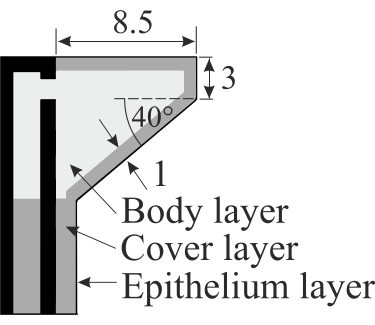
Figure 1: Coronal cross-section of the larynx modules. Coronal cross-section of the larynx modules illustrating the widest width of the vocal folds (8.5 mm). Each vocal fold comprises a body layer, a cover layer, and an epithelium layer. This figure has been modified from13. Reproduced from Häsner, P., Prescher, A., Birkholz, P. Effect of wavy trachea walls on the oscillation onset pressure of silicone vocal folds. J Acoust Soc Am.149 (1), 466-475 (2021) with the permission of the Acoustical Society of America. Please click here to view a larger version of this figure.
Other publications use partially only one layer7, two layers without epithelium layer2 or model the mucosa with multiple layers3. Usually, the layers are cast from the inside out, i.e., starting with the deepest layer. The epithelium, which is very thin with 30 µm thickness, is cast at the end over the entire body to envelop it with a sturdy skin8.
The cover layer in the model is the softest part, with Young's modulus of about 1.1 kPa9. For the body layer, the approximate Young's modulus in the transverse direction using in vitro measurements10 is 2 kPa. In vivo, the Young's modulus of the thyroarytenoid muscle may be higher due to the presence of fibers in the longitudinal direction as well as the possible tensing of the muscle. To achieve this extremely low Young's modulus, it is necessary to add a high amount of silicone oil to the silicone mixture (approximately 72%). However, the manufacturer strongly advises against using an oil proportion greater than 5%. In general, the addition of silicone oil to the elastomer is intended to increase flow and drip time, as well as reduce the shrinkage of the cured silicone polymer. It helps the silicone to cure more uniformly, thereby reducing stress in the material. Its purpose is to optimize the moldability and properties of the cured material, rather than to increase its softness, although this is also a consequence. This is because silicone oil is chemically inert, meaning that it cannot polymerize itself and is not integrated into the network of the silicone polymer11. Instead, it remains as a liquid phase in the polymer matrix, weakening the polymer structure at higher levels and potentially causing it to dissolve out of the cured material and adhere to the surface. As a result, other negative properties such as curing disorders, uneven vulcanization, chemical shrinkage, and brittleness are possible. Vocal fold models with high silicone oil contents were investigated with regard to aging and reproducibility, and it was found that there is a high variability in the properties of different models and a change in their properties over time11.
When producing vocal fold models in the conventional way7,12, the stickiness of the epithelial layer can be a problem as it can affect the homogeneity of vibration and lead to rupture of the epithelium. Although the silicone used to make the epithelium is undiluted, it can be assumed that the oil that leaks from the neighboring mucosa layer has similar effects on the silicone as if it had been diluted. The problem of stickiness was addressed by adding various powders such as talcum or carbon powder as an intermediate layer between the mucosa and the epithelial layer12. This approach may have been successful because the oil was partially absorbed by the powder and, as a result, the stickiness of the epithelial surface could be reduced.
In this publication, we show that the problem of stickiness can be circumvented by a slight modification of the process of vocal fold manufacturing. By changing the order of layering and starting with the undiluted epithelial silicone (so-called closed silicone), non-sticky super-soft vocal fold models can be produced. This change involves unusual types of molds and methods that are best presented and explained in the form of a video. In this paper, we describe our manufacturing process in detail and demonstrate how the properties of the vocal fold models can be characterized in an application.
Protocol
Loading...
$$\rightleftharpoonup{xx}$$
$$\longleftharp{xx}$$,
$$\longrightharp{xx}$$,
1. Design of the vocal fold models and 3D printing of parts
- Create a multi-layered representation of the common M5 geometry of silicone vocal folds using various soft silicone materials. Design the individual parts using computer-aided design (CAD) software. Check the Supplementary Coding File 1, Supplementary Coding File 2, Supplementary Coding File 3, Supplementary Coding File 4, Supplementary Coding File 5, Supplementary Coding File 6, Supplementary Coding File 7, Supplementary Coding File 8 for details. The files are named according to their function in the model and serve as the foundation for the subsequent steps.
- Compile and organize the necessary files for each step in step 2. Refer to the list of required parts and their quantities in Supplementary Figure 1. See a schematic depiction of mold assembly in Supplementary Figure 2.
- Load the STL files into a 3D printing program to generate G-code files that can be read by the 3D printer.
- Prepare the materials (see Table of Materials) for the 3D print.
- For Supplementary Coding File 2 and Supplementary Coding File 5, use a material that causes less visible layer lines, such as polylactic acid (PLA+) or PC.
- For Supplementary Coding File 1, use a harder material such as Tough PLA or Polyethylene terephthalate glycol (PETG) due to its susceptibility to bending stresses. No further restrictions on the choice of printing material apply to the remaining parts.
- Adjust the settings of the 3D printing software for the corresponding selected 3D printer.
- For Supplementary Coding File 2 and Supplementary Coding File 5, set a maximum layer height of 0.1 mm.
- For Supplementary Coding File 1, set the infill value to 100% and the print pattern to ZigZag to achieve better stability. Also, set the build plate adhesion category to Skirt instead of Brim, because the geometry of the parts would make it considerably more difficult to remove the brim.
- For the other parts, use the default settings and layer heights of 0.2 mm.
- Print the mentioned parts on the 3D printer. Clean the parts and remove any excess material such as brim or printing errors. Smooth the inner contact surfaces with sandpaper (equal or finer than P1000 recommended).
2. Fabrication of the vocal fold models
- Gather the following parts and materials for creating the body layer: vocal-fold-positiv (2x), vocalis_mold-cap, vocalis_mold-main-part, vocalis_mold-hull, primary silicone, release agent, and thinner (See Table of Materials for details).
- Apply some release agent to the inside surfaces of all the mold parts.
- Assemble the main part and cap of the mold over the positive and place the mold package in the designated pot. Correct the alignment of the two mold parts if necessary. Ensure the hole in the positive for pouring the silicone faces upwards, and the mold has a stable footing on a flat surface.
- Create a mixture of the primary silicone with three parts of thinner (1:1:3), begin by combining component A with the thinner, and subsequently adding component B. Thoroughly mix the components. A total amount of 6 g of silicone mixture is sufficient for casting the body layer from two vocal fold halves.
- Vacuum the silicone mixture in a vacuum chamber at a minimum of -1 bar sub pressure to prevent air bubbles from forming in the cured silicone body.
- Carefully pour the vacuumed silicone mixture into the mold cavity until it appears filled. Fill the surrounding areas of the mold pot to prevent the very thin silicone mixture from sinking through the mold joints. Check the silicone level during the dripping time and add more if necessary. The drip time for this mixture is between 1-2 h.
- After a curing time of about 1 day, but at least 8 h, remove the mold, including the positive, from the pot. Remove the silicone between the mold and the pot before opening the mold.
- When opening the mold, first carefully remove the lid starting from the back of the positive. Then, remove the main body of the mold. Carefully remove any excess silicone using a scalpel or a side cutter.
- Prepare the musosa_mold-back, musosa_mold-main-part, and musosa_mold-hull parts, as well as the secondary silicone and release agent for the production of the epithelium layer. (See Table of Materials).
NOTE: Steps 2.1 and 2.2 (body and epithelium layer) can be completed simultaneously.- Assemble the two mold parts and place them in the hull. Prepare the inside of the mold with some release agent, ensuring that the inner walls are coated according to the usage instructions of the respective release agent. Allow the component to air-dry briefly before proceeding.
- Mix a batch of the secondary silicone without using thinner (1:1:0). If air bubbles have been introduced into the silicone mixture while mixing, degas the mixture as in step 2.1.4.
NOTE: Be aware of the short drip time of this mixture, which is about 15 min. - Pour some of the mixture into the mold and swirl it around (leaving the mold in the hull) until all interior surfaces are coated with silicone.
- Turn the mold over and let excess silicone drain out. Secure the mold in this position over a mesh, grate, or at an angle that allows further silicone drainage.
- Prevent the formation of overhangs in the silicone during the curing process by regularly smoothing it out, especially in the area where the air channel will be located.
NOTE: These can also be carefully removed later with pliers.
- Prepare for the production of the mucosa intermediate layer by preparing the positive with the vocalis silicone layer from step 2.1, the mold prepared with the epithelium layer from step 2.2, and the silicone and thinner as listed in Table of Materials.
- Create a mixture of the primary silicone with five parts of thinner (1:1:5), begin by combining component A with the thinner, and subsequently adding component B. Thoroughly mix the components. A total amount of 4 g of silicone mixture is sufficient.
- Vacuum the silicone mixture in a vacuum chamber as in step 2.1.4.
- Fill a portion of the silicone mixture into the mucosa mold with the prepared epithelial silicone. Tilt the mold until all interior surfaces of the epithelial silicone are covered with a thin layer of oil to facilitate insertion of the positive.
NOTE: Optional: Due to the high proportion of diluent, the mixture has a long drip time of several hours during which the mixture can shrink through evaporation. Therefore, wait about 2-3 h before proceeding with the next steps. - Carefully insert the positive with the vocal body into the mold. Secure the positive in the mold, for example with a clamp, if the positive floats up on the silicone. Depending on the amount of silicone previously added, it may escape at the filling points.
- Fill the mold in the same way as for the casting of the vocalis layer and top up accordingly if the material sinks.
- Wait 24 h after the drip time has ended for the silicone to completely cure.
- After 24 h, remove the body from the mold. First, remove the mold from the shell. Then, starting with the rear section, open the mold and remove the main part of the mold as well.
- Carefully remove any excess silicone, wash the surface and let the body dry.
- Mount the two vocal fold halves at the designated locations on the measurement and assembly module in Supplementary Coding File 8. The connection was designed for two M3 screws and M3 square nuts (DIN 562), but they are not mandatory.
Results
Loading...
$$\rightleftharpoonup{xx}$$
$$\longleftharp{xx}$$,
$$\longrightharp{xx}$$,
The fabricated vocal fold model was integrated into the measurement setup depicted in Supplementary Figure 3 at the vocal folds position. The setup, extensively detailed in a previous publication13, comprises a multi-stage controllable airflow source that stimulates the vocal fold models into oscillation, along with an array of measuring instruments that record data such as sound pressure, static pressure at specific positions, and volume velocity. For the measurements, the airflow gradually increased until the vocal fold model began to oscillate. Subsequently, the air pressure was elevated by 200 Pa above the onset pressure to achieve a stable and robust oscillation. An additional high-speed camera was added and placed above the vocal tract model, capturing the vocal fold oscillation movements at a maximum frame rate of 2304 frames per second.
A lamp integrated within the lung emits light through the subglottal tract, causing the glottis to appear white. Figure 2 depicts two series of oscillation images, each consisting of six frames, illustrating a typical close-open-close cycle. The upper row (Figure 2A) displays the oscillation of vocal folds manufactured using the presented method, while the lower row (Figure 2B) demonstrates an extreme example of a conventional vocal fold model, created during the preliminary work13, incapable of generating stable oscillation due to its sticky surface. For the latter, the surface stickiness causes the glottis to open at the anterior and posterior ends first, and the central part opens later. The model's surface is already slightly damaged at a specific point due to adhesion.
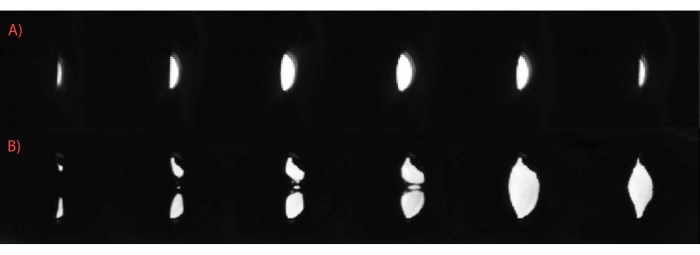
Figure 2: Sequence of individual frames captured by the high-speed camera. Sequence of individual frames captured by the high-speed camera, showcasing a close-open-close cycle of vocal fold vibration. (A) Vocal folds fabricated using the presented method. (B) Vibration of a conventional vocal fold model with sticky surface. Please click here to view a larger version of this figure.
Figure 3 and Figure 4 show the time functions of the glottal area of the proposed model and the conventional (sticky) model, respectively. The area waveform (left part in each of the figures) was computed using the GlottalImageExplorer software14 from the available image sequences. The right parts of the figures show the magnitude spectra of the time functions to indicate their degree of periodicity. The fundamental frequency was extracted from the time functions using the Praat software15. It is evident from Figure 3 that the proposed vocal fold model shows a stable oscillation over the selected duration, enabling the accurate calculation of the fundamental frequency. In contrast, Figure 4 displays an atypical and chaotic glottal area function with inconsistent minima and maxima, along with various artifacts. The extraction of the fundamental frequency becomes challenging or even unfeasible in this scenario.
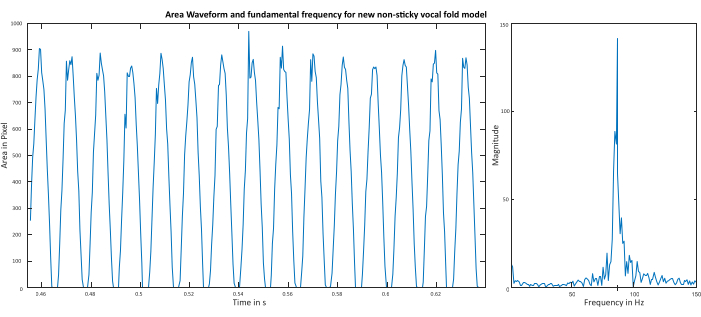
Figure 3: Area waveform for a vocal fold model fabricated using the presented method. Representation of the area waveform obtained from the high-speed camera image data using (A) the GlottalImageExplorer, as well as (B) the derived magnitude spectrum for a vocal fold model fabricated using the presented method. Please click here to view a larger version of this figure.
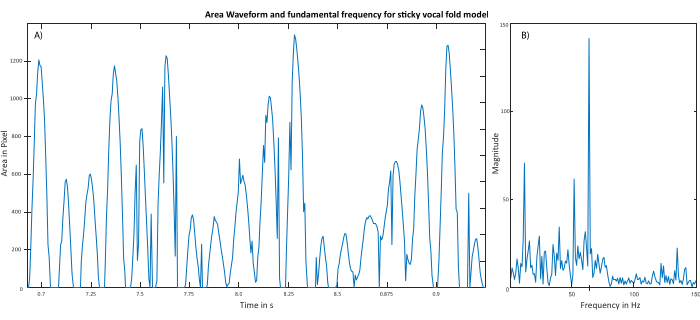
Figure 4: Area waveform for a vocal fold model with sticky surface. Representation of the area waveform obtained from the high-speed camera image data using (A) GlottalImageExplorer, as well as (B) the magnitude spectrum using a conventional vocal fold model with sticky surface. Please click here to view a larger version of this figure.
Supplementary Figure 1: List of essential components for manufacturing a vocal fold half. List of essential components for manufacturing a vocal fold half. 1 - Support structures for one vocal fold half, 2a-c - Mold components for crafting the body layer, 3a-c - Mold components for crafting the cover layer, 4 - Support structures for attachment. Please click here to download this File.
Supplementary Figure 2: Schematic depiction of mold assembly. Schematic depiction of mold assembly. Left - Mold for creating the body layer, Right - Mold for creating the cover layer. Labels correspond to the parts list in Supplementary Figure 1. Please click here to download this File.
Supplementary Figure 3: Complete setup of the measurement system. Complete setup of the measurement system. This figure has been modified from13. Reproduced from Häsner, P., Prescher, A., Birkholz, P. Effect of wavy trachea walls on the oscillation onset pressure of silicone vocal folds. J Acoust Soc Am.149 (1), 466-475 (2021) with the permission of the Acoustical Society of America. Please click here to download this File.
Supplementary Coding File 1: Support structures for one vocal fold half. This is the file to produce vocal-fold-positiv. Please click here to download this File.
Supplementary Coding File 2: Mold component 1 for crafting the body layer. This is the file to produce vocalis_mold-main-part. Please click here to download this File.
Supplementary Coding File 3: Mold component 2 for crafting the body layer. This is the file to produce vocalis_mold-cap. Please click here to download this File.
Supplementary Coding File 4: Mold hull for crafting the body layer to avoid leakage of silicone. This is the file to produce vocalis_mold-hull. Please click here to download this File.
Supplementary Coding File 5: Mold component 1 for crafting the cover layer. This is the file to produce mucosa_mold-main-part. Please click here to download this File.
Supplementary Coding File 6: Mold component 2 for crafting the cover layer. This is the file to produce mucosa_mold-back. Please click here to download this File.
Supplementary Coding File 7: Mold hull for crafting the cover layer to avoid leakage of silicone. This is the file to produce mucosa_mold-hull. Please click here to download this File.
Supplementary Coding File 8: Support structures for attaching the vocal fold halves. This is the file to produce measurement-pressure-tap-adapter. Support structures for attaching the vocal fold halves including pressure measuring tap. Please click here to download this File.
Discussion
Loading...
$$\rightleftharpoonup{xx}$$
$$\longleftharp{xx}$$,
$$\longrightharp{xx}$$,
The manufacturing process presented here involves critical steps that significantly impact its success. Firstly, it should be noted that the presented manufacturing process does not solve the problem of oil saturation in the vocal fold body material but rather circumvents certain negative side effects. The outgassing and the associated shrinkage and surface waviness still persist, albeit to a lesser extent. A solution to these problems would involve the use of an ultra-soft silicone or alternative material that combines the elasticity modulus of real vocal folds with a stable and durable polymer structure. However, the absence of such a material underscores the ongoing limitations in achieving a comprehensive resolution to these issues.
The manufacturing process is somewhat more complex than conventional manufacturing methods for vocal fold models consisting of two halves, as it involves more components, and the usual inside-out assembly approach is not applicable here. Inherent advantages include the integrated overflow protection, which facilitates working with highly diluted silicone, and the ability to better observe and react to the filling level and potential bubble formation during the curing process. This is helpful when aiming to minimize manufacturing-induced variations in the properties of models in a small series produced with the same silicone mixtures. Furthermore, it reduces the reject rate.
In comparison to conventional vocal fold modeling, the presented technique offers distinct advantages. With video recordings of the glottal area during oscillation, it was demonstrated that the stickiness of the vocal fold surface could be reduced. As a result, stable flow-induced oscillations could be generated, and clean, artifact-free waveform data could be obtained from the images without the need for aids such as talcum powder or washes before measurement. While the presented conventional model (as the reference) is an extreme example, stickiness is nonetheless an issue for measurements and a risk to the fragile thin epithelium layer. The presented engineering solution can circumvent this problem and contributes to more reliable and reproducible results.
Looking forward, the modified manufacturing process holds promise for diverse applications. The technique's suitability for producing humanoid robots or speech apparatuses with human-like vocal tracts16 opens avenues for advancements in artificial intelligence and robotics. Furthermore, its application in fundamental research on speech generation and voice production6,17 signifies its potential contribution to the broader scientific community.
Disclosures
Loading...
$$\rightleftharpoonup{xx}$$
$$\longleftharp{xx}$$,
$$\longrightharp{xx}$$,
The authors declare that they have no known competing financial interests or personal relationships that could have appeared to influence the work reported in this paper.
Acknowledgements
Loading...
$$\rightleftharpoonup{xx}$$
$$\longleftharp{xx}$$,
$$\longrightharp{xx}$$,
This project has been supported by the German Research Foundation (DFG), grant no. BI 1639/9-1.
Materials
| Name | Company | Catalog Number | Comments |
|---|---|---|---|
| 3D Printer | ULTIMAKER | Type S5 | |
| 3D Printing software | ULTIMAKER CURA | Version 5.2.2 | |
| CAD Software | Autodesk Inventor | Version 2023 | |
| High Speed Camera | XIMEA GmbH | MQ013CG-ON | |
| PLA+ 3D Printer Material | eSun | none | white |
| Primary silicone | KauPo Plankenhorn | 09301-005-000041 | EcoFlex 00-30 |
| Release Agent | KauPo Plankenhorn | 09291-006-000001 | UTS Universal |
| Secondary silicone | KauPo Plankenhorn | 09301-005-000181 | DragonSkin NV10 |
| Silicone Thinner | KauPo Plankenhorn | 09301-010-000002 | |
| Tougth PLA 3D Printer Material | BASF | black |
References
Loading...
$$\rightleftharpoonup{xx}$$
$$\longleftharp{xx}$$,
$$\longrightharp{xx}$$,
- Influence of supraglottal structures on the glottal jet exiting a two-layer synthetic, self-oscillating vocal fold model. J Acoust Soc Am. 123 (6), 4434-4445 (2008).">Drechsel, J. S., Thomson, S. L. Influence of supraglottal structures on the glottal jet exiting a two-layer synthetic, self-oscillating vocal fold model. J Acoust Soc Am. 123 (6), 4434-4445 (2008).
- Validating Stereo-endoscopy with a synthetic vocal fold model. Acta Acustica United with Acustica. 102 (4), 745-751 (2016).">Stevens, K. A., Shimamura, R., Imagawa, H., Sakakibara, K. I., Tokuda, I. T. Validating Stereo-endoscopy with a synthetic vocal fold model. Acta Acustica United with Acustica. 102 (4), 745-751 (2016).
- Synthetic, multi-layer, self-oscillating vocal fold model fabrication. J Vis Exp. (58), e3498(2011).">Murray, P. R., Thomson, S. L. Synthetic, multi-layer, self-oscillating vocal fold model fabrication. J Vis Exp. (58), e3498(2011).
- Determination of superior surface strains and stresses, and vocal fold contact pressure in a synthetic larynx model using digital image correlation. J Acoust Soc Am. 123 (2), 1089-1103 (2008).">Spencer, M., Siegmund, T., Mongeau, L. Determination of superior surface strains and stresses, and vocal fold contact pressure in a synthetic larynx model using digital image correlation. J Acoust Soc Am. 123 (2), 1089-1103 (2008).
- Intraglottal pressure profiles for a symmetric and oblique glottis with a divergence angle of 10 degrees. J Acoust Soc Am. 109 (4), 1616-1630 (2001).">Scherer, R. C., et al. Intraglottal pressure profiles for a symmetric and oblique glottis with a divergence angle of 10 degrees. J Acoust Soc Am. 109 (4), 1616-1630 (2001).
- Mechanics of human voice production and control. J Acoust Soc Am. 140 (4), 2614-2635 (2016).">Zhang, Z. Mechanics of human voice production and control. J Acoust Soc Am. 140 (4), 2614-2635 (2016).
- Studientexte zur Sprachkommunikation: Elektronische Sprachsignalverarbeitung. , TUD Press. Dresden, Germany. 58-66 (2017).">Birkholz, P., Wang, L. Studientexte zur Sprachkommunikation: Elektronische Sprachsignalverarbeitung. , TUD Press. Dresden, Germany. 58-66 (2017).
- Flow-induced responses of normal, bowed, and augmented synthetic vocal fold models. , Brigham Young University. (2011).">Murray, P. R. Flow-induced responses of normal, bowed, and augmented synthetic vocal fold models. , Brigham Young University. (2011).
- Measurement of vocal folds elastic properties for continuum modeling. J Voice. 26 (6), e21-29 (2012).">Alipour, F., Vigmostad, S. Measurement of vocal folds elastic properties for continuum modeling. J Voice. 26 (6), e21-29 (2012).
- Measurement of young's modulus of vocal folds by indentation. J Voice. 25 (1), 1-7 (2011).">Chhetri, D. K., Zhang, Z., Neubauer, J. Measurement of young's modulus of vocal folds by indentation. J Voice. 25 (1), 1-7 (2011).
- Reproducibility and aging of different silicone vocal folds models. J Voice. , (2023).">Häsner, P., Birkholz, P. Reproducibility and aging of different silicone vocal folds models. J Voice. , (2023).
- Studientexte zur Sprachkommunikation: Elektronische Sprachsignalverarbeitung. , TUD Press. Dresden, Germnay. 221-230 (2019).">Gabriel, F., Häsner, P., Dohmen, E., Borin, D., Birkholz, P. Studientexte zur Sprachkommunikation: Elektronische Sprachsignalverarbeitung. , TUD Press. Dresden, Germnay. 221-230 (2019).
- Effect of wavy trachea walls on the oscillation onset pressure of silicone vocal folds. J Acoust Soc Am. 149 (1), 466-475 (2021).">Häsner, P., Prescher, A., Birkholz, P. Effect of wavy trachea walls on the oscillation onset pressure of silicone vocal folds. J Acoust Soc Am. 149 (1), 466-475 (2021).
- Studientexte zur Sprachkommunikation: Elektronische Sprachsignalverarbeitung. , TUD Press. Dresden, Germany. (2016).">Birkholz, P. Studientexte zur Sprachkommunikation: Elektronische Sprachsignalverarbeitung. , TUD Press. Dresden, Germany. (2016).
- Praat, a system for doing phonetics by computer. Glot. Int. 5, 341-345 (2001).">Boersma, P., Weenink, D. Praat, a system for doing phonetics by computer. Glot. Int. 5, 341-345 (2001).
- Mechanical vocal cord model for anthropomorphic talking robot based on human biomechanical structure. Trans Japan Soc Mech Eng Ser C. 73 (734), 2750-2756 (2007).">Fukui, K., Shintaku, E., Honda, M., Takanishi, A. Mechanical vocal cord model for anthropomorphic talking robot based on human biomechanical structure. Trans Japan Soc Mech Eng Ser C. 73 (734), 2750-2756 (2007).
- Electrically conductive synthetic vocal fold replicas for voice production research. J Acoust Soc Am. 142 (1), 63(2017).">Syndergaard, K. L., Dushku, S., Thomson, S. L. Electrically conductive synthetic vocal fold replicas for voice production research. J Acoust Soc Am. 142 (1), 63(2017).
Reprints and Permissions
Request permission to reuse the text or figures of this JoVE article
Request Permission