We developed an accelerated social defeat stress model for adolescent C57BL/6 mice, which works in both males and females and allows exposure during discrete adolescent periods. Exposure to this model induces social avoidance, but only in a subset of defeated male and female mice.
A subscription to JoVE is required to view this content. Sign in or start your free trial.
Method Article
Social Defeat Stress Model for Adolescent C57BL/6 Male and Female Mice
In This Article
Summary
Abstract
Social adversity in adolescence is prevalent and can negatively impact mental health trajectories. Modeling social stress in adolescent male and female rodents is needed to understand its effects on ongoing brain development and behavioral outcomes. The chronic social defeat stress paradigm (CSDS) has been widely used to model social stress in adult C57BL/6 male mice by leveraging on the aggressive behavior displayed by an adult male rodent to an intruder invading its territory. An advantage of this paradigm is that it allows to categorize defeated mice into resilient and susceptible groups based on their individual differences in social behavior 24 h after the last defeat session. Implementing this model in adolescent C57BL/6 mice has been challenging because adult or adolescent mice do not typically attack early adolescent male or female mice and because adolescence is a short period of life, encompassing discreet temporal windows of vulnerability. This limitation was overcome by adapting an accelerated version of the CSDS to be used for adolescent male and female mice. This 4-day stress paradigm with 2 physical attack sessions per day uses a C57BL/6 male adult to prime the CD-1 mouse for aggressiveness such that it readily attacks the male or female adolescent mouse. This model was termed accelerated social defeat stress (AcSD) for adolescent mice. Adolescent exposure to AcSD induces social avoidance 24 h later in both males and females, but only in a subset of defeated mice. This vulnerability occurs despite the number of attacks being consistent across sessions between resilient and susceptible groups. The AcSD model is short enough to allow exposure during discrete periods within adolescence, allows the segregation of mice according to the presence or absence of social avoidance behavior, and is the first model available to study social defeat stress in adolescent C57BL/6 female mice.
Introduction
The chronic social defeat stress paradigm is widely used to model social stress in adult postnatal day (PND) >65 male rodents. This paradigm is based on the natural aggressive behavior of an adult male rodent when an intruder invades its territory. This model is used in a variety of rodent species, including rats, hamsters, and mice1,2,3,4,5,6,7,8,9, and consists of a combination of physical aggression and psychological stress lasting about 10 days, during which an intruder rodent experiments a few min of physical aggression from the resident rodent. The two rodents remain in the resident's home cage, separated by a divider that allows sensory but not physical contact7. In mice experiments, the most commonly used resident/aggressor mice are retired breeders Swiss CD-1 mice, which show robust territorial behavior against intruder mice6,7. For the intruder mice, the best characterized strain is the inbreed C57BL/6 strain2,4,5. The defeated mouse is exposed to a new aggressor every day to prevent habituation to the aggressor. Control mice are housed with a different conspecific each day. At 24 h after the last defeat session, experimental mice are tested in a social interaction test (SIT) in which they can explore an open field in the absence (no target), or presence of a novel CD-1 mouse (target). Control mice spend more time in the interaction zone with the target versus the non-target part of the task. Defeated mice are classified as susceptible (ratio<1) or resilient (ratio>1) according to a social interaction ratio (time spent in the interaction zone with aggressor present/time spent in the interaction zone with aggressor absent). This procedure provides a useful tool to study individual differences in response to stress.
Until recent years, the chronic social defeat stress model has been used mostly in adult male mice because the accentuated male dominance hierarchies involve fighting against males but not against females6,7. Furthermore, male rodents typically do not attack females; instead, they engage in mating behaviors10. Notwithstanding these obstacles, different strategies have been developed to adapt the chronic social defeat stress paradigm for adult female mice. For example, the California mouse model of social defeat is based on the natural aggression of this monogamous species from both sexes when defending their territory9,11. Other approaches focus on inducing aggressive behavior of the CD-1 mice by stimulating their ventromedial hypothalamus to have consistent aggressive behavior10,12, or by applying male urine in the experimental adult female mice to receive attacks from CD-1 aggressors13. This heightened and consistent aggression of the CD-1 mice is critical for the experimental intruder mouse to show clear behavioral signs of subordination towards the repeated attacks by the aggressor during length of the interaction6.
Adapting the chronic social defeat model to use in adolescent C57BL/6mice
Adolescence is a period marked by substantial psychosocial maturation, which unfolds in parallel with changes in the micro and macro architecture of the brain, particularly in the prefrontal cortex. In both humans and rodents, there is little consensus regarding the specific onset and end of the adolescent period14,15. Furthermore, there are critical windows of vulnerability within adolescence for experience-induced disruption of ongoing brain and cognitive development16,17,18,19. Puberty and adolescence occur at the same time, but these terms are not synonymous. Puberty signifies the onset of sexual maturation, whereas adolescence represents a broader phase characterized by the gradual shift from a juvenile state to achieving independence20. Different groups have suggested that adolescence in mice spans from weaning (PND 21) until adulthood (PND 60)21. Particularly, early adolescence can be referred to as the first and second weeks postweaning (PND 21-34) and mid-adolescence as the PND 35-48 period. These ranges encompass discrete developmental periods regarding for example the development of the dopamine system22,23,24, vulnerability to drug effects on developing neuronal networks17,25,26,27, and distinct behavioral characteristics16,20,28,29,30.
Fighting behavior from the resident mouse is required for the social defeat protocol. However, as with female mice, males do not typically engage in aggressive interactions with early adolescent mice, possibly because they do not perceive them as a threat. Most studies exploring the effects of chronic social defeat in adolescent C57BL/6 mice have been performed during the mid-adolescent period31,32,33,34,35; others do not specify the postnatal day of adolescent exposure36,37, or extend the days for the defeat to early adulthood38 or do not allow sensory contact39; other studies on adolescent mice use different strains40,41. The characteristics of these studies using chronic social defeat stress in adolescent male mice are summarized in Table 1.
Our research group is interested in targeting specific adolescent windows of exposure, including early adolescence, in C57BL/6 mice. Because of the short duration of the different adolescent periods, a modified version of the accelerated version of the chronic social defeat stress paradigm was designed42. This model was termed accelerated social defeat stress (AcSD) for adolescent mice. Previous work shows that there are significant sex differences in sensitivity to social stress in adolescence in rats8,26,43,44,45, as well as in the harmful effects of social stress on mental health trajectories in humans46,47,48,49,50,51,52,53,54,55,56. The AcSD model works effectively for adolescent female mice, too, allowing them to investigate potential sex-specific consequences as well as explore the neurobiological foundation.
Table 1: Studies using social defeat stress paradigms in adolescent male mice. Strain and species: California Mouse: Peromyscus californicus. C57BL/6: Mus musculus black 6 inbred mouse strain. C57BL/6J: M. musculus black 6 inbred mouse model provided by Jackson's laboratories. CD-1: M. musculus from Swiss outbred albino mouse strain. ICR: M. musculus Institute of Cancer Research outbred albino mouse strain. OF1: M. musculus Oncins France 1 outbred albino mouse strain.
Abbreviations: wk = week; PND = Postnatal day; res = resilient; sus = susceptible; unsus = unsusceptible. Please click here to download this Table.
Access restricted. Please log in or start a trial to view this content.
Protocol
Experimental procedures were performed in accordance with the guidelines of the Canadian Council of Animal Care and approved by the McGill University and Douglas Hospital Animal Care Committee (animal experiment approval number: 2005-5084). All mice were housed in a temperature- and humidity-controlled (21-22 °C; 60%) colony room and on a 12 h light-dark cycle (light on at 8:00 h) at the Neurophenotyping Centre of the Douglas Mental Health University Institute. The mice had ad libitum access to food and water throughout the experiments. Mice were assigned randomly to each experimental condition. Experimental animals were obtained from a commercial source (see Table of Materials). Table 2 summarizes the animal's characteristics for each experimental phase. In total, 489 adolescent C57BL/6J mice (259 males; 230 females) were used across 20 experimental cohorts.
Table 2: Animal subjects for each experimental phase. †If these animals are not severely injured, they can be reused for priming. ‡If these animals are not severely injured, they can be reused for priming during AcSD, §Neurophenotyping Centre of the Douglas Mental Health University Institute. ¶For experiments with males, #For experiments with females, if defeat is mixed, use females for priming. ††Not to be used for AcSD. Abbreviations: AcSD = accelerated social defeat stress; PND = Postnatal day Please click here to download this Table.
1. Acclimation
NOTE: This phase should last 1 week minimum.
- Purchase male CD-1 retired breeder mice (see Table of Materials) older than 4 months of age and twice the quantity of the adolescent C57BL/6J mice (i.e., if 10 mice will be exposed to stress, purchase 20 CD-1 mice).
NOTE: Acquiring this quantity of CD-1 mice is recommended because just a small proportion of CD-1 mice show aggressive behavior towards adolescent mice. - Let the CD-1 male mice habituate to the new facility in their home cage with food and water ad libitum for 1 week prior to the screening and priming.
- Use C57BL/6 at PND >65 (adults) and PND 25 ± 3 (adolescents) (Table 2) for the screening and priming sessions. Acquire 4 C57BL/6 mice of each age per day of priming (i.e., for 3 days of priming, acquire 12 PND >65 and 12 PND 25 ± 3) to decrease the risk of injuries because these animals will be employed repeatedly for screening and priming process.
2. CD-1 screening and priming
NOTE: The duration of this phase is 3 days of screening (1 day for female mice) and 3-4 days of priming (this can increase for female mice and depending on the CD-1 mice aggressive behavior.)
- Use the operational definition of attack to register the attacks of the CD-1 as described below.
- One attack is defined as when the CD-1 mouse bites the C57BL/6J mouse, and the C57BL/6J mouse moves away in response to the bite. A bite is defined as when the CD-1 mouse places its teeth on any part of the C57BL/6J mouse's body. Moving away is defined as when the C57BL/6J mouse moves both of its hind paws from the position they were in before the CD-1 engaged it.
- Ensure there is a difference of at least ~2 s between separate attacks. If more than one bite occurs <2 s apart, count as one attack.
- If the CD-1 mouse bites more than once in succession without a break (<~2 s apart), gently separate animals with a plastic ruler. If the CD-1 mouse bites and does not let go, gently separate the animals. If the C57BL/6J mouse becomes trapped in a corner or is pinned down by the CD-1 mouse and cannot move away in response to a bite, gently separate animals with a ruler. Count all of these as one attack (up to separation).
- Screening
- Use nitrile examination gloves for all animal handling and avoid the use of perfume or fragrances.
- Perform the 1st day of the screening only with adult C57BL/6 male mice as intruders (PND >65) in the CD-1 mice home-cage. Always screen the CD-1 mice before a new experiment.
- Introduce an adult male C57BL/6 mouse PND >65 in the home-cage of a CD-1 male mouse for 3 min. Register the latency to the first aggression and how many aggressions are performed (see Supplementary Table 1).
- From the 2nd to the last day of screening, introduce an adult male C57BL/6 PND>65 for 1 min (limit to 30 s if the CD-1 is very aggressive) and then swap it with an adolescent C57BL/6 PND 25 ± 3 for 5 min.
NOTE: It is important to perform the screening with adolescent mice because not all the mice that attack the adult C57BL/6 male mouse will attack the adolescent C57BL/6. In fact, CD-1 mice that attack adolescent mice will not always attack adult C57BL/6 males. - If the experiment is for aggressiveness towards female mice, perform the screening and priming with adolescent female mice, even if the experimental mice include both sexes.
- Register the latency to the first aggression, the number of attacks, and the wounds received by all the C57BL/6 mice (see Supplementary Table 2).
- Register any kind of interaction: chasing, mounting behaviors, sniffing, grooming, or biting. Register if the CD-1 does not approach the adolescent C57BL/6 mice; if this behavior is repeated for 2 days, do not include the CD-1 in priming.
- For the priming phase, select all the CD-1 mice that display behaviors such as chasing, mounting behaviors, sniffing, following, grooming, or biting the adolescent C57BL/6.
- Keep the non-selected CD-1 mice and use them for the social interaction test (SIT).
NOTE: Territorial behavior increases with time; therefore, the non-selected CD-1 mice may become aggressive toward adolescent mice in the next experiment.
- Priming CD-1 aggressive behavior
- House the CD-1 mice selected for priming in their home cage until the last day of priming.
- Introduce an adult male C57BL/6J mouse PND >65 for 30 s to the CD-1 home-cage and then swap it with an adolescent C57BL/6 PND 25 ± 3 mouse for 5 min.
- Register the latency to the first aggression, the number of attacks, and any interaction (see Supplementary Table 3).
- Perform the priming 2x a day for 3-4 days at the same time the defeats are scheduled (9:00 am and 2:00 pm).
NOTE: Not all the CD-1 mice will attack the adolescent mice during the first days, especially if the priming is towards female mice. The number of days for priming can increase or decrease depending on the aggressive behavior shown by the CD-1 mice. - To decrease the number of priming days, reuse CD-1 mice that have been through a prior social defeat experiment with male mice. If CD-1 mice do not show increased aggression, extend the days for priming until reaching criteria.
- Decrease the days for priming if the CD-1 mice show extreme aggressive behavior (C57BL/6 mice show excessive wounding) to prevent severe injuries during social defeat.
- For the next phase of the experiment, select the CD-1 mice that attack the adolescent mice at least 10x (males) or 5x (females) for 2 consecutive days.
3. AcSD protocol
NOTE: This phase consists of 3 days of habituation and 4 days of exposure to AcSD.
- Habituation
- Set-up the rat cages for social defeat (Figure 1A-F). Divide the rat cages into 2 compartments using appropriate acrylic glass dividers (Figure 1B,D; see Table of Materials).
- Add hard woodchip bedding to both sides of the cage, add a cotton square per side as bedding material (Figure 1D). Ensure that the wire top is secured with binder clips (Figure 1E). Ensure that the rat cage is covered with the cover lid without the protective cotton (Figure 1F).
- Place a CD-1 mouse per cage on one side of the cage. Place a tag on the outside of the cage for easy identification of each mouse.
- House the selected CD-1 mice in the social defeat apparatus (Figure 1F) 2 or 3 days before the AcSD protocol starts (to enhance CD-1 territorial behavior).
- Perform a priming session 1 day before the experiment; this is important to keep aggression consistent.
- Defeat sessions
- Perform 2 sessions per day (first session: 9 AM, second session: 2 PM) for 4 days, 8 sessions in total. Make a schedule to ensure that the aggressor will be different for each session (see Supplementary Table 4 and Supplementary Table 5).
- Weigh the C57BL/6 adolescent mouse before introducing it to the CD-1 side of the cage. Introduce an adult male C57BL/6 mouse >65 for 30 s into the CD-1 side of the defeat cage and then swap it with an adolescent C57BL/6 PND 24-28 mouse for a 10-min long defeat episode or 10 attacks maximum per session.
- Separate the animals after each attack with a plastic ruler. After every session of defeat, check for injuries, and treat them with pain relief cream. Register the number of injuries.
- Place the adolescent C57BL/6J mouse in the free compartment next to an unfamiliar aggressor until the next session. Repeat the procedure with a different aggressor each session.
- Start the session with the experimental and aggressor mice that were not paired the previous session. Monitor the injuries of the adult C57BL/6J male mice used for priming (see Supplementary Table 6).
- Follow the recommendations below for animal welfare and humane endpoints.
- Follow the standard operating procedure of the corresponding institutional review board for social defeats and ensure constant veterinary evaluation.
- Monitor the health of mice throughout the study to avoid animal suffering and death.
- Verify that the perforated divider is correctly set to prevent mice from crossing to the other compartment.
- Notify the veterinary care staff when an animal has a wound for appropriate monitoring and apply pain relief cream daily until the wound is completely healed.
- If an injury worsens (wounds increase in size), limit the attacks to 5 in the next session allowing recovery. Check for severe injuries. Severe injuries are defined as wounds totaling > 1 cm.
- Immediately remove and euthanize animals presenting a 15%-20% reduction of their weight from initial body weight; reduced/decreased locomotor activity and impaired grooming; mice with wounds > 1 cm; severed penis, or bite marks with swelling of the forelimbs.
NOTE: Primary euthanasia is conducted via isoflurane/CO2 gas chambers followed by secondary euthanasia done by cervical dislocation.
- Control mice
- Perform 2 sessions per day (first session: 9 AM, second session: 2 PM) for 4 days, 8 sessions in total. Make a schedule to ensure that control mice share the cage with a different C57BL/6J conspecific every session (see Supplementary Table 7 and Supplementary Table 8).
NOTE: Control mice are not exposed to an aggressor. To mimic the introduction to a novel CD-1 mouse every defeat session, control mice are paired with a new same-sex and same-age conspecific (non-littermate) every session. - House the control mice in the social defeat apparatus (Figure 1) in a separate room from that of the AcSD mice.
- Place two control mice per cage, one on each side of the cage. House the mice in a different side of the cage or different cage altogether, so they do not recognize the odor. Rotate the control mice each session.
- Perform 2 sessions per day (first session: 9 AM, second session: 2 PM) for 4 days, 8 sessions in total. Make a schedule to ensure that control mice share the cage with a different C57BL/6J conspecific every session (see Supplementary Table 7 and Supplementary Table 8).
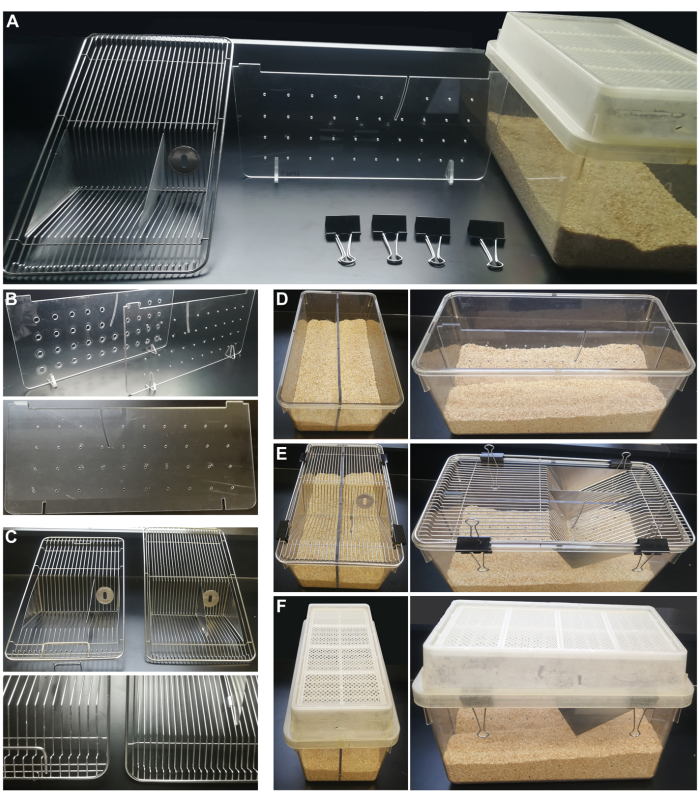
Figure 1: Apparatus for the accelerated social defeat stress (AcSD) for adolescent mice. (A) From left to right, paired steel-wire tops with 0.6 cm of separation between bars, clear perforated polycarbonate divider with perforations diameter of 0.6 cm, binder clips to secure the wire tops, clear rat cage with cover lid (without cotton protective layer). (B) Up: comparison between the polycarbonate dividers for chronic social defeat in adults (left) and AcSD in adolescents (right); down: close up to the polycarbonate divider for adolescent mice. (C) Up: comparison between the steel-wire tops for chronic social defeat in adults (left) and AcSD in adolescents (right); down: close-up of the steel-wire tops. (D-F) Assembling of the social defeat apparatus. Please click here to view a larger version of this figure.
4. Social interaction test
- Perform the SIT following the AcSD as described previously57,58,59.
- Perform the SIT 24 h after the last session of AcSD. Perform the SIT under red light conditions (not under yellow light conditions) between 9 AM and 4 PM.
- Set up the main squared-arena and the overhead video camera (see Table of Materials). The main arena is divided into 3 areas: the social interaction zone (SIZ), the corners, and the center; these areas should be marked in the arena with a black line (use a black permanent marker). Use the following dimensions and criteria for each area.
- Ensure the SIZ is the squared area 14 cm x 9 cm, that surrounds the enclosure. The corners are small, squared areas (9 cm x 9 cm) in the corners of the wall opposite to the enclosure and represent the farthest point from the SIZ. The center is the area between the SIZ and the corners.
- Clean the arena and the enclosures with a cleaning hydrogen peroxidase solution.
- Place identification tags for each animal on the floor for analysis. Record all animal behavior for offline analysis.
- First session to determine baseline exploration
- Place an empty wire mesh enclosure against one of the walls of the arena. Place the experimental (defeated or control) adolescent C57BL/6 mouse in the middle of the arena. Allow it to explore the arena freely for 2.5 min. Retrieve the mouse.
- Clean the arena and the enclosures with a cleaning hydrogen peroxidase solution.
- Second session for social interaction
- Place an unfamiliar CD-1 mouse inside the wire mesh enclosure. Place the enclosure in the same location as the previous session.
- Reintroduce the same adolescent C57BL/6 mouse to the arena. Allow it to explore the arena freely for 2.5 min. Retrieve the mice.
- Clean the arena and the enclosures with a cleaning hydrogen peroxidase solution.
- Repeat the process for all adolescent C57BL/6 mice (stressed and control mice) in a counterbalanced order.
- Use more than one CD-1 mouse for the SIT to decrease handling stress and bias (e.g., for a cohort of 30 C57BL/6 mice, use 4 CD-1 mice). Counterbalance them among the adolescent mice.
NOTE: This test measures the approach and/or avoidance behavior of the experimental mice toward a social target, as first described by Krishnan5 and Golden7.
- Analysis
- Record the time (s) spent in the interaction zone and the corners during both sessions of the test.
- Calculate the social interaction ratio as the time spent in the interaction zone with the CD-1 aggressor present divided by the time spent in the interaction zone with the CD-1 aggressor absent.
- Classify stressed mice with a ratio < 1.00 as susceptible and a ratio ≥ 1.00 as resilient.
- Exclude animals that do not explore the arena during the first session (i.e., spent 0 s in any of the designated areas) from all analyses to control differences in locomotor activity.
- Exclude all animals that receive 0 attacks in ≥4 social defeat sessions from all analyses to prevent non-representative resilient animals.
- Exclude mice (not susceptible) that do not spend at least 61 s inside the interaction zone to ensure that high social interaction ratios reflect actual interest in the social target.
- Exclude mice with outlier interaction ratio scores.
Access restricted. Please log in or start a trial to view this content.
Results
A total of four different experiments were performed using the chronic social defeat stress model in adolescent C57BL/6 male mice (PND 21). However, this model presented important limitations for its use in early adolescent C57BL/6 mice.
Equipment required modifications for adolescent C57BL/6 mice
The first limitation was that the equipment used for the social defeat apparatus was designed for adult mice. Because of their size, adolescent C57BL/6 mice at PND 21 were able t...
Access restricted. Please log in or start a trial to view this content.
Discussion
Consistent, aggressive behavior in CD-1 mice
During the screening phase, it is very important to take note of all the behaviors displayed by the CD-1 (chasing, mounting behaviors, sniffing, grooming, or biting) and to closely follow these records when selecting the CD-1 mice for the AcSD. It is likely that a CD-1 mouse which interacts with the adolescent mouse without attacking it will develop aggressiveness towards adolescent mice during priming. In contrast, a CD-1 mouse which attacks an adu...
Access restricted. Please log in or start a trial to view this content.
Disclosures
The authors have nothing to disclose.
Acknowledgements
This work was funded by the Canadian Institutes for Health Research (CF Grant Numbers: MOP-74709; PJT 190045), the National Institute on Drug Abuse (CF Grant number: R01DA037911), the Natural Sciences and Engineering Research Council of Canada (CF Grant Number: 2982226). Andrea Pantoja-Urban was supported by The National Council for Humanities, Science and Technologies/Consejo Nacional de Humanidades, Ciencias y Tecnologías (CONAHCYT) from México and FRQNT - Merit scholarship program for foreign students (PBEEE). Samuel Richer was supported by a scholarship from the Integrated Program of Neuroscience at McGill University. Figure illustrations were created using templates from BioRender.com.
Access restricted. Please log in or start a trial to view this content.
Materials
| Name | Company | Catalog Number | Comments |
|---|---|---|---|
| C57BL/6 adolescent mice | In house breeding | Mice were breeded at the Neurophenotyping Centre of the Douglas Mental Health University Institute. | |
| C57BL/6 adult mice | Charles River Laboratories | Strain Code: 027 | Mice are ordered so as to arrive at PND>65 and are group housed (four mice per cage) in standard mice cages. |
| C57BL/6J adolescent mice | Jackson Labs | Strain Code: 000664; RRID:IMSR_JAX:000664 | Mice are ordered so as to arrive at PND 24 and are group housed (four mice per cage) in standard mice cages. |
| CD-1 mice | Charles River Laboratories | Strain Code: 022 | Mice retired breeders more than three months of age and singled housed throughout. |
| Cleaning solution | Virox Animal Health | DIN 02537222 | Prevail: Accelerated Hydrogen Peroxide. Desinfectant cleaner and deodorizer. |
| Clear perforated acrylic glass divider | Manufactured by Douglas Hospital, custom order | 0.6 cm (w) × 45.7 cm (d) × 22.23 cm (h); perforations of 0.6 cm diameter. The dividers are perforated allowing sensory but no physical contact between the pair of mice. | |
| Clear rectangular rat cages | Allentown | 24 cm (w) × 48.3 cm (d) × 22.23 (h). | |
| Cotton squares for bedding | Inotiv Envigo | T.6060 iso-BLOX | 2.5 cm x 2.5 cm. Added to the social defeat apparatus. |
| Hard woodchip bedding | Inotiv Envigo | Teklad 7090, 7115 | Sani-chip bedding. |
| Large binder clips to secure the steel-wire tops | STAPLES | Item #: 132429, Model #: 24178-CA | 51 mm |
| Medium binder clips to secure the steel-wire tops | Item #: 132367, Model #: 24172-CA | 32 mm, in case the cover lids of the rat cages do not close with the large clips | |
| Pain relief cream | Polysporin | Plus Pain Relief Cream (red format, NOT ointment), 2 Antibiotics plus lidocaine hydrochloride | |
| Paired Steel-wire tops | 24 cm (w) × 48 cm (d) with 0.6 cm (w) of separation between the grill | ||
| Removable wire-mesh enclosure | Johnston industrial plastics | 11 cm (w) × 6.8 cm (d) × 42 cm (h) custom order; two per social interaction test arena secured in precut clear polycarbonate | |
| Social interaction open-field arena | PEXIGLAS | 45 cm (w) × 45 cm (d) × 49 cm (h), custom-crafted from opaque acrylic glass (Plexiglas) | |
| Stopwatch | For timing defeat sessions | ||
| Video camera with infrared lights | Swann | SRDVR-44580V | Swann Camera - 4 Channel 1080p Digital Video Recorder & 2 x PRO-T853 |
| Video tracking software | Topscan | 2.0 Clever Systems Inc. |
References
- Miczek, K. A. A new test for aggression in rats without aversive stimulation: Differential effects of d-amphetamine and cocaine. Psychopharmacology. 60, 253-259 (1979).
- Kudryavtseva, N., Bakshtanovskaya, I., Koryakina, L. Social model of depression in mice of c57bl/6j strain. Pharmacol Biochem Behav. 38 (2), 315-320 (1991).
- Blanchard, R. J., Mckittrick, C. R., Blanchard, D. C. Animal models of social stress: Effects on behavior and brain neurochemical systems. Physiol Behav. 73 (3), 261-271 (2001).
- Berton, O., et al. Essential role of bdnf in the mesolimbic dopamine pathway in social defeat stress. Science. 311 (5762), 864-868 (2006).
- Krishnan, V., et al. Molecular adaptations underlying susceptibility and resistance to social defeat in brain reward regions. Cell. 131 (2), 391-404 (2007).
- Bartolomucci, A., Fuchs, E., Koolhaas, J. M., Ohl, F. Acute and chronic social defeat: Stress protocols and behavioral testing. Neuromethods. 42, 261-275 (2009).
- Golden, S. A., Covington Iii, H. E., Berton, O., Russo, S. J. A standardized protocol for repeated social defeat stress in mice. Nat Protoc. 6 (8), 1183-1191 (2011).
- Bourke, C. H., Neigh, G. N. Behavioral effects of chronic adolescent stress are sustained and sexually dimorphic. Horm Behav. 60 (1), 112-120 (2011).
- Steinman, M. Q., Trainor, B. C. Sex differences in the effects of social defeat on brain and behavior in the California mouse: Insights from a monogamous rodent. Semin Cell Dev Biol. 61, 92-98 (2017).
- Takahashi, A., et al. Establishment of a repeated social defeat stress model in female mice. Sci Rep. 7 (1), 12838(2017).
- Wright, E. C., et al. Sexual differentiation of neural mechanisms of stress sensitivity during puberty. Proc Natl Acad Sci U S A. 120 (43), 2306475120(2023).
- Yin, W., et al. Repeated social defeat in female mice induces anxiety-like behavior associated with enhanced myelopoiesis and increased monocyte accumulation in the brain. Brain Behav Immun. 78, 131-142 (2019).
- Van Doeselaar, L., et al. Chronic social defeat stress in female mice leads to sex-specific behavioral and neuroendocrine effects. Stress. 24 (2), 168-180 (2021).
- Hollenstein, T., Lougheed, J. P. Beyond storm and stress: Typicality, transactions, timing, and temperament to account for adolescent change. Am Psychol. 68 (6), 444(2013).
- Sawyer, S. M., Azzopardi, P. S., Wickremarathne, D., Patton, G. C. The age of adolescence. Lancet Child Adolesc Health. 2 (3), 223-228 (2018).
- Adriani, W., Laviola, G. Windows of vulnerability to psychopathology and therapeutic strategy in the adolescent rodent model. Behav Pharmacol. 15 (5), 341-352 (2004).
- Reynolds, L. M., et al. Early adolescence is a critical period for the maturation of inhibitory behavior. Cereb Cortex. 29 (9), 3676-3686 (2019).
- Reynolds, L. M., et al. Amphetamine disrupts dopamine axon growth in adolescence by a sex-specific mechanism in mice. Nat Commun. 14 (1), 4035(2023).
- Sisk, L. M., Gee, D. G. Stress and adolescence: Vulnerability and opportunity during a sensitive window of development. Curr Opin Psychol. 44, 286-292 (2022).
- Spear, L. P. The adolescent brain and age-related behavioral manifestations. Neurosci Biobehav Rev. 24 (4), 417-463 (2000).
- Reynolds, L. M., Flores, C. Mesocorticolimbic dopamine pathways across adolescence: Diversity in development. Front Neural Circuits. 15, 735625(2021).
- Manitt, C., et al. The netrin receptor dcc is required in the pubertal organization of mesocortical dopamine circuitry. J Neurosci. 31 (23), 8381-8394 (2011).
- Reynolds, L. M., et al. Dcc receptors drive prefrontal cortex maturation by determining dopamine axon targeting in adolescence. Biol Psychiatry. 83 (2), 181-192 (2018).
- Kalsbeek, A., Voorn, P., Buijs, R., Pool, C., Uylings, H. Development of the dopaminergic innervation in the prefrontal cortex of the rat. J Comp Neurol. 269 (1), 58-72 (1988).
- Cuesta, S., et al. Dcc-related developmental effects of abused-versus therapeutic-like amphetamine doses in adolescence. Addict Biol. 25 (4), 12791(2020).
- Bekhbat, M., et al. Adolescent stress sensitizes the adult neuroimmune transcriptome and leads to sex-specific microglial and behavioral phenotypes. Neuropsychopharmacology. 46 (5), 949-958 (2021).
- Hammerslag, L. R., Gulley, J. M. Age and sex differences in reward behavior in adolescent and adult rats. Dev Psychobiol. 56 (4), 611-621 (2014).
- Wheeler, A. L., et al. Adolescent cocaine exposure causes enduring macroscale changes in mouse brain structure. J Neurosci. 33 (5), 1797-1803 (2013).
- Schneider, M. Adolescence as a vulnerable period to alter rodent behavior. Cell Tissue Res. 354, 99-106 (2013).
- Makinodan, M., Rosen, K. M., Ito, S., Corfas, G. A critical period for social experience-dependent oligodendrocyte maturation and myelination. Science. 337 (6100), 1357-1360 (2012).
- Iñiguez, S. D., et al. Social defeat stress induces a depression-like phenotype in adolescent male c57bl/6 mice. Stress. 17 (3), 247-255 (2014).
- Iñiguez, S. D., et al. Social defeat stress induces depression-like behavior and alters spine morphology in the hippocampus of adolescent male c57bl/6 mice. Neurobiol Stress. 5, 54-64 (2016).
- Latsko, M. S., Farnbauch, L. A., Gilman, T. L., Lynch Iii, J. F., Jasnow, A. M. Corticosterone may interact with peripubertal development to shape adult resistance to social defeat. Horm Behav. 82, 38-45 (2016).
- Zhang, F., Yuan, S., Shao, F., Wang, W. Adolescent social defeat induced alterations in social behavior and cognitive flexibility in adult mice: Effects of developmental stage and social condition. Front Behav Neurosci. 10, 149(2016).
- Xu, H., et al. Effects of adolescent social stress and antidepressant treatment on cognitive inflexibility and bdnf epigenetic modifications in the mpfc of adult mice. Psychoneuroendocrinology. 88, 92-101 (2018).
- Huang, G. B., et al. Effects of chronic social defeat stress on behaviour, endoplasmic reticulum proteins and choline acetyltransferase in adolescent mice. Int J Neuropsychopharmacol. 16 (7), 1635-1647 (2013).
- Hasegawa, S., et al. Dysfunction of serotonergic and dopaminergic neuronal systems in the antidepressant-resistant impairment of social behaviors induced by social defeat stress exposure as juveniles. Int J Neuropsychopharmacol. 21 (9), 837-846 (2018).
- Resende, L., et al. Social stress in adolescents induces depression and brain-region-specific modulation of the transcription factor max. Transl Psychiatry. 6 (10), e914(2016).
- Mouri, A., et al. Juvenile social defeat stress exposure persistently impairs social behaviors and neurogenesis. Neuropharmacology. 133, 23-37 (2018).
- Rodriguez-Arias, M., et al. Social defeat in adolescent mice increases vulnerability to alcohol consumption. Addict Biol. 21 (1), 87-97 (2016).
- Montagud-Romero, S., et al. Repeated social defeat and the rewarding effects of cocaine in adult and adolescent mice: Dopamine transcription factors, probdnf signaling pathways, and the trkb receptor in the mesolimbic system. Psychopharmacology. 234, 2063-2075 (2017).
- Wilkinson, M. B., et al. A novel role of the wnt-dishevelled-gsk3β signaling cascade in the mouse nucleus accumbens in a social defeat model of depression. J Neurosci. 31 (25), 9084-9092 (2011).
- Hyer, M., et al. Chronic adolescent stress causes sustained impairment of cognitive flexibility and hippocampal synaptic strength in female rats. Neurobiol Stress. 14, 100303(2021).
- Bekhbat, M., et al. Chronic adolescent stress sex-specifically alters central and peripheral neuro-immune reactivity in rats. Brain Behav Immun. 76, 248-257 (2019).
- Pyter, L. M., Kelly, S. D., Harrell, C. S., Neigh, G. N. Sex differences in the effects of adolescent stress on adult brain inflammatory markers in rats. Brain Behav Immun. 30, 88-94 (2013).
- Dalsgaard, S., et al. Incidence rates and cumulative incidences of the full spectrum of diagnosed mental disorders in childhood and adolescence. JAMA psychiatry. 77 (2), 155-164 (2020).
- Pedersen, C. B., et al. A comprehensive nationwide study of the incidence rate and lifetime risk for treated mental disorders. JAMA psychiatry. 71 (5), 573-581 (2014).
- Heim, C., Shugart, M., Craighead, W. E., Nemeroff, C. B. Neurobiological and psychiatric consequences of child abuse and neglect. Dev Psychobiol. 52 (7), 671-690 (2010).
- Kessler, R. C., Petukhova, M., Sampson, N. A., Zaslavsky, A. M., Wittchen, H. U. Twelve-month and lifetime prevalence and lifetime morbid risk of anxiety and mood disorders in the united states. Int J Methods Psychiatr Res. 21 (3), 169-184 (2012).
- Boyd, A., et al. Gender differences in mental disorders and suicidality in europe: Results from a large cross-sectional population-based study. J Affect Disord. 173, 245-254 (2015).
- Bale, T. L., Epperson, C. N. Sex differences and stress across the lifespan. Nat Neurosci. 18 (10), 1413-1420 (2015).
- Hankin, B. L., Mermelstein, R., Roesch, L. Sex differences in adolescent depression: Stress exposure and reactivity models. Child Dev. 78 (1), 279-295 (2007).
- Kim, S., Colwell, S. R., Kata, A., Boyle, M. H., Georgiades, K. Cyberbullying victimization and adolescent mental health: Evidence of differential effects by sex and mental health problem type. J Youth Adolesc. 47, 661-672 (2018).
- Filipponi, C., Petrocchi, S., Camerini, A. L. Bullying and substance use in early adolescence: Investigating the longitudinal and reciprocal effects over 3 years using the random intercept cross-lagged panel model. Front Psychol. 11, 571943(2020).
- Brody, G. H., Yu, T., Chen, E., Miller, G. E. Persistence of skin-deep resilience in african american adults. Health Psychol. 39 (10), 921(2020).
- Rijlaarsdam, J., Cecil, C. A., Buil, J. M., Van Lier, P. A., Barker, E. D. Exposure to bullying and general psychopathology: A prospective, longitudinal study. Res Child Adolesc Psychopathol. 49, 727-736 (2021).
- Vassilev, P., et al. Unique effects of social defeat stress in adolescent male mice on the netrin-1/dcc pathway, prefrontal cortex dopamine and cognition. eNeuro. 8 (2), (2021).
- Vassilev, P., et al. Custom-built operant conditioning setup for calcium imaging and cognitive testing in freely moving mice. eNeuro. 9 (1), (2022).
- Pantoja-Urbán, A. H., et al. Gains and losses: Resilience to social defeat stress in adolescent female mice. Biol Psychiatry. 95 (1), 37-47 (2024).
- Torres-Berrío, A., et al. Dcc confers susceptibility to depression-like behaviors in humans and mice and is regulated by mir-218. Biol Psychiatry. 81 (4), 306-315 (2017).
- Ver Hoeve, E. S., Kelly, G., Luz, S., Ghanshani, S., Bhatnagar, S. Short-term and long-term effects of repeated social defeat during adolescence or adulthood in female rats. Neuroscience. 249, 63-73 (2013).
Access restricted. Please log in or start a trial to view this content.
Reprints and Permissions
