A subscription to JoVE is required to view this content. Sign in or start your free trial.

Method Article

pH Modulation Assay on Supported Lipid Bilayers to Detect Protein-Phosphoinositide Interactions

936 views

⸱

July 8th, 2025

In This Article

Abstract

Source: Shengjuler, D., et al., PIP-on-a-chip: A Label-free Study of Protein-phosphoinositide Interactions. J. Vis. Exp. (2017)

In this video, we demonstrate protein-phosphoinositide interactions in a microfluidic pattern using the pH modulation assay, using pH-sensitive fluorescent dye tagged to phosphatidylethanolamine lipid of a supported lipid bilayer, called a microfluidic platform. The modulations in pH after protein binding to phospholipid cause fluorescence quenching.
Protocol

1. Forming Supported Lipid Bilayers (SLBs)

  1. Transfer 100 µL of PI(4,5)P2-containing SUVs into a 0.65 mL microcentrifuge tube. Adjust the pH of the solution to ~3.2 by adding 6.4 µL of 0.2 N hydrochloric acid.
    NOTE: Confirm the pH of the solution with a pH meter equipped with a micro pH probe (see table of materials).
  2. Pipette 10 µL of the pH-adjusted SUV solution into each channel through the inlet and apply pressure through the pipette until the solution reaches the outlet. Detach the tip from the pipette and leave it attached to the device.
  3. Repeat the above step fo....

Access restricted. Please log in or start a trial to view this content.

Results

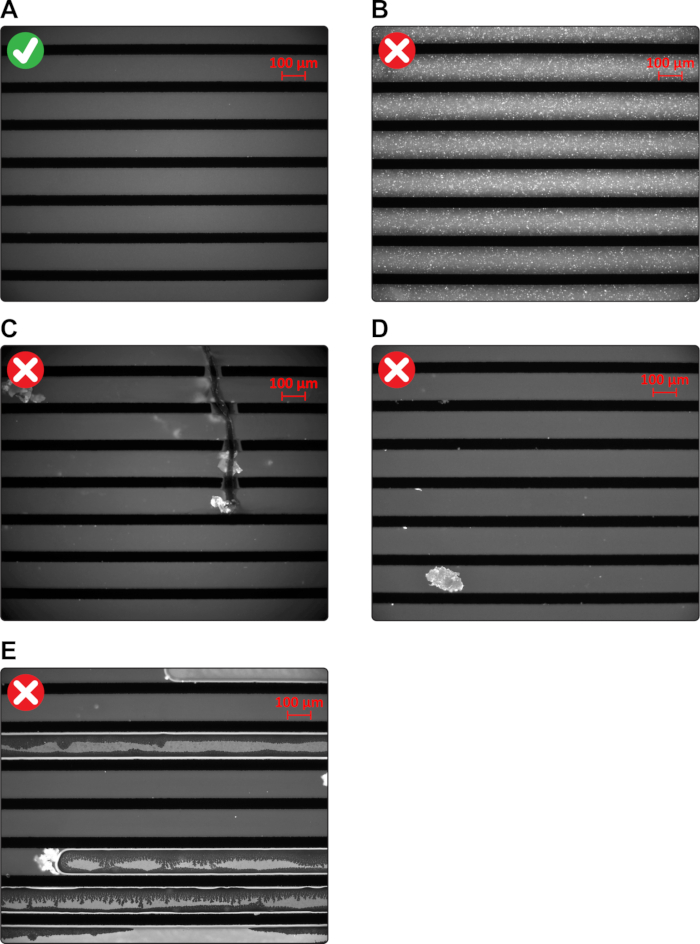
Microscopy images of striped patterns; comparison of clean versus contaminated samples; scale 100μm.
Figure 1: Assessing the integrity of SLBs and microchannels. (A) An image illustrating high-quality SLBs and microchannels. (B) Incomplete fusion. (C) Fused microchannels. (D) Dust.......

Access restricted. Please log in or start a trial to view this content.

Disclosures

No conflicts of interest declared.

Materials

List of materials used in this article
NameCompanyCatalog NumberComments
1-palmitoyl-2-oleoyl-sn-glycero-3-phosphocholineAvanti Polar Lipids850457CPOPC
L-α-phosphatidylinositol-4-phosphateAvanti Polar Lipids840045XPI4P
L-α-phosphatidylinositol-4,5-bisphosphateAvanti Polar Lipids840046XPI(4,5)P2
1-palmitoyl-2-oleoyl-sn-glycero-3-phosphoethanolamineAvanti Polar Lipids850757CPOPE; Required for the synthesis of oSRB-POPE
Lissamine Rhodamine B Sulfonyl Chloride (mixed isomers)ThermoFisher ScientificL-20Required for the synthesis of oSRB-POPE
pH-Sensitive Fluorescent Lipid Probe (oSRB-POPE)In-houseN/AIn-house Synthesis (Huang D. et al. 2013)
Axiovert 200M Epifluorescence MicroscopeCarl Zeiss MicroscopyN/AMicroscope
AxioCam MRm CameraCarl Zeiss MicroscopyN/ACamera
X-Cite 120Excelitas TechnologiesN/ALight Source
Alexa 568 Filter SetCarl Zeiss MicroscopyN/AEx/Em 576/603 nm
AxioVision LE64 v.4.9.1.0 SoftwareCarl Zeiss MicroscopyN/AImage-Processing Software
TipsVWR10034-132200 uL pipette tips; Thin and smooth tip for applying the protein solution into the microfluidic channel
TipsVWR53509-07010 uL pipette tips; Thin and smooth tip for applying the vesicle solution into the microfluidic channel
Orion Star A321 pH meterThermo ScientificSTARA3210pH meter
Orion micro pH probeThermo Scientific8220BNWPmicro pH probe
N-(2-Hydroxyethyl)-Piperazine-N'-(2-Ethanesulfonic Acid)VWRVWRB30487HEPES, Free Acid
Sodium ChlorideVWRBDH8014-2.5KGRNaCl
TubingAllied Wire & CableTFT-200-24 NInternal Diameter: 0.020-0.026 inches (0.051-0.066 cm); Wall Thickness: 0.010 inches (0.025 cm); Flexible Polytetrafluoroethylene Thin-Wall Tubing; Natural Color
Nitrogen Gas - IndustrialPraxairN/ALocal Provider
Oxygen Gas - IndustrialPraxairN/ALocal Provider
Liquid NitrogenPraxairN/ALocal Provider

Explore More Articles

Phospholipase C BindingFluorescence Quenching DetectionMicrofluidic PlatformSmall Unilamellar VesiclespH-Sensitive Fluorescent DyePhosphatidylinositol 45-bisphosphatePleckstrin Homology Domain