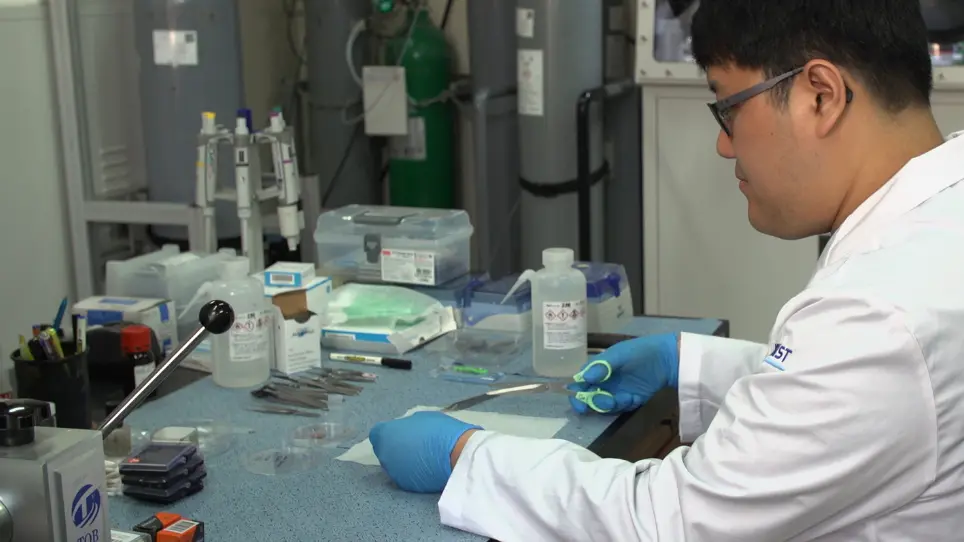
Here, we present a protocol for the fabrication and preparation of a graphene liquid cell for in situ transmission electron microscopy observation, along with a synthesis of electrode materials and electrochemical battery cell tests.
A subscription to JoVE is required to view this content. Sign in or start your free trial.
Method Article
Preparation of Graphene Liquid Cells for the Observation of Lithium-ion Battery Material
* These authors contributed equally
In This Article
Summary
Abstract
In this work, we introduce the preparation of graphene liquid cells (GLCs), encapsulating both electrode materials and organic liquid electrolytes between two graphene sheets, and the facile synthesis of one-dimensional nanostructures using electrospinning. The GLC enables in situ transmission electron microscopy (TEM) for the lithiation dynamics of electrode materials. The in situ GLC-TEM using an electron beam for both imaging and lithiation can utilize not only realistic battery electrolytes, but also the high-resolution imaging of various morphological, phase, and interfacial transitions.
Introduction
Recently, the consumption of energy has constantly increased, as well as the importance of high-performance energy storage devices. To meet such a demand, the development of lithium-ion batteries that have a high energy density, durability, and safety is necessary1,2. In order to develop batteries with superior properties, a fundamental understanding of energy storage mechanisms during battery operation is essential3,4,5.
In situ transmission electron microscopy (TEM) pr....
Access restricted. Please log in or start a trial to view this content.
Protocol
1. Synthesis of SnO2 Nanotubes by Electrospinning and Subsequent Heat Treatment17
- Prepare an electrospinning solution.
- Dissolve 0.25 g of tin chloride dihydrate in a solvent mixture of 1.25 g of ethanol and 1.25 g of dimethylformamide (DMF) at room temperature (RT, 25 °C).
- After stirring for 2 h, add 0.35 g of polyvinylpyrrolidone (PVP) to the electrospinning solution and stir the mixture for another 6 h.
- Perform an electrospinning of the Sn precursor/PVP composite nanofibers.
- When the electrospinning solution is well prepared, wash the rectangular, flexible ....
Access restricted. Please log in or start a trial to view this content.
Results
SnO2 nanotubes were fabricated by electrospinning and subsequent calcination, during which the nanotubular and porous structures could be seen clearly, according to the SEM image (Figure 3a). Such a nanotubular structure comes from the decomposition of PVP, while the Sn precursor in the core is moved outward due to the Kirkendall effect17,18. Additionally, Ostwald ripening .......
Access restricted. Please log in or start a trial to view this content.
Discussion
There are critical steps within the protocol. First, the transfer of the graphene onto the TEM grid needs the researchers' careful attention. It is important to handle the grids with tweezers and not damage any of grids, for instance by destroying the amorphous carbon membrane or bending the frame. These kinds of damages will result in a poor coverage of the graphene and affect the number of liquid pockets. In addition, placing the upper grid at the right position is critical. As described in the protocol, the top gr.......
Access restricted. Please log in or start a trial to view this content.
Disclosures
The authors have nothing to disclose.
Acknowledgements
This work was supported by the National Research Foundation of Korea (NRF), grant no. 2014R1A4A1003712 (BRL Program), the Korea CCS R&D Center (KCRC) grant funded by the Korea government (Ministry of Science, ICT & Future Planning) (No. NRF-2014M1A8A1049303), an End-Run grant from KAIST funded by the Korea government in 2016 (Ministry of Science, ICT & Future Planning) (N11160058), the Wearable Platform Materials Technology Center (WMC) (NR-2016R1A5A1009926), an National Research Foundation of Korea (NRF) Grant funded by the Korean Government (NRF-2017H1A2A1042006-Global Ph.D. Fellowship Program), a National Research Foundation of Korea (NRF) grant funded by the Korea....
Access restricted. Please log in or start a trial to view this content.
Materials
| Name | Company | Catalog Number | Comments |
|---|---|---|---|
| Tin chloride dihyrate | Sigma Aldrich | CAS 10025-69-1 | In a glass bottle |
| Ethanol | Merck | CAS 64-17-5 | In a glass bottle |
| Dimethylformamide | Sigma Aldrich | CAS 68-12-2 | In a glass bottle |
| Polyvinylpyrrolidone | Sigma Aldrich | CAS 9003-39-8 | In a plastic bottle |
| Cell tester | KOREA THERMO-TECH | Maccor Series 4000 | |
| Cell tester 2 | WonaTech | WBCS4000 | |
| Sodium perchlorate | Sigma Aldrich | CAS 7601-89-0 | In a glass bottle |
| 25 gauge needle | Hwa-In Science Ltd. | ||
| 1.3 M of lithium hexafluorophosphate (LiPF6) dissolved in EC/DEC with 10 wt% of FEC | PANAX ETEC | In a stainless steel bottle | |
| Propylene carbonate | Sigma Aldrich | CAS 108-32-7 | In a glass bottle |
| Super P Carbon Black | Alfa-Aesar | CAS 1333-86-4 | In a glass bottle |
| Cell components (bottom cell, top cell, separator, gasket, spring, spacer) | Wellcos Corporation | ||
| Cell punch | Wellcos Corporation | ||
| Glove Box | Moisture Oxygen Technology (MOTEK) | ||
| Box Furnace | Naytech | Vulcan 3-550 | |
| Electrospinning device | NanoNC | ||
| Hydrofluoric acid | Junsei | 84045-0350 | 85% |
| Cu foil | Alfaaesar | 38381 | Copper Thinfoil, 0.0125mm thick, 99.9% |
| Holy carbon Au grid | SPI | Quantifoil R2/2 Micromachined Holey Carbon Grids, 300 Mesh Gold | Quantifoil R2/2 Micromachined Holey Carbon Grids, 300 Mesh Gold |
| Isoprophyl alchol | Sigmaaldrich | W292907 | 99.70% |
| Ammonium persulfate | Sigmaaldrich | 248614 | 98% |
| Transmission electron microscope (TEM) | JEOL | JEOL JEM 3010 | 300 kV |
| Chemical vapor depistion (CVD) | Scientech | ||
| Charge coupled device (CCD) | Gatan | Orius SC200 | |
| Plasma Cleaner | Femtoscience | VITA | |
| Electrospinning program | NanoNC | NanoNC eS- robot |
References
- Sun, Y. -K., et al. Nanostructured high-energy cathode materials for advanced lithium batteries. Nature Materials. 11 (11), 942-947 (2012).
- Manthiram, A., Fu, Y., Chung, S. -H., Zu, C., Su, Y. -S. Rechargeable Lithium-Sulfur Batteries. Chemical Reviews. 114 ....
Access restricted. Please log in or start a trial to view this content.
Reprints and Permissions